Beyond Arkham (Mythos, Part II)
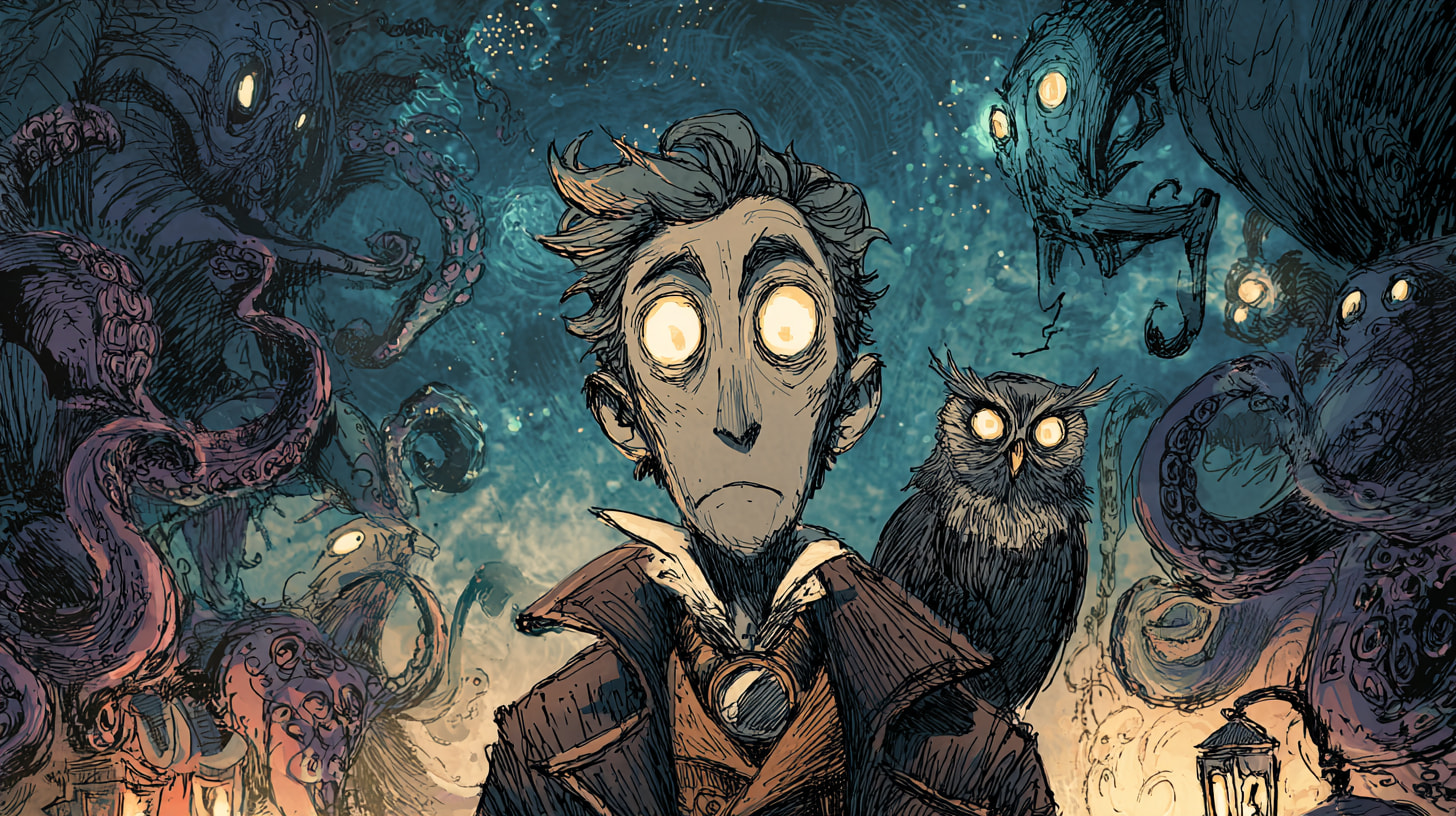
The second crate arrived unsealed. Whatever apprentice signed for it did not see fit to label it; I can only guess it was delivered during the same hours I was pinning the Part I catalogue to the exhibit wall. Inside: a globe-trotting wing of the Mythos that ranges from Innsmouth to the Yucatán, from an Edinburgh university library to a sickness-struck town in the Pacific Northwest that calls itself Cypress Falls. Daniel (@dungeondive) assures me it is all related. I have laid out the pieces as best I can.
We begin with a grievance. A Failing of the Cthulhu Mythos Board Games is Daniel’s complaint — registered while setting up Death May Die — that these games almost never point their players toward the literature. No Appendix N. No reading list. No small card beside Yog-Sothoth naming him as Wilbur Whateley’s father. He reads a passage from Robert M. Price’s “Wilbur Whateley Waiting” to show what a single short story can do for a table, and he is quite correct: most of this fiction is public domain, and the authors deserve the credit.
From there the crate opens on two faces of the pulp side. Cthulhu: Death May Die — Review is the Wild Bunch meets the Elder Gods — you want the ritual to resolve so the Old One manifests in a beatable form. Daniel praises CMON’s insert (set up, close the box, never reopen it until pack-down), the Sanity track that doubles as skill-levelling, and the scenario-boss combinatorics. Returning to Cthulhu: Death May Die revisits the game years later and formalises what works: interlocking currencies of sanity, stress, and wounds; immediate turn-one tension; no lore. None. Hastur is a lump of plastic. Daniel argues that half a page of public-domain Chambers would fix it.
Alongside, the FOMO confession. How I deal with FOMO is Daniel’s three-filter policy — space, time, self-knowledge — and why he will decline the new Death May Die standalone and the new Wander. He loves both games. What he wants are small-box expansions. I note the principle for the archive.
The older pulp wing. Mansions of Madness 2nd Edition — Some Thoughts places the game firmly in Daniel’s personal top ten adventure games; it is what he reaches for when a new player must be shown what a modern thematic game can feel like. He celebrates the app’s reactive storytelling, the face-up/face-down damage deck with its hidden flips, and the thematic item distribution (you do not draw a spear — you find one, on a specific body, in a specific tomb). He grumbles, fairly, about the tile-digging tax and the enemy minis whose black bases squash the best tile art on the table.
Then Some thoughts on Eldritch Horror, “Lovecraftian” theming, and Brian Lumley — which I believe is the thesis statement of this whole shipment. Daniel reads a passage from Lumley’s The Transition of Titus Crow naming Yog-Sothoth, Hastur, Ithaqua, Shub-Niggurath, Cthulhu, and Shudde M’ell in one breath, and notes that the catalogue reads exactly like an Eldritch setup. The Arkham-files games, he argues, are Lumleyan, not Lovecraftian — globe-trotting, pulp-forward, humans-can-actually-win fiction. He praises the four small-box expansions (Forsaken Lore, Cities in Ruin, Signs of Carcosa, Strange Remnants), the fact that dead investigators become board-level encounters, and the modular Great Old One decks.
Then the crate turns roleplaying. Call of Cthulhu RPG — 7th Edition Starter Set walks through Alone Against the Flames and finds it a complete system for beginners — backwards-compatible with four decades of Chaosium’s catalogue, PDF bundled free with every physical purchase, mechanically clean for solo play. Daniel’s own investigator Stuart Chappell of Castle Rock emerged from the book in two and a half hours. He recommends Pulp Cthulhu for solo work because sandbox mysteries are notoriously hard when you are your own keeper.
Call of Cthulhu — 40th Anniversary Edition & the Solo Investigator’s Handbook opens the Chaosium vault: the Gene Day–cover 1st edition rulebook, the 1920s sourcebook, Shadows of Yog-Sothoth, The Asylum and Other Tales, two Cthulhu Companions, The Trail of Tsathoggua, the Arkham City map, and the creature comparison chart. First edition’s 3d6-vs-3d6 opposed-roll chart earns particular attention for its solo-play virtues. The second half turns to Paul Bimler’s Solo Investigator’s Handbook — a scenario generator, five-direction investigation rounds, Mythos-points pacing, and a Q&A oracle built for journaling.
A small side exhibit: Little Town & Eldritch Town is a solo RPG by Stavo Coo — Twin Peaks as a PbtA system, with a supplement that swaps the cosy small-town vibe for Call of Cthulhu. Daniel walks through the creation of FBI Agent Bradley Walter investigating a supernatural pandemic in Cypress Falls. The second half of that video becomes a David Lynch reverence — twelve films ranked, The Return at the top. I have filed the Lynch segment under ancillary texts.
And then, closing the Mythos wing, a comparative study: Lands of Galzyr vs. Freelancers vs. Mansions of Madness 2e. Six categories across three app-assisted adventure games. Mansions wins three (implementation, tone, conflict resolution); Galzyr wins expansiveness; Freelancers wins character progression. Daniel’s overall ranking places Mansions first, Galzyr second, Freelancers third. All three remain in the collection.
The Exhibit Catalogue:
- A Failing of the Cthulhu Mythos Board Games
- Cthulhu: Death May Die — Review
- Returning to Cthulhu: Death May Die
- How I deal with FOMO, and why I am not backing the new Cthulhu & Wander campaigns
- Mansions of Madness 2nd Edition — Some Thoughts
- Some thoughts on Eldritch Horror, “Lovecraftian” theming, and Brian Lumley
- Call of Cthulhu 7th Edition Starter Set — for absolute beginners?
- Call of Cthulhu — 40th Anniversary Edition & the Solo Investigator’s Handbook
- Little Town & Eldritch Town — Solo RPG inspired by Twin Peaks
- Lands of Galzyr vs. Freelancers vs. Mansions of Madness 2e — Comparative Review
One item does not belong to the Mythos at all, but arrived in the same delivery and clamours too loudly to ignore. Stonesaga — A Triumph of the Modern Adventure Game is Daniel’s re-recorded review of a prehistoric survival epic, replacing an earlier ninety-minute attempt that did not meet his own standard. He catalogues seven things to love: the stacking hex-tray save system, the three-epoch non-linear campaign, the Kingdom-Death-level settlement phase, the art-that-genuinely-matters crafting (you read pip-positions on illustrated components to produce hundreds of items from a handful of materials), the evolving cave-wall illustrations, the five distinct mini-games, and the behemoths framed as instinct-driven beings rather than bosses. A warning on first-printing errata is honestly given; the free app is the fix.
Something All Together New
Eleven files added — ten to the Mythos wing, one to the Modern Adventure gallery next door. The Mythos shelves are now substantial enough that I have begun cross-referencing the Lumley annotations with the Chaosium pronunciation guides, which is, I confess, the happiest use I have found for an afternoon in some weeks.
314 transcripts • 393 posts archived
– The Keeper
Notes that Daniel has now asked, in three separate videos, for the same small-box expansion of curated Mythos flavour text to be added to existing games. The request is so reasonable it cannot possibly be fulfilled.