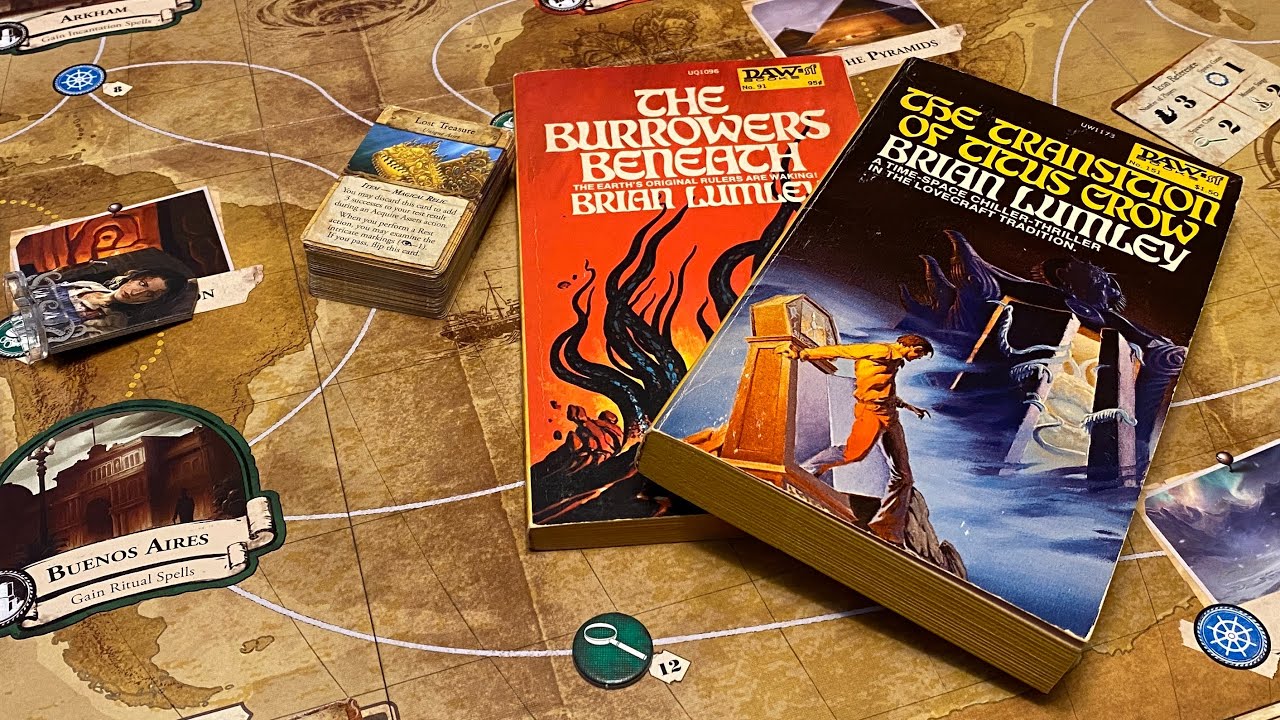
Daniel (@dungeondive) offers his small drop in the ocean of Eldritch Horror opinions: this is the game that replaced Arkham Horror 2E on his shelf, streamlined without jettisoning the random encounters, monsters, and gear he loved. Arkham 2E took him months and a stack of BGG flowcharts to learn. Eldritch teaches itself.
The bigger argument is literary. “Lovecraftian” rarely means Lovecraft — it means the pulp-adjacent Mythos that August Derleth codified and Brian Lumley pushed into globe-trotting, action-forward territory. He reads a long passage from Lumley’s The Transition of Titus Crow — Yog-Sothoth, Hastur, Ithaqua, Shub-Niggurath, Great Cthulhu, Shudde M’ell — and the catalogue reads exactly like an Eldritch Horror setup. Lumley, he argues, is the author these globe-hopping Arkham-files games are really channelling.
Game praise: the four small-box expansions (Forsaken Lore, Cities in Ruin, Signs of Carcosa, Strange Remnants) all fit in the base box and add variety without new systems; setup to play is fast; investigator death becomes a board-level encounter rather than an exit; modular Great Old One decks and mythos-difficulty tiers let players dial the game they want. His current run: Hastur on the Lake of Hali, Ithaqua already on the board, and the Pnakotic Manuscripts pulled as an early mythos card — a Lumley story made literal.
Does calling Eldritch Horror “Lumleyan” rather than “Lovecraftian” change how you read its globe-spanning tone?