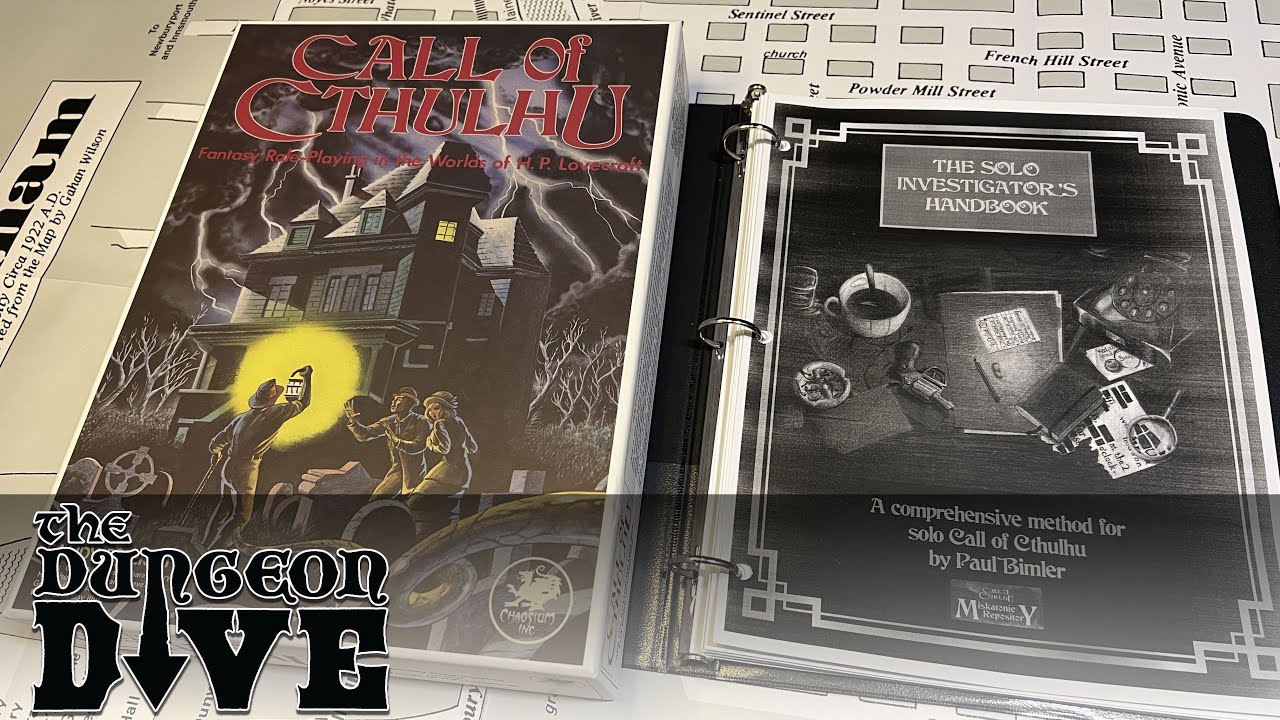
Daniel (@dungeondive) flips through Chaosium’s deluxe 40th Anniversary reprint of Call of Cthulhu 1st edition — a two-inch box crammed with the original rulebook (Gene Day cover and interiors), a 1920s sourcebook, Shadows of Yog-Sothoth, The Asylum and Other Tales, The Cthulhu Companion, The Second Cthulhu Companion, The Trail of Tsathoggua, a keeper screen, handouts, a ruby anniversary dice set, the Arkham City map, and the iconic creature comparison chart. He’s kicking himself for missing decades of this game and wants to document it as a kind of digital museum piece.
Key mechanical note for solo play: 1st edition stats were 3d6 rather than d100, which meant opposed rolls used a quick cross-reference chart instead of two rolls. Daniel wants to preserve that chart for solo use because halving die rolls is huge for table friction. The bestiary, magic tables, pronunciation guides, and Mythos-tome listings (Necronomicon, De Vermis Mysteriis, Cultes des Goules) are all handed back in their 1981 form, with a short statement on problematic original language.
The second half of the video turns to Paul Bimler’s Solo Investigator’s Handbook on DriveThruRPG. This is the tool he’s been looking for — a scenario generator, five-direction investigation rounds (downtime, development, discovery, danger, dice roll), Mythos-points pacing, Q&A oracle, NPC tables, verb prompts, location tables, and a full sample session. Journaling is central. A quick scenario roll generates a basement-excavation hook with bugs forming runic patterns around a found object.
Are the first-edition 3d6 opposed-roll tables genuinely better for solo play than modern 7e’s d100, or is that nostalgia talking?