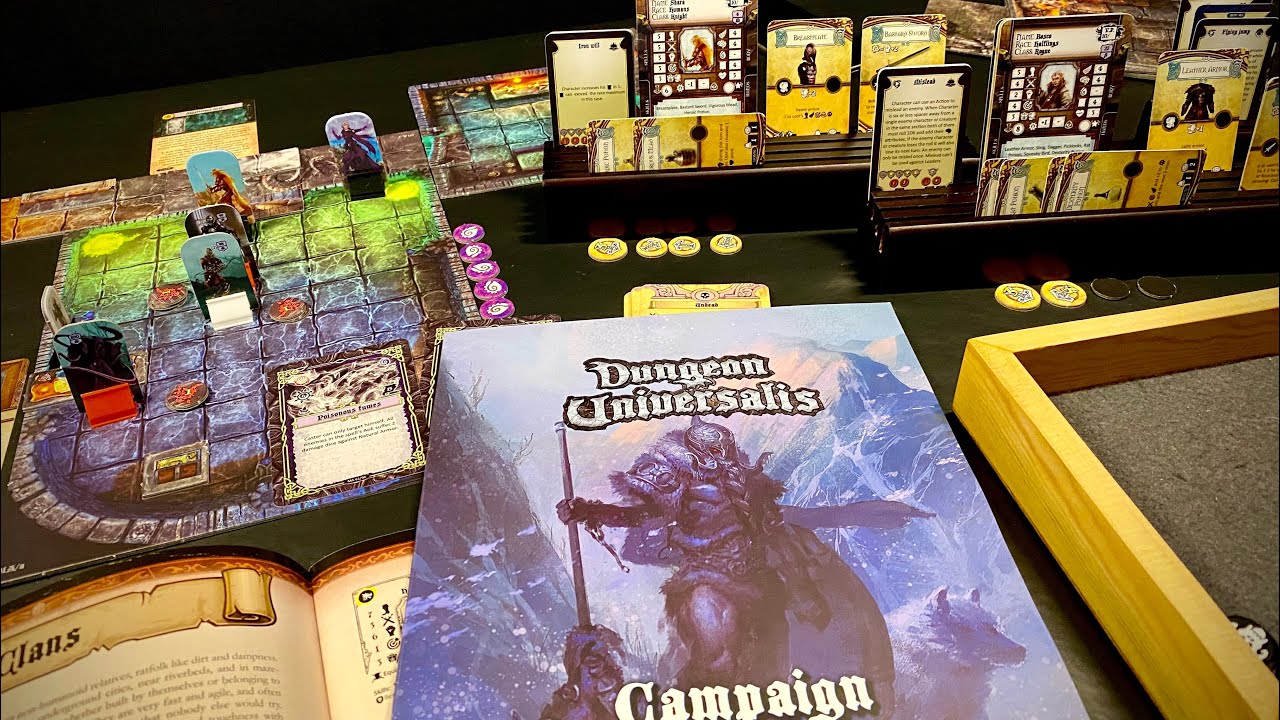
Daniel (@dungeondive)'s defining review of Dungeon Universalis, after three solo plays and an online multiplayer session with Oscar Bribián and the dev team. The headline framing: this is an anachronistic game, the kind that feels like it fell through a portal from a dingy 1988 game store onto a 2020 table — rejecting streamlining, component economy, and modern simplification in favour of writing a rule for everything.
Verdict: “a good game that is almost a great game.” His one substantive complaint is the rulebook’s English translation — repeat used for reroll, besides used for additionally, impact used for hit — and a few convoluted definitions (the combat-turn paragraph gets quoted in full as Exhibit A). One more pass from a fluent-English playtester would close the gap.
Strengths: the 2d6 bell-curve system creates meaningful stat investment and pushes ties to the more-agile combatant. Spells push enemies back, breaking the line-up-at-the-doorway tactic that ruins Advanced HeroQuest. The AI dark player surprises — the same scenario plays radically differently between runs. Sixteen schools of magic with six spells each, all uniquely illustrated. The hidden-information app preserves exploration in solo and co-op.
Caveat: this is not for post-Descent-2.0 sensibilities. Daniel jokes Gloomhaven is “a dungeon crawl for people who don’t like dungeon crawls” — Dungeon Universalis is the opposite, made for fans of Advanced HeroQuest, classic Warhammer Quest, magic realm. A holiday-and-special-occasion game in his rotation, not a Wednesday-night pickup.
Daniel frames Dungeon Universalis as a love letter from genre fans to genre fans, narrowly aimed and unapologetic about who it isn’t for. Are there games in your collection that you keep specifically because they don’t try to court a wider audience?