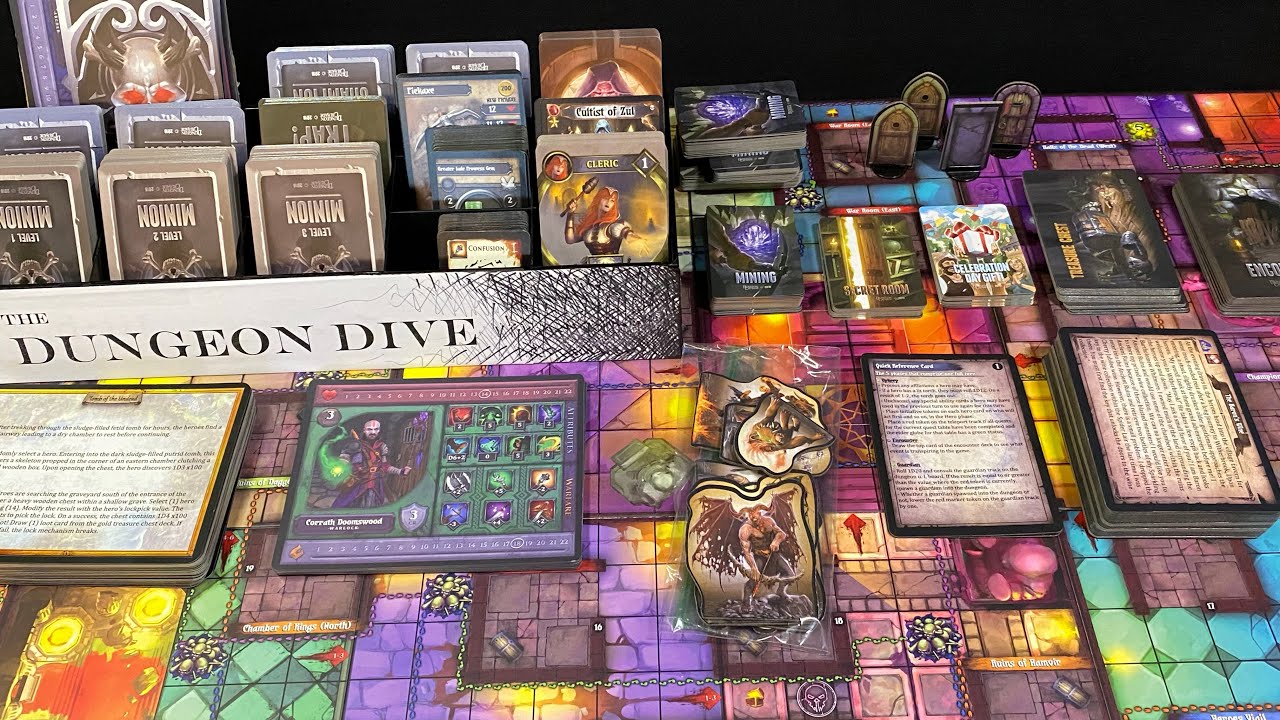
The first half of a spoiler-heavy two-part component tour. Daniel (@dungeondive) opens with the 70-page Crusader’s Handbook — verbose, magazine-sized, and written in Roger’s conversational voice. The rules are all in there, but Daniel openly hopes someone will produce a condensed reference because mid-play lookups bury you in paragraphs.
He moves to the scenario book and surfaces what may be the game’s most interesting structural idea: scenarios are not ten distinct stories, they are difficulty containers. Each scenario tells you which three quest tables of three to use, then hands you dials for starting gold, blacksmith stock, bazaar potions, raid difficulty, guardian spawn track, minion count, and village terror level. You can run the same scenario at novice or master, accommodate fewer than six heroes, or randomise everything for replayability.
He compares the high-contrast scenario-book map of Avalon to the slightly washed-out version on the avalon adventure board game and quietly wishes for an alternate board print. The village UI board (terror, blacksmith, bazaar, academy, tavern, temple, house of chance) and the dungeon UI board (mining decks, quest tables, guardian spawn track, raid difficulty, incantation track) get the same tour. He closes on the dungeon tiles — the visual highlight of the game, but already fraying at the corners on his expansion set, with noticeable warping. He recommends a brushed-on bead of super glue along edges before the laminate starts to peel.
Roger’s scenario system makes the player set the difficulty rather than the designer. Does that feel like player empowerment to you, or like the designer punting on balance?