Hi there!
Just like many others here, I’m quite fascinated by solo adventuring, and constantly thinking and tinkering with game ideas and rules. Somehow things are starting to converge, and a seemingly consistent game system is slowly taking shape.
In this game, the player uses one or two player boards, to keep track of skills, items, and things like HP, wealth etc. I’d prefer to do this by placing markers (small cubes, like in e.g. Tine Helm or Mini Rogue) on certain spots on these cards.
In my experience, however, a small bump against the table (or a cat walking across the table, for that matter), will ruin my bookkeeping. That’s why I’d like to use two-layered player boards, with square holes to place the cubes in. Manually cutting out dozens of small squares, however, is not the way to go. 3D printing, on the other hand, doesn’t allow for colouring or writing on the board.
Does anyone have a clever idea how to realize this? Preferably in a way thet is relatively easy to repeat if I decide to change my design.
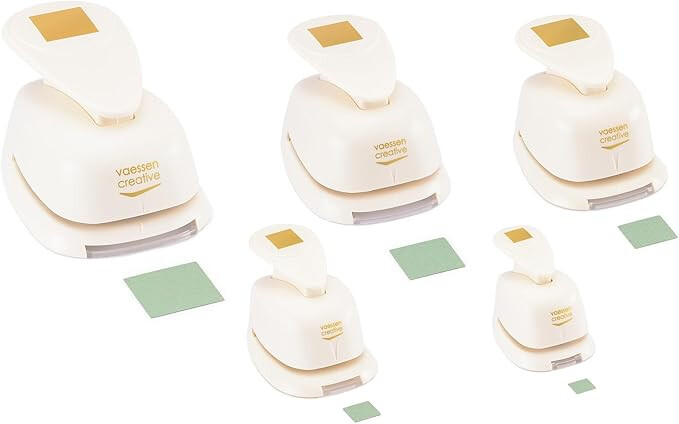
I suspect you would have a tough time using small hand-held punches like these to work with chipboard. These tend to be designed for paper, and not even for many sheets at once. Personally I would not make the attempt expecting great success.
Unfortunately I don’t know a great alternative. I once sat down with a craft knife/boxcutter and tried to carefully cut out each individual square to create room for cubes along an elaborate tracker. I wasn’t terribly happy with the results or with the time I put in to get them. I told myself I wouldn’t do it again and so far I have kept that promise.
Probably the most effective option would be something like
(1) a laser-cutting machine or cri-cut machine,
(2) a square arch-punch or leather punch that you strike with a hammer,
or
(3) a proper die-cutting machine with a lever and a separate square die.
Since I have not used these myself I can’t recommend anything specific. Each is a bit more involved. #1 would probably be the easiest, possibly most effective, and definitely most pricey. #2 would be the most labor-intensive (and loudest) but I think it could probably work. #3 would be fiddly since you would need to line up each individual square pre-punch, and most die-cutters aren’t really built to make that too easy.
I like questions like this though, so I’ll keep thinking.
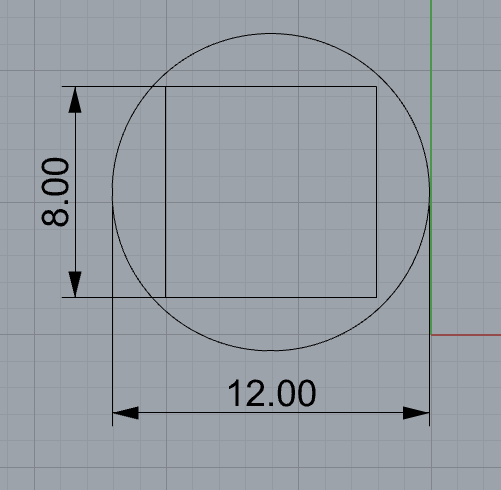
Ghenghis is right. The thickness of the materials you want to use is certainly a factor. I have been using hollow punches in my workshop. They are closer to the second option as it requires a hammer. It is loud yet it is the cheapest option. For an 8mm cube you can use 12mm hole
As promised, one more family of thoughts:
do an internet search for “binder clip checklist.” That’s not a “normal” game component, but it’s completely bump-proof and very revisable while you work on the design. Or for a “normal” alternative, quite a few games use small "plastic slider clips: basically paper clips where (unlike a check-list) you reposition the clip along the edge of a tracker card. If you find plastic a bummer, a normal paper clip could work.
Neither is glamorous, but if the design is not settled it may be too soon for glamor.
And I second bigbosses pitch for the hollow punch/arch punch. I have used them to make small round tokens with decent results, and just punching spots for cubed should definitely work. It will take a little practice. And they do make square ones, though that is a “specialty” purchase.
To be honest, it never occurred to me that one could use circular holes for keeping cubes in place…
The clipboard checklist is a fun idea as well, though my design also includes a 4 x 10 matrix of slots, which would become slightly cluttered using 40 odd paperclips.
I think I’ll create the first 10 or so iterations just on printed paper, and keep the cat at bay. And when it’s time for a moment of gloriousness, a 3D board design will probably appear miraculously before my mind’s eye, maybe using round cubes…
Oh, as an afterthought: while still developing the game and boards, there is this app called simply “Character sheet for any RPG”, which is pretty amazing within its limitations, for making up sheets with lists, tables, boxes, check boxes etc.
I used it for Mini Rogue on the train, which worked fine. So why not give it a shot here?
I actually hadn’t heard of this. I did make an in-hand game that used a binder clip to track health (and hold some cards together) and a few paperclips to track other things: Office Quest. I thought it was pretty clever, but it didn’t make too much traction in the BGG in-hand contest, lol.
As others have said (who have actually worked with chip board), you need a square punch and hammer.
Another option, if you have access to a 3D printer is to print the plate, and also print an overlay on sticker paper. Then you can use those lightweight square punches (for paper) to punch your holes. Peel the sticker, and overlay on the 3D printed plate.
The Game Crafter has offered dual-layered boards for a while now:
They come in a variety of sizes and formats:
I haven’t had a game that uses them yet, so I can’t speak to the quality, warping, or general finish. But it might be worth exploring if you’re looking to add some tactile flair to your build.
Thanks a lot, @modius !
Apart from the reassurance that I could order it, once I’ve finalised the board(s), it also gave me a great suggestion, of using overlapping, possibly diagonally placed, squares, to save a lot of space on the board for keeping stats (although even harder to fabricate and punch out myself in prototyping).
Another thought if you’re just prototyping, and you need to maintain position on a track or that 4x10 matrix you mentioned. Get a set of small magnets, and you can pair them up on opposite sides of your player sheet/board. They’re easily available online, or a hardware store like Home Depot, Lowe’s, ACE, etc.