Tapestries + Storyweaver, my solo RPG and digital play tool

Greetings,

I thought I’d share something I’ve been working on for quite a while.

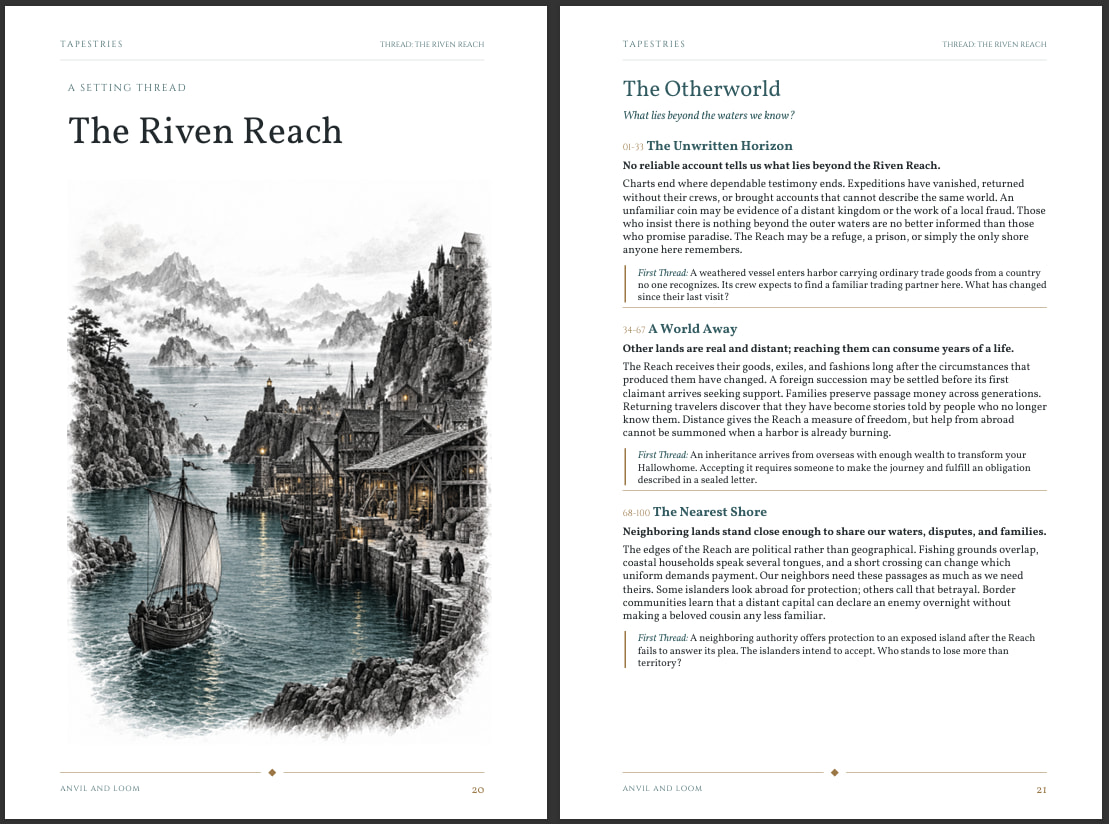
Tapestries is a solo RPG built around emergent storytelling. The idea is that you establish enough of the world to begin playing, but you don’t decide the story ahead of time. You ask questions when they matter, use oracles and tables to introduce what you don’t know, and then follow the consequences wherever they lead. It is inspired by Ironsworn and Starforged, but I have eliminated moves altogether. You just role-play and face the challenges when they appear.

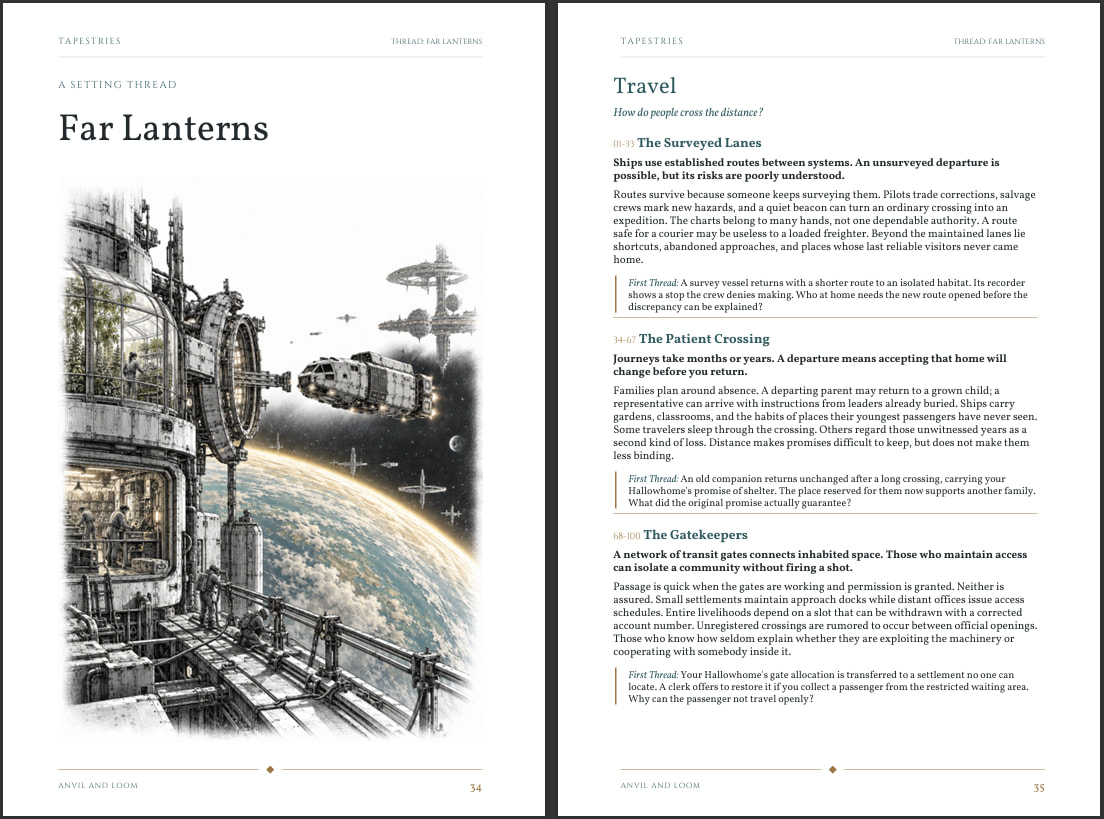
It uses one core system for both fantasy and science fiction, with The Riven Reach and Far Lanterns as the two starting game worlds. The Riven Reach is actually the setting for my first novel, Masks.

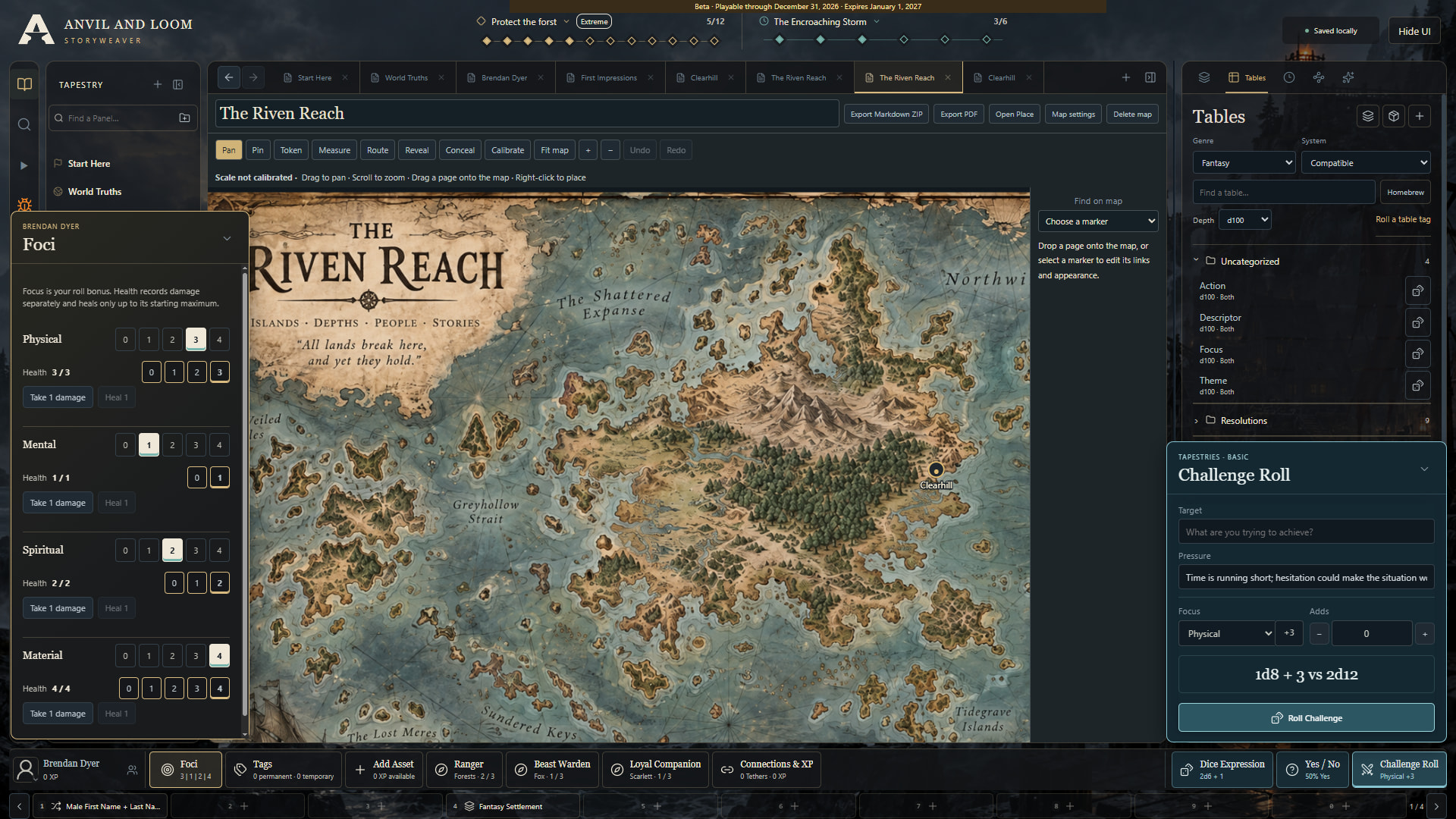
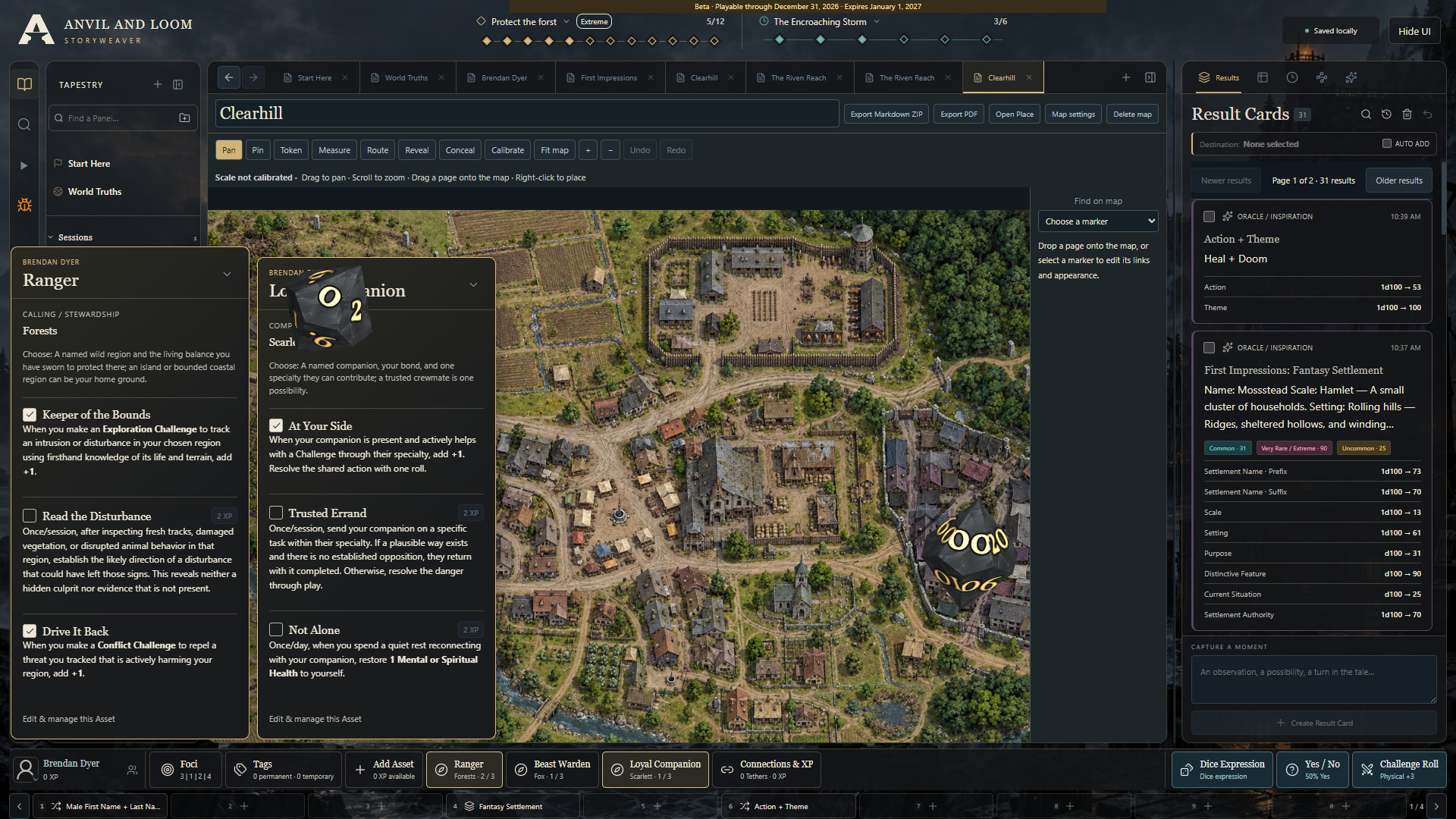
Alongside it I’ve been developing Storyweaver, a digital companion/VTT for the same style of play. It handles things like characters, Assets, maps, dice, Challenge Rolls, tables, oracle results, Places, session notes, and the other moving pieces of a solo campaign. Tapestries doesn’t require Storyweaver at all, but the two have been developed together and work particularly well as a pair.

Both are currently in beta, so I’m not really promoting or selling anything yet. I mostly wanted to share what I’ve been building and see what people here think. I know there are quite a few solo gamers and table/oracle enthusiasts (fantasy alone has 108 tables to begin with!) hanging around this forum, so this seemed like a good place to show it.

I’ve attached a few screenshots from both the book and Storyweaver.

I hope you’re doing well. :slightly_smiling_face:

2 Likes

In general I think this looks very cool, but I’m one of those who aspires to get away from “screens” as much as I can when I engage with tabletop hobbies. (Not saying I succeed as often as I’d like, and for all I know this is part of why I don’t do as much solo roleplaying as I’d like – but I’m stubborn about it.)

2 Likes

Then you will be happy to know that there is a Solo RPG TTRPG aligned with this. Hence, the screen shots of the interior of the books. :slight_smile:

Yes, apologies, I meant to only be signalling hesitation/stubbornness about screen-dependent stuff.

I like emergent storytelling quite a bit when it goes well, so I’ll be interested to hear more about Tapestries down the road. I think that’s pretty much the main thing I want to get out of table-time in any form – I tend to be dissatisfied with play sessions that amount to a couple rounds of stat-based combat/challenges back and forth with little narrative “oomph.” But I also find that I don’t really want a tidy, linear, “hero’s journey” arc (and in this I may be idiosyncratic). I want something in the middle, not a complete jumble of random events but something messy enough to allow for reinterpretation and Gestalt switches along the way. I want an experience that can support multiple, conflicting stories.

When I sit down with sandboxy solo RPGs I often find there’s an initial period where you have to just kind of muck around and let random events and themes accumulate in the hopes that they’ll sustain (at least one) story later. There’s a lot of talk about why it’s so hard to get going on solo rpgs and for me, I think this is part of it. (In addition to finding a lot of rulesets to be very poorly communicated.) During this initial period I only have the core game loop to go with and I often have a lingering skepticism that it’s going to “add up” to anything narratively interesting. I often think of this as not trusting that a designer’s tables are suitably built, but I suspect that I have yet to fully work out the correct division of labor between the designer and myself here.

1 Like

Beta for the tabletop version will be happening soon. I will be sure to announce it here.

That being said, yes, I do agree with your assessment that the beginning sometimes feels like you are wandering aimlessly. I think that is why Session 0 is so important, particularly in the Ironsworn family. Your Truths are one way to start shaping your story. Tapestries does have this feature in World Truths for both fantasy and sci-fi.

The Iron Vow in Ironsworn is a great concept, but it does feel really same-y once you start your second and third campaigns. “Why do I have to make vows all the time?” Tapestries answer to that is Hallowhomes. A Hallowhome is anything where your heart resides. It could be a community, a ship, a faction or society, a family, an oath, or whatever else you can think of. This gives you something other than yourself to align with and serve for. So far, it seems to serve this purpose. When you generate a Hallowhome, you are also generating its purpose and conflicts, which can then become your own.

I also think you will be pleased with the tables. The prompts are inspiring and immersive.

My biggest issue with Ironsworn was always the Challenge Roll. You always went up against 2d10, which means jumping a 10 foot gap was no different than jumping a 15 foot gap. Tapestries resolves this by introducing Gateways of sophistication in the Challenge Roll. Basic is d8 vs 2d12, no different than Ironsworn other than the dice difference.

Gateway 1 has you assign one d12 as the Target (what you are trying to accomplish) and the other the Pressure (what about your surroundings is making your task difficult). Weak hits resolve one while failing the other. Target and Pressure have incredible narrative value in the game.

Gateway 2 allows you to change the shapes of Target and Pressure. Target can become a static value, typically from 6 to 12. Pressure becomes a scale of d12 + 0 to d2 + 10. The higher the static value, the more pressure. The Target value CAN BE TIED. Which means a Weak Hit can have a match, which introduces Knots, the super version of matches.

Gateway 3 introduces a Resolution Economy where each hit grants you 2 Success points and each miss grants you 2 Failure points. These 4 points are used to purchase the outcomes. Three are basic outcomes and the other is a repeatable purchase that allows you to roll on a Depth table (d44, d66, d88, and d100) which one table can produce common, uncommon, rare, and very rare outcomes. There is a risk/reward component to this. You could spend all 4 points on the table roll, yet roll a common result. This outcome would be horrible on a 4-point Success roll but incredible on a 4-point Failure roll.

Also, I have completely eliminated Moves. They are completely unnecessary. You just role-play until it’s time for a Challenge roll or an Oracle/Table roll.

Anyhow, that’s a 50,000-foot view of the game.

1 Like