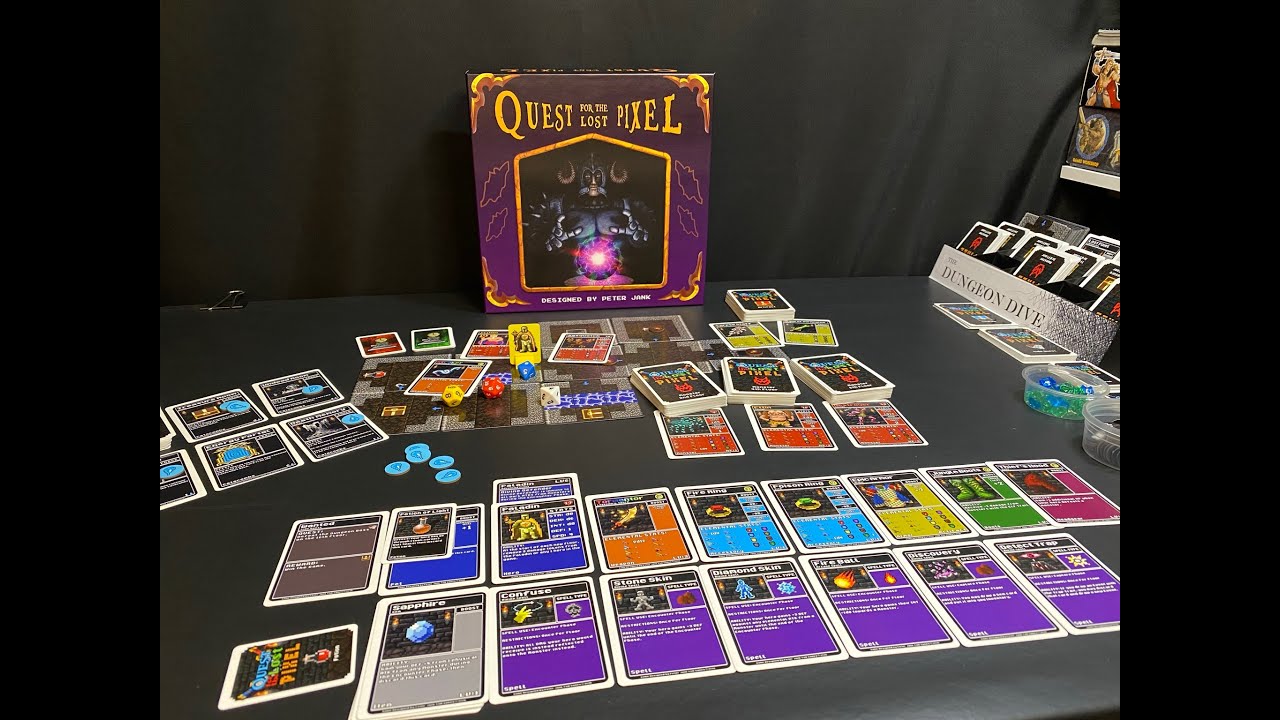
Daniel (@dungeondive) delivers a Quick Hit—his concentrated format for games deserving attention without requiring exhaustive examination. Quest for the Lost Pixel, Peter Jank’s print-on-demand roguelike dungeon crawl, receives an unabashed love letter.
The headline: with four expansions now released and official support concluded, Lost Pixel has reached its final form. Nearly a thousand cards in the base game alone. Ten decks of monsters. Ten decks of treasure. Artifacts. Spells. Events. Cheat codes requiring Yahtzee-style mini-games to unlock. Fishing. Pets. Deity worship. Town rebuilding. Catacombs offering press-your-luck dungeon-within-dungeon exploration.
Daniel’s central thesis concerns the virtue of randomness itself. Like its video game cousins, this roguelike dungeon crawl lives and dies by its seed. Shuffle your cards, and you’ve determined that session’s fate. Sometimes the seed favours you; sometimes it emphatically doesn’t. This isn’t a game for those seeking perfect tactical control—it’s for players who embrace chaos and find joy in adaptation.
The criticism “it can be unfair” lands with a qualifier: “but it is always fun.” The pixel art charm, the video game easter eggs, the wonderful variety of heroes, monsters, and loot—everything serves a singular design goal: fun. Simple, light, challenging, and infinitely replayable.
“A nearly perfect example of the dungeon crawl genre,” Daniel concludes. “A passion project in the purest sense of the phrase.”
Do you embrace randomness as a feature or fight against it as a flaw in your solo dungeon delving?