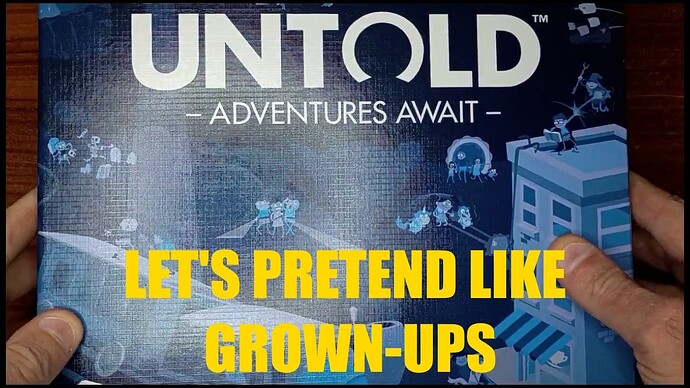
I’ve been a fan of Rory’s Story Cubes for years. When they made a boxed set that used them in a more organized framework, I bought it, and did nothing with it for several years. I finally had the time and motivation, so I gave it a try with a low level vigilante setting, and was amazed with how easily the story flowed.
It simultaneously keeps you focused on story elements while giving you the freedom to be creative within its limits.
Keep in mind, there’s not really a game in this. Your character has abilities, but they could easily not work with any given action. It’s up to you to make sense of why something does, or doesn’t work when the cards tell you so.
Anyway, I made a video about it. I’ve included a direct link to the summarized setup and gameplay. The rest of the video is about recreation, and might not be of interest to you. Be warned that the game has a left leaning political theme, so if you’re not in the mood for that, you might want to skip it.
Has anyone else tried it? A lot of reviewers suggested playing it with your kids.
That’s surprising to hear about a game voted best family game at the 2018 UK games expo–may I ask, what do you reckon is the left-leaning political theme in this game?
OH, I see. Well that tipped me over to definitely watch the video – archaeology/exploration of an obscure storytelling game plus a story with a left-leaning political theme is a solid value proposition, in my book.
I appreciate your remarks at the end about recreation and creativity. I have not thought long and hard about it, but I may be of mixed minds…
Would you like to know more?
I think even forms of recreation that look “passive” at first glance can perhaps feed into more active/creative intellectualizing and storytelling. For example, I probably spend more time thinking about tabletop games or watching/reading what other people say about them than I do playing them. But by doing so (and by acquiring a modest collection of them) I can (creatively) tell myself the story that I am getting closer to becoming a person who plays them more regularly. So all my passive recreation can appear to me as if it is laying the groundwork for more active recreation, and thus that the distinction is not a hard one. Likewise (not my case, but) someone might watch a lot of films and develop a very critical aesthetic eye about them. Or, likewise, the advice to aspiring writers is often to read a lot. Examples could be multiplied.
I’m not even sure I like that I do this, but I do think I do it, and I suspect a lot of us do. This kind of thing can make it hard to easily distinguish some instances as passive vs. active recreation. It might also make it harder to recognize when I have an itch for some something more overtly creative that isn’t being properly scratched.
You make a good point. Out of respect for this forum, should we continue the convo on YT?
I agree. Your example reminds me of how my mother claims that she actively listens to classical music. She can pick out nuances that I can’t. I can listen to it and enjoy it, but her active analysis with a particular piece of music is more meaningful to her than my experience with it.