Matt's musings - game dev journal

I was going to create a design journal in YouTube, but:

  • I don’t know how to do that
  • I’m not a game designer, so putting myself out there would trigger imposter syndrome too much.

I instead intend to use this thread to document my attempt at creating a game and a bit of reflective practice. If this helps me or anybody else then I’ll consider it a win regardless of how bad the game is :slight_smile:

5 Likes

Some design guidelines to begin with…

Goals

Daniel’s “Ten Things I Look for in a Good Dungeon Crawl and Adventure Game” video has a large cross-over with what I look for. It serves as a great starting point, and his thoughts are much more organised than mine :+1:
Ten Things I Look for in a Good Dungeon Crawl and Adventure Game

  1. Solo friendly
  2. Unthrottled access
  3. Character campaign (if there is a campaign)
  4. Encounter variety
  5. Simplicity > Complexity
  6. One and done
  7. Aesthetics
  8. Set up and storage
  9. Sense of discovery
  10. Interesting character choices

I’m sure I’ll refer back to this list often as I try to build a game.

Minimum Viable Product

  • Complete: no additional written resources needed.
  • Simple components: easy to print and play at home - no need to craft terrain, build figures, or custom components.
  • Few components: I want to make this easy to store and transport.
  • Start small: a first game should be small enough to create quickly so the experience can be learnt from. Perfect is the enemy of good (or done).
  • Not a magnum opus: There is no single ideal game, this shouldn’t be my life’s work.

Constraints

Constraints are a good thing, not negative. If anything, having some boundaries to push against can help with creativity. Some self-imposed constraints are:

  • Black and white art: colour can be added later, BW art is a low ink option.
  • 3 sheets of paper: 1 for rules, 1 for the game board, 1 for the encounters.
  • Standard components: pen/paper, D6s, and poker cards.
5 Likes

Game setting

In deciding on a setting, I’m going to try and follow the old adage “write about what you know”. As a guiding principle this should help me make the setting believable, and to generate ideas for encounters and the world. Now for the place and time…

Place

I enjoy both kinds of games: dungeon crawls and overland adventures. :slight_smile:
Having no life experience of dungeons, I’ll go with an overland adventure.

An overland adventure in a place that I know? There is no wilderness in modern Britain. Its a tiny island that’s been populated since the last ice age. The closest I can get to a wild country is the Peak District national park. Even then its peppered with villages that have been there since at least medieval times.

The Peak District forms a breathing space between the cities of Manchester (my side) and Sheffield, and now has millions of visitors every year. It only covers 555 square miles, so is not a vast expanse, but should be big enough for a bit of adventure. In the modern world it could be circumnavigated quickly in a car. But even a couple of hundred years ago it was wild enough to require a local guide.

To quote Daniel Defoe: “This, perhaps, is the most desolate, wild, and abandoned country in all England.”

The Peak District also has hundreds of remains of stone circles, cairns, barrows, henges, standing stones, and hill forts to act as evocative locations.

It is also the 75th anniversary of the national park this year. Happy birthday. :partying_face: :birthday_cake:

Time

The further back in time we go, the more untamed the country becomes. But I also want the Bronze and Iron age barrows to be haunted relics of a bygone age - much as they are today. I also want to stay far back enough in history to avoid gunpowder weapons.

I think sub-Roman Britain gives a good reason for the area to be wild and under-populated. 410AD is often mentioned to be the date that Roman legions withdrew from Britain, leading to the rise of small tribal kingdoms. This is a reason to define the boundary of the realm on the map.

Historians might dislike the term Dark Ages, but it is an evocative term for game lore.

1 Like

Hex Crawl vs Point Crawl

I love hex crawls, but it doesn’t really give me the right feeling for a realm where the player’s character is a local tribesperson.

Hex crawling makes perfect sense in Forbidden Lands, where it is part of the game lore that the villages have been isolated apart in a magical mist, and you are exploring the area for the first time. Hexes really help with the feeling of freedom to roam as you can explore in any direction.

In my case, a point crawl feels like a better way to represent prehistoric trading routes that have existed since the Stone age. Even today I think there are remnants of Roman paving along some paths (like Doctor’s Gate).

But even that may be step too far - to stick with the idea of starting small and simple, my first version will be basic regions drawn onto the map.

3 Likes

The Realm

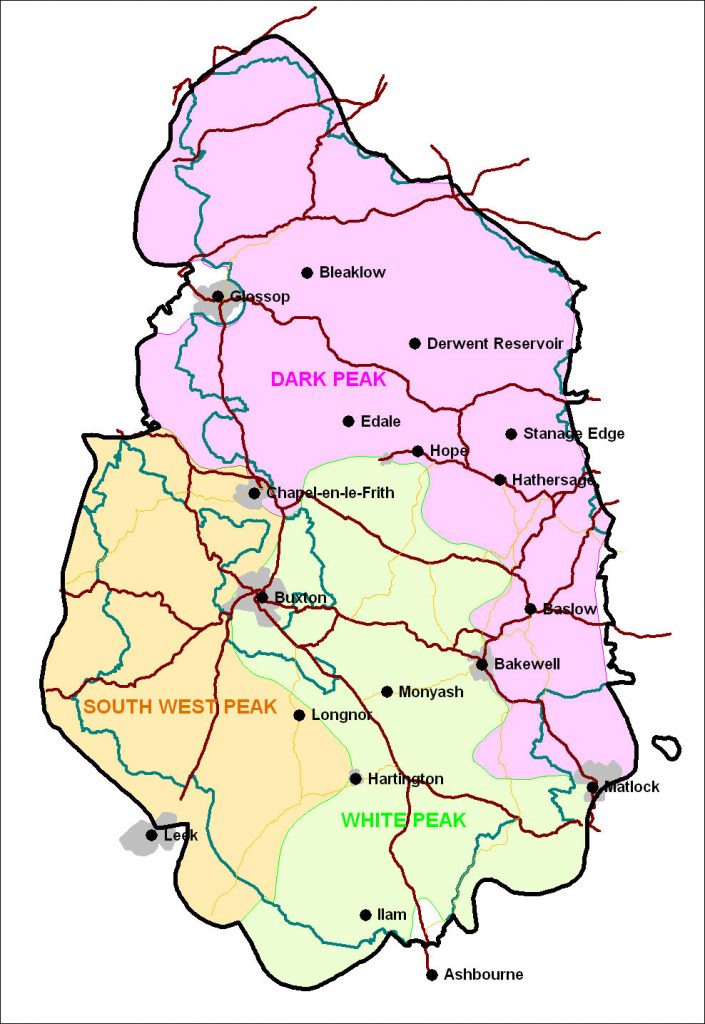
Here is a modern map of the Peak District, which clearly shows the area when fitted into a rectangle (i.e. a piece of paper):


source: Visiting from Overseas? Try Rock Climbing in the Peak District?

The Dark Peak is named after the gritstone bedrock, the White Peak similarly named after the local limestone.

Maybe the 3 coloured areas could be different danger levels in the game?

Either way, the map is useful in several ways:

  • Start locations: There are 3 towns on the periphery: Glossop, Leek, Matlock.
  • Adventure destination: Mam Tor (just south of Edale) is very close to the centre and the hottest tourist destination right now. Massively popular with Instagram influencers and other blights on society.
  • White space: The rounded shape leaves useful space in the corners. Hopefully I’ll be able to squeeze a character sheet and other useful bits in these corners. In a 3 page game I need to use every inch.

The Peak District doesn’t have any clearly defined borders such as coast or mountains. In my hand-drawn attempt in the previous post I have instead covered the areas outside the game realm with heavy woodland, as if the Peak District realm is in land cleared by your character’s tribe.

4 Likes

Maps, maps, maps!

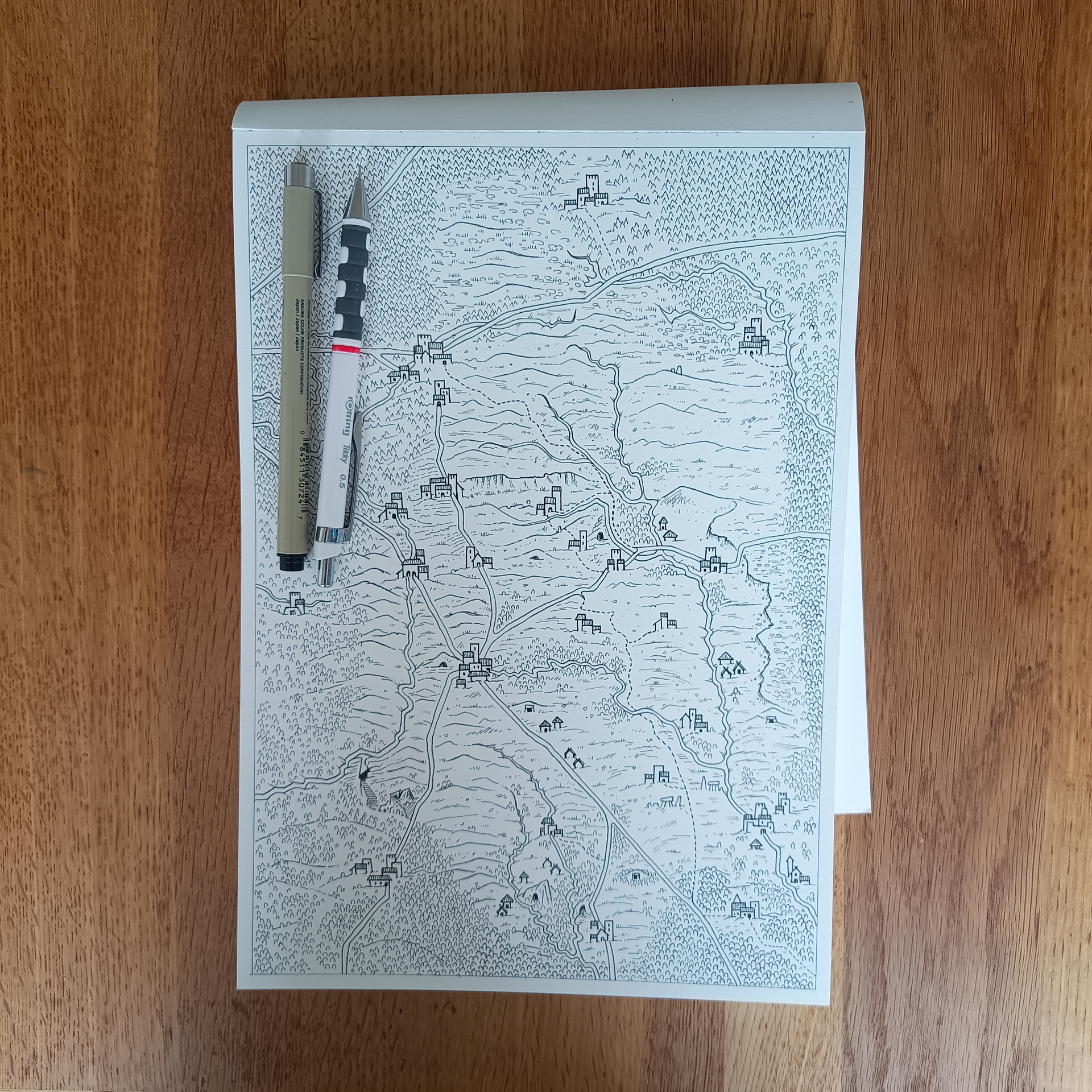
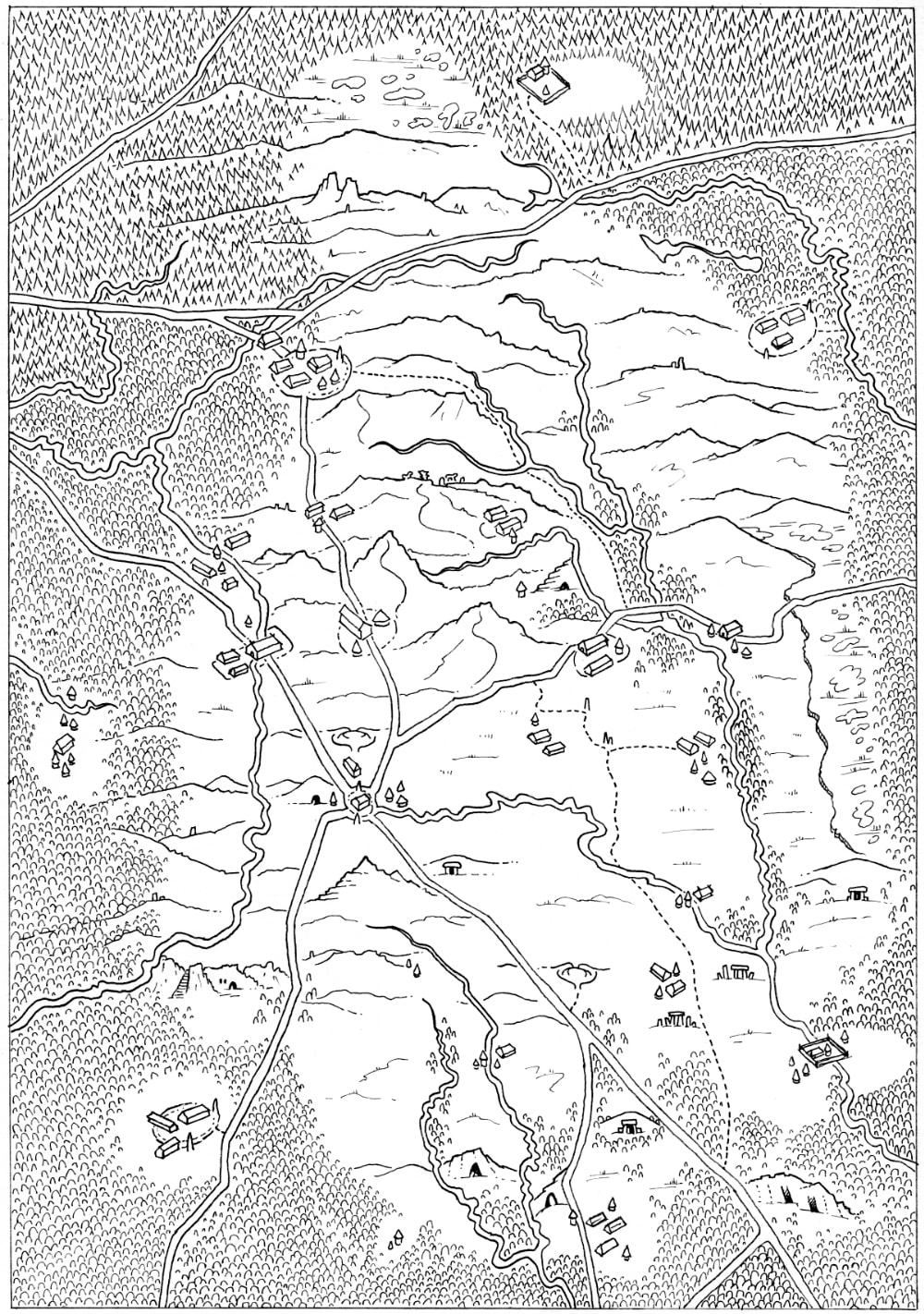
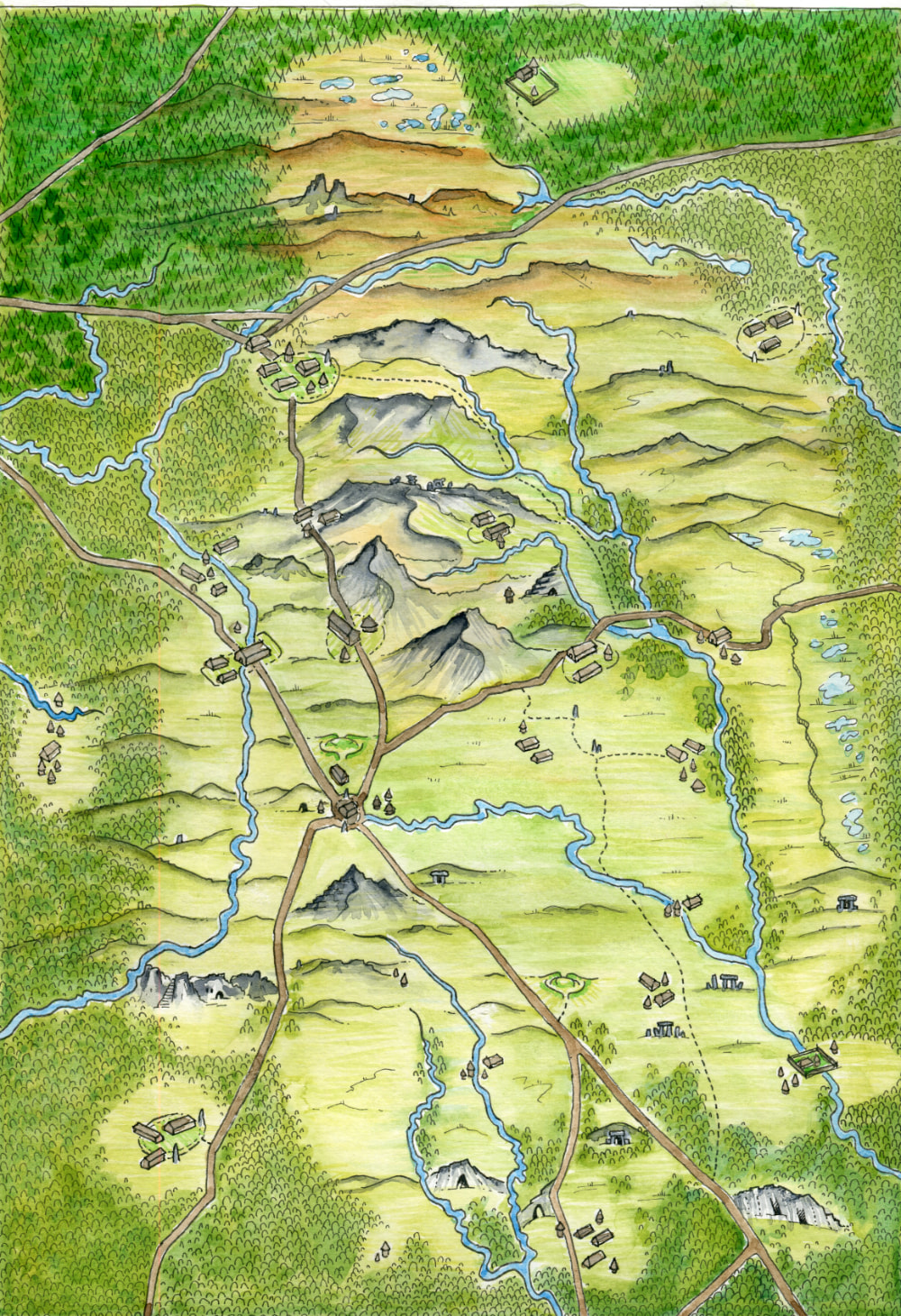
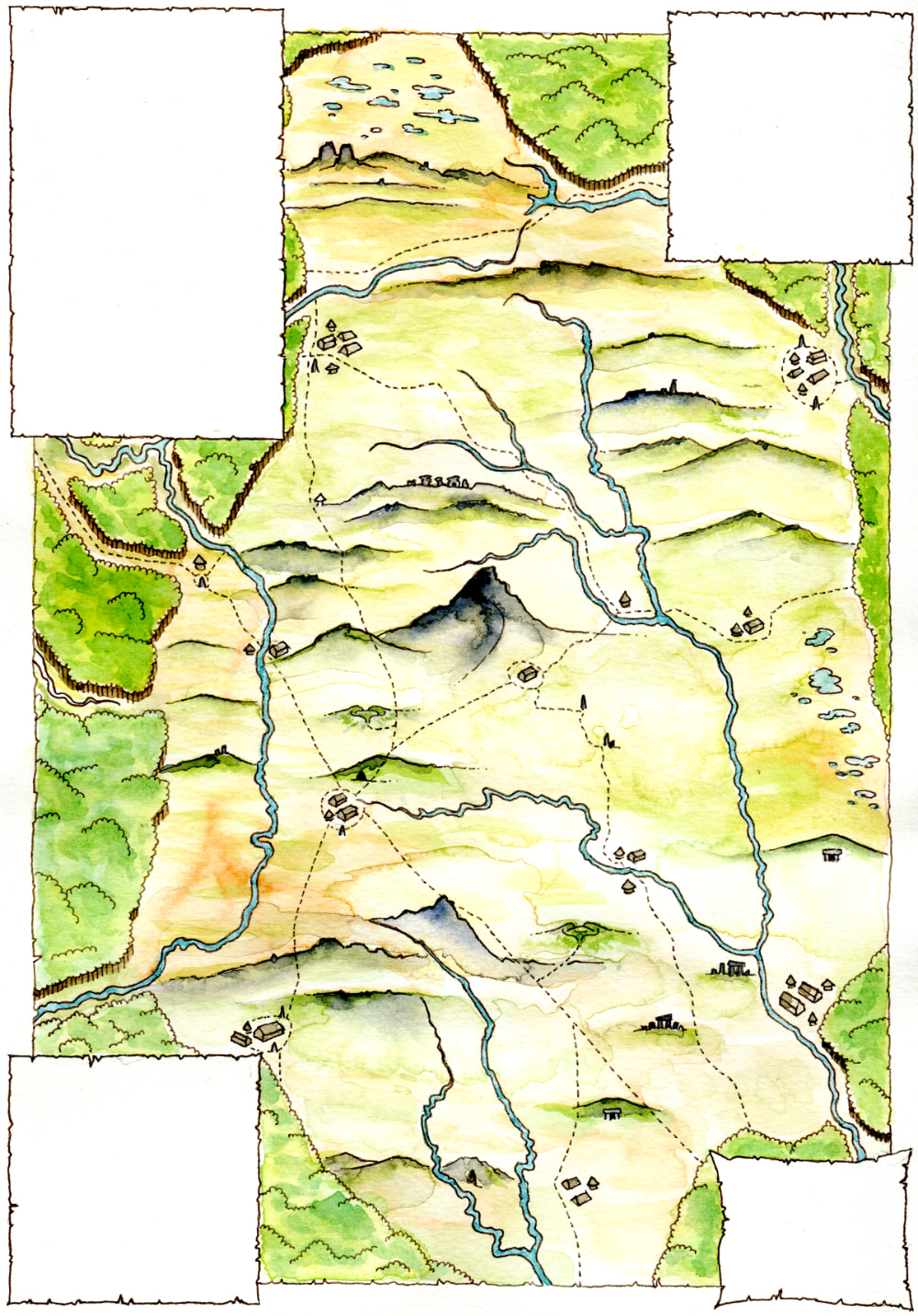
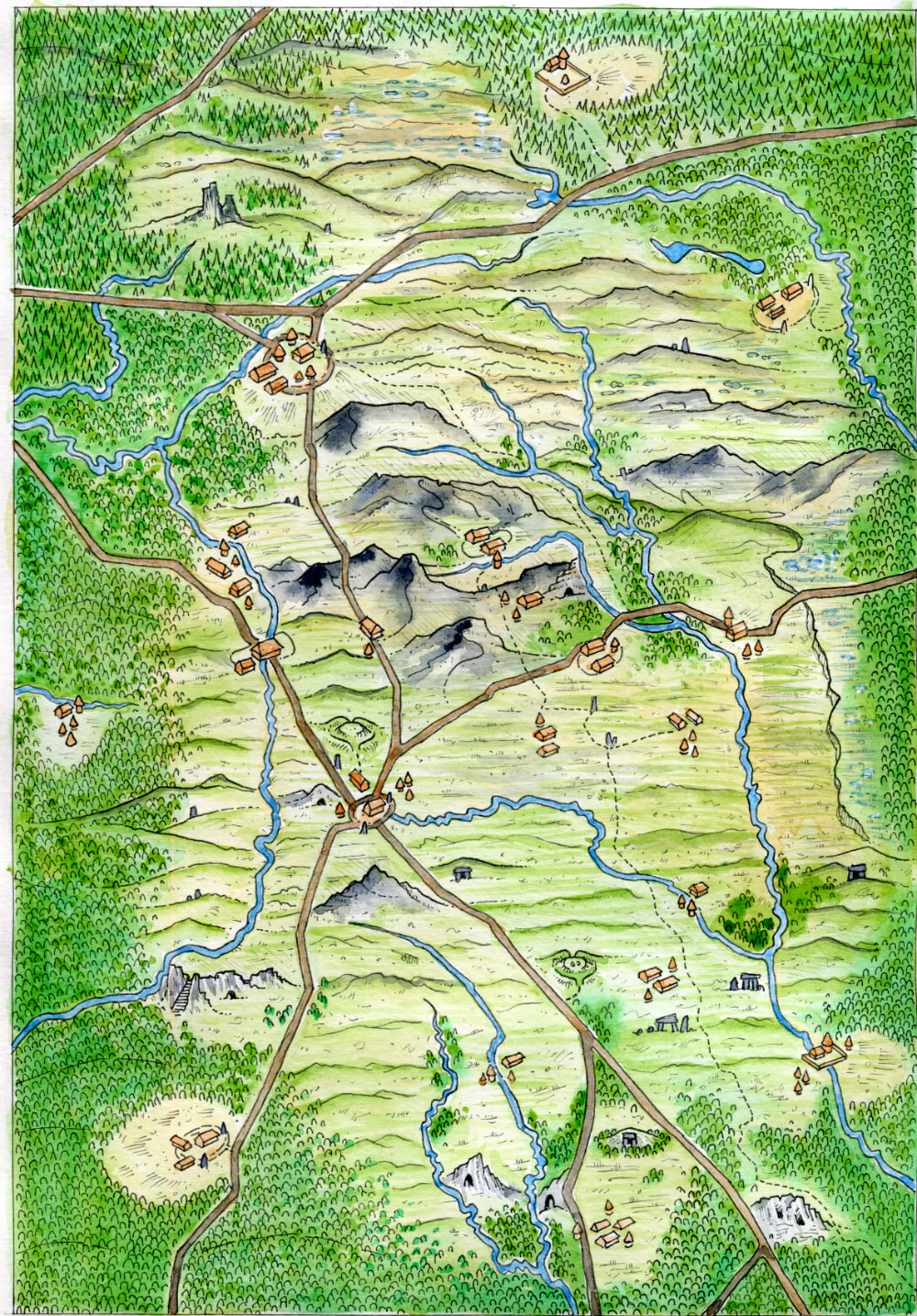
I’ve drawn of few iterations of the same basic idea - i.e. the real countryside in a fantasy map style. This is largely based on the Tolkien quote “I wisely started with a map, and made the story fit.” I’m sure this isn’t the best way to approach game design, but I’m starting from zero so any progress is good.

Black and white

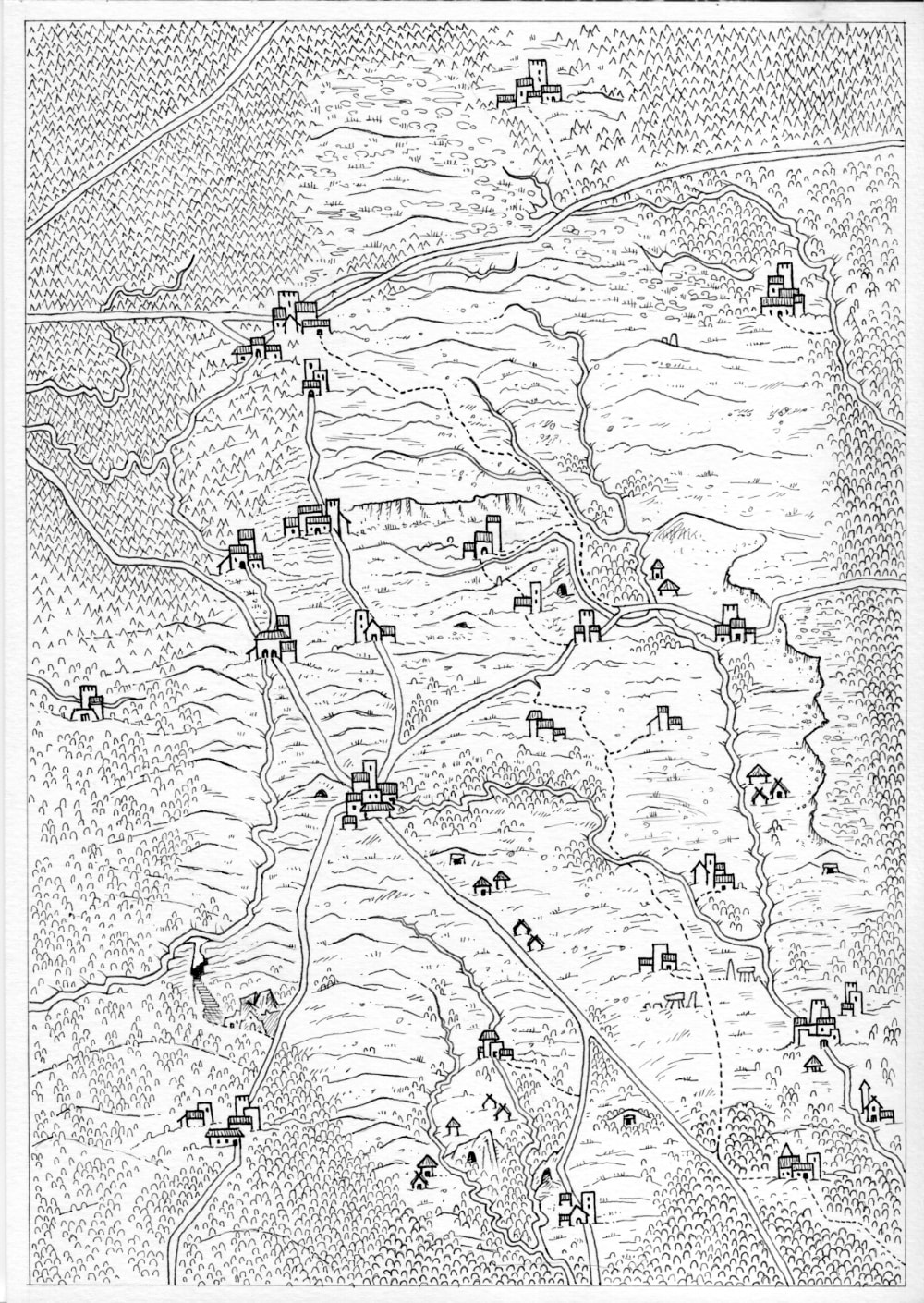
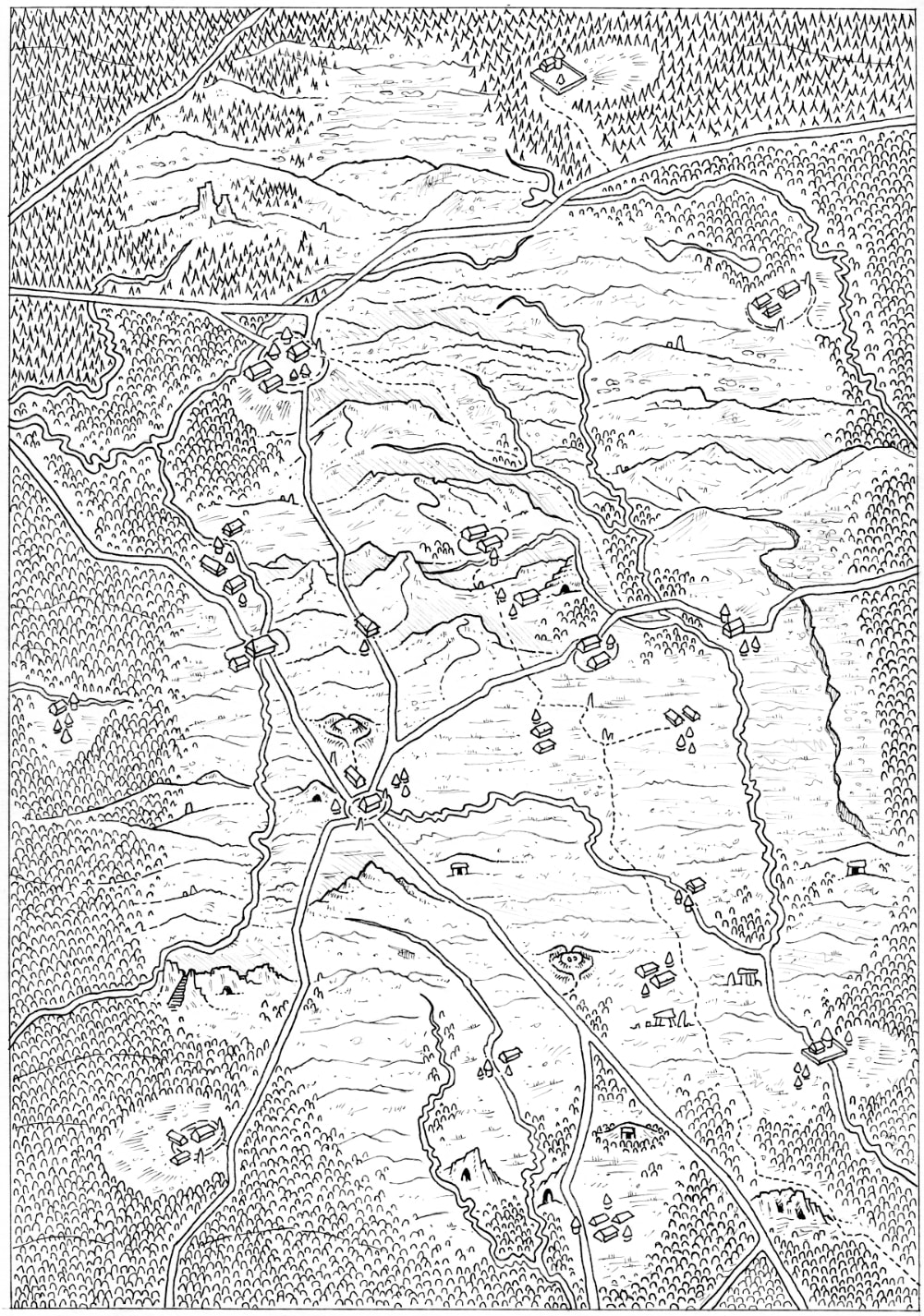
Here they are scanned into the computer:

Map 1

:-1: “Mountains” aren’t exaggerated enough. They need to be properly pointy, not like the real-life green rolling hills.
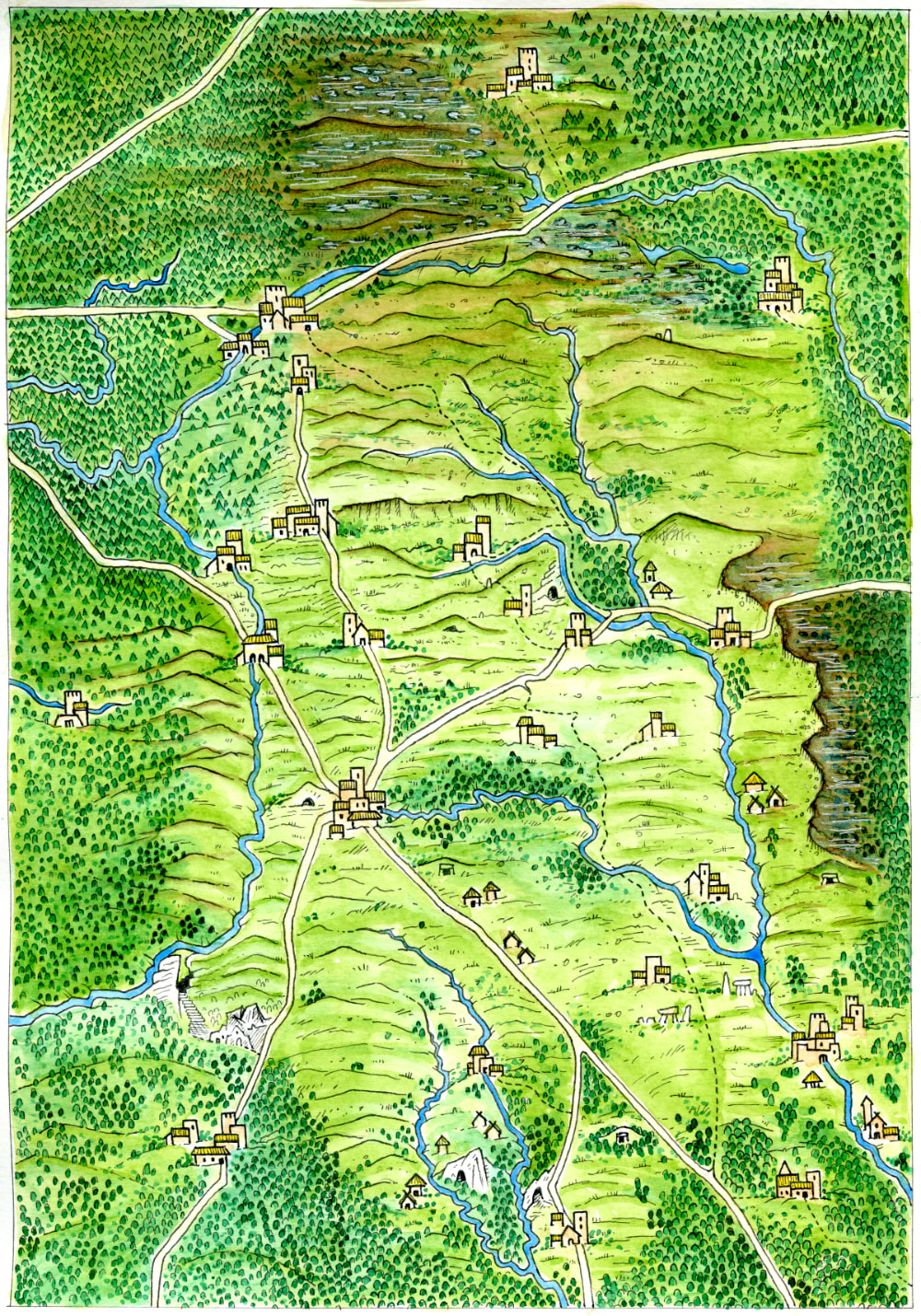
:-1: Buildings look too ‘generic medieval fantasy’ rather than Dark Ages British. The lines are too heavy as well.

Map 2

:+1: The mountains are pointy enough.
:+1: The buildings are smaller and simpler, this makes the area seem bigger.
:-1: I went to the art shop and asked for the thinnest pen they have. A bit too thin, the scratchy lines all over the ground give too much visual noise.

Map 3

Much cleaner, but I think this is still going to be too complicated once it has icons and keyed locations overlaid onto it. Time will tell.

Colour

The silver lining with not really liking these maps is that I don’t have to worry as much about spoiling them with paint.

Map 1

:-1: The greens are way too saturated using the colours out of the watercolour starter set.
:-1: The swampy parts look messy because they are over-worked.
:-1: The trees took ages to paint. I was trying to use watercolours like the model painting acrylics that I’m used to. I need to loosen up.

Map 2

:+1: I mixed desaturated greens using a cold blue and a warm yellow.
:+1: The swampy parts look much better and don’t draw the eye too much.
:-1: There isn’t enough tonal variation in the ground.

Map 3

Painting overall is OK, but the underlying drawing is too busy.

Map 4 (I forgot to scan in BW first)

:+1: Less detail and a more painterly approach works better with watercolour.
:+1: It’s very clear which the central hill of the game is.
:-1: The trees are in a simpler style, but now they look like green clouds :frowning:

Summary

That will have to do for now. My wife occasionally pokes her round the door to say things like “have you finished drawing Middle Earth yet?” :slight_smile:

The last map has had some boxes added. This was mainly to avoid drawing more trees. The next task will be to decide what goes in them.

3 Likes

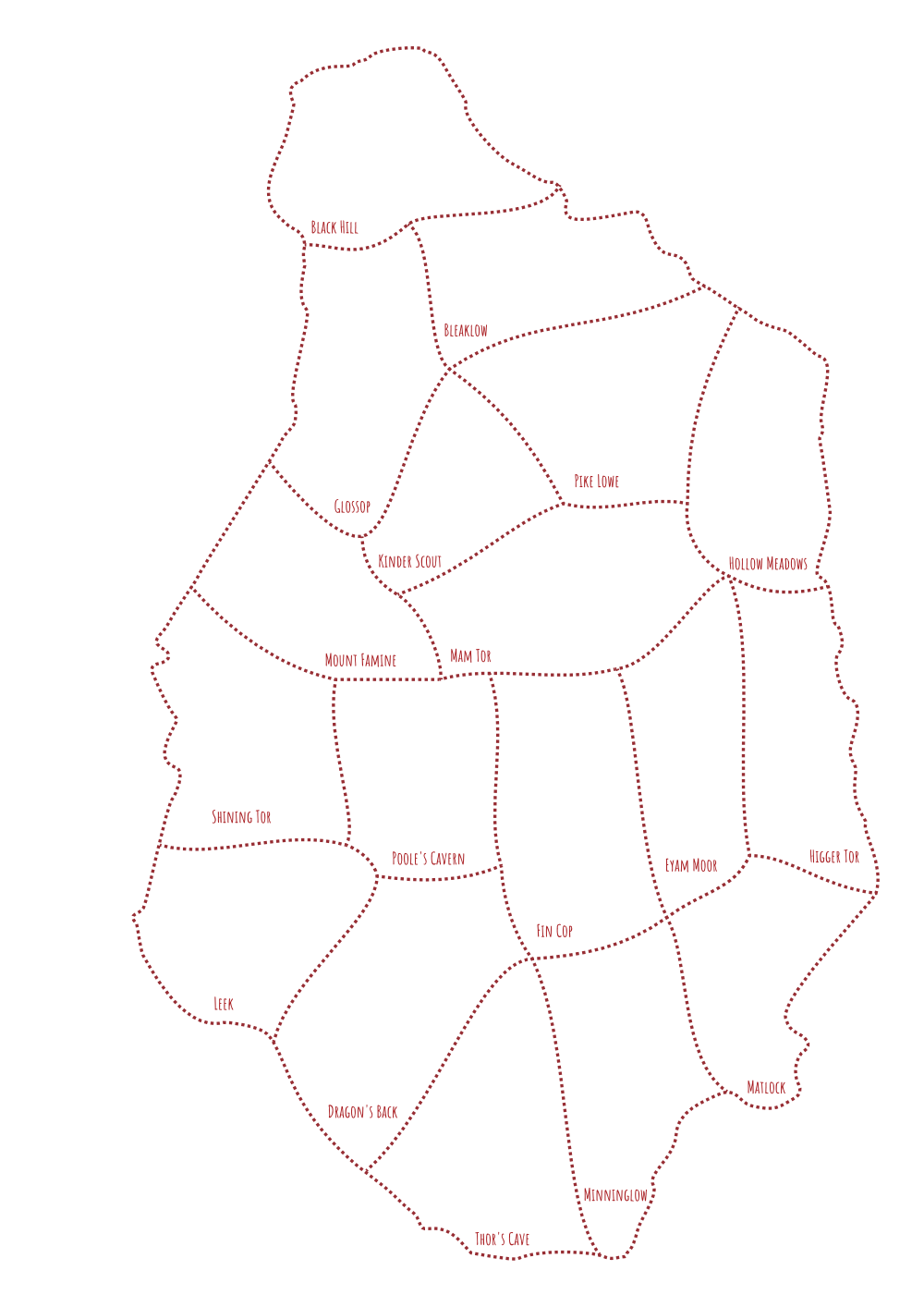
Map regions

I recently re-watched this Dungeon Dive video about Fortune & Glory: Fortune & Glory - Revisiting a Game I Should Have Ranked Higher

Feeling inspired by the simple regions, I have mapped out something similar for my game board:

I overlaid this over a real map, and chose an evocative place name that appeared in each region:

  1. Black Hill
  2. Bleaklow
  3. Pike Lowe
  4. Kinder Scout
  5. Mam Tor - “the shivering mountain” due to landslides.
  6. Mount Famine - peasant black humour denoting poor farmland.
  7. Hollow Meadows
  8. Shining Tor
  9. Poole’s Cavern - a 15th C. outlaw, but I shall use the name anyway.
  10. Fin Cop
  11. Eyam Moor
  12. Higger Tor
  13. Dragon’s Back
  14. Thor’s Cave
  15. Minninglow

This gives me 18 regions when added to the 3 previously chosen towns (Glossop, Leek, Matlock). Plenty to be going on with.

A few place names use dialect words that may be unfamiliar to some folk:

  • Low: hill or burial mound (Old English hlāw)
  • Scout: high, overhanging rock (Old Norse skúte )
  • Tor: hill or rocky peak (Old English torr)

Encounters and characters

Having established “where” and “when”, I’ve starting thinking about “who”.
(I also need a break from maps.)

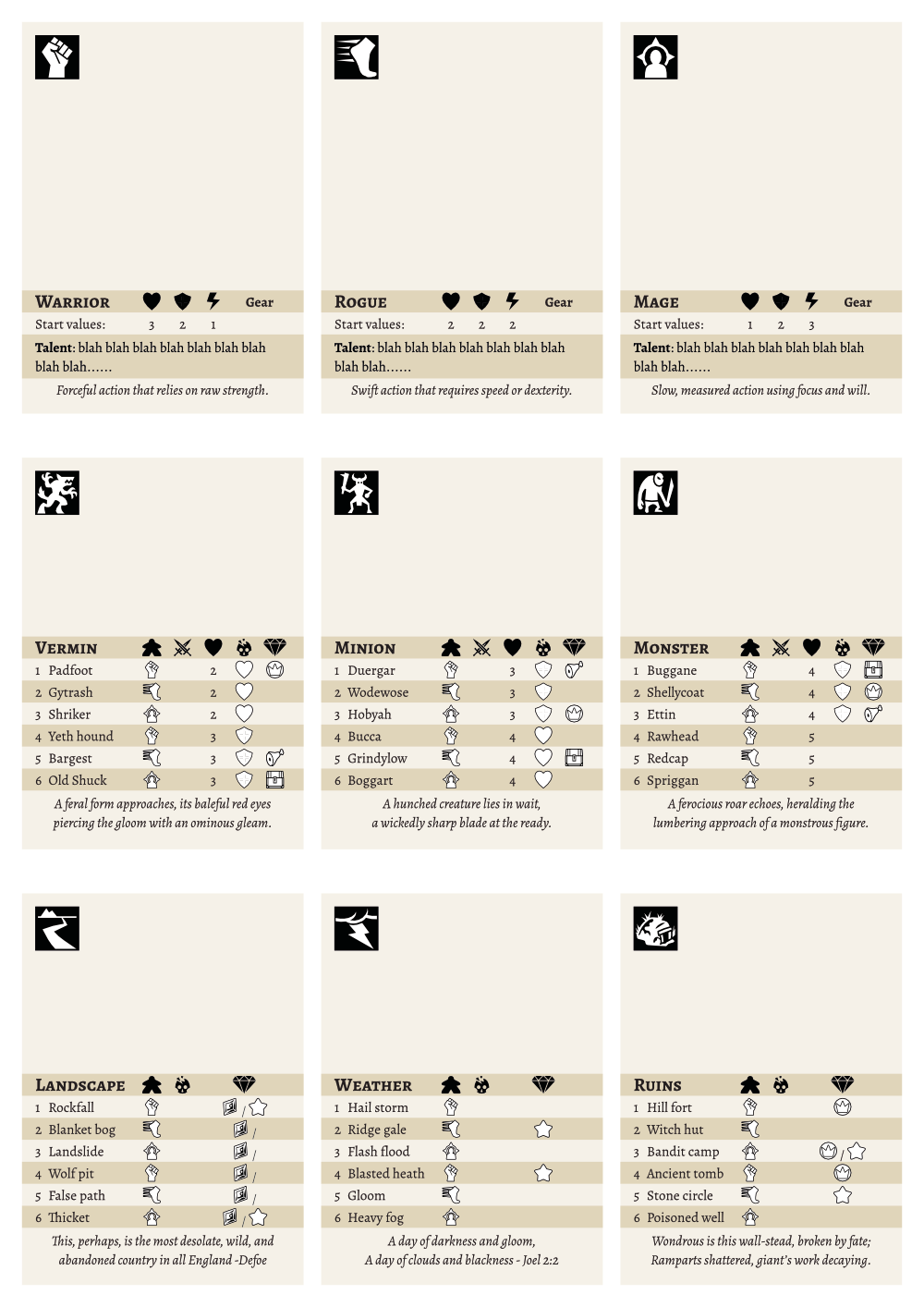
To stick to my self-imposed rule of 3 sheets of paper, I’m limited to 1 sheet for a bestiary. It occurred recently whilst reading about a 9 card challenge on BGG that I can just about squeeze 9 poker cards onto a sheet of A4. If shuffling the cards isn’t required, I don’t even need to cut them out. This makes crafting even easier and means I don’t have to sorry about the safe areas or bleed of card templates.

So, I can allow myself:

  • 3 pre generated Player Characters (PCs)
  • 3 combat encounters
  • 3 non-combat encounters

Player Characters (PCs)

My wife has limited/no knowledge of RPGs. When I tried to explain this project the only reference she has is Diablo 1 from the nineties. This is a game that I used to love but have a hazy memory of the classes being: Warrior, Rogue, Sorcerer. If its good enough for Diablo then its good enough for me! I don’t want a high fantasy setting with wizards blasting out fireballs, but there should be space for Merlin-like characters and magic items.

Combat encounters

This will simply be 3 different danger levels of adversary: Vermin, Minion, Monster. I find that 3 is the “Goldilocks” number for so many things, it gives just enough choice to be satisfying without being overwhelming.

Non-combat encounters

I’m less sure on what this will be, but the land the Peak District itself should play a part - peat bogs, ancient ruins, and terrible weather.

Putting it all together

I should be able to layout the encounters like this:

Warrior Rogue Mage
Vermin Minion Monster
Landscape Weather Ruins

If I can somehow squeeze a list of D6 encounters onto each card then even better.

TBC: I might merge landscape and weather into a single card so I can also add in some NPCs.

Game lore

I don’t want the bestiary to be populated by “just elves and orcs”, but I also don’t want to invent entirely new ideas that are hard to convey in a low word-count single page of rules.

Goblins are ten a penny and a bit boring, but they do have the advantage that there is a common understanding of what they represent.

A theme that I have used previously in solo roleplaying relates to British folklore. Alongside the local countryside, this is something that I know about. Hopefully other people do too, but I’m less sure when it comes to an international audience.

To over-simplify, I see the evolution of the orc as:
British folklore → Lord of the Rings → Dungeons & Dragons → Warhammer.

I would like to take my goblins back to the folklore that inspired Middle Earth in the first place. A bit more Alan Garner than Tolkien.

I wrote a small amount of lore recently for a version of Firelights, and will use this as a starting point here:

In an imagined distant Dark Age, the land of your forefathers is threatened by an invasion of uncanny forces. The dwindling people of the Fae folk, once numerous throughout the land, have retreated in the face of encroaching human civilisation. They seek to establish their own domain in the upland wilderness of Peakland - the ancestral home of the Pecsætan. Your home.

You are no hero of great renown, the Pecsætan people are commoners, peasants, and outlaws. Adventurers who seek to make their own destiny. Forgotten magic, ancestral artefacts, and strange powers await discovery amongst the ruins of the past.

Since its a theme I’ve used before and enjoyed it can be something to build upon. I imagine that the barrows that pepper the land are already mysterious and feared, and ripe for the Fae folk to colonise. Maybe some are even portals to fairyland?

1 Like

Ere Be Boggarts!

In order to fill out the list of D6 vermin, D6 minions, and D6 monsters I need to collect sufficient adversaries from folklore.

Aside from local knowledge, there is a great encyclopaedia of fairies by Katherine Briggs that I recently got out from a local library. I had to return it though, so here is an online copy to refer to:
An Encyclopedia Of Fairies Hobgoblins, Brownies, Bogies, And Other Supernatural Beings : Briggs, Katharine Mary : Free Download, Borrow, and Streaming : Internet Archive

There are hundreds of entries, but they can be categorised into a shorter list of archetypes: giants, witches, goblins, black dogs, dragons, etc.
I’ve decided to exclude anything undead or ghostly for now to avoid complication and allow for future expansion. The same applies to Wales and Scotland, its just England for now.

Vermin

Example black dogs that I can turn into a D6 list:

  1. Black Shuck
  2. Barghest
  3. Whist hound
  4. Yeth hound
  5. Padfoot
  6. Shriker

Minions

There are also a myriad of goblins, but many have too similar names: boggart, boggle, buggane, bugbear, bug, bucca…

So how about this:

  1. Duergar
  2. Wodewose
  3. Hobyah
  4. Bucca
  5. Grindylow
  6. Boggart

Monsters

These need to be larger and more powerful. Things like common trolls and ogres:

  1. Buggane
  2. Shellycoat
  3. Ettin
  4. Rawhead
  5. Redcap
  6. Spriggan
2 Likes

This is really excellent. I love black and white line work (yours is excellent) and have enjoyed many a happy cragging day on the Grit, so this is really an intersection of lots of my favourite things! I will enjoy watching the game develop I am sure, so thanks for sharing.

2 Likes

Thanks for the kind words. I can’t promise a good game, but getting my thoughts written down is definitely helping to organise them.

1 Like

Core parts of an adventure game

I was recently watching this wargame design video from Sam Pearson:
Designing a Wargame & Creating its Vision

In it, he lists the five essential parts of a wargame as: Turn sequence, Combat, List building, Scenarios, and Setting.

Translating those terms for an adventure game gives me a rough to-do list:

  • Turn sequence: I need to define the core phases of the game loop.
  • Challenges: not all encounters should be combat.
  • Character creation: equivalent of list building.
  • Scenarios: there is a main quest to defeat the final boss, there should be side quests too.
  • Setting: this is mostly done (fighting Fae in dark ages Britain).

Turn sequence

I want to give the player agency to do what they want, but having phases with a list of actions should balance freedom of choice with concise rules.
So far, I have a map with regions, towns, and some random encounters. As a starting point I will use:

  • Travel phase: map movement.
  • Challenge phase: random encounters.
  • Rest phase: settlement actions, possibly wilderness survival.

Challenges

Mini Rogue is one of my favourite dungeon crawls, and probably the game I play the most. Despite loving it, there are a couple of things that irk me: confusing icons and having different dice mechanics for combat and other encounters.

To have any hope of squeezing D6 encounters onto a playing card I will undoubtedly need to use icons. This is a note to self to make sure I include a complete list of icons in a quick reference table.

For combat, I want this to be a specialised subset of encounter rather than its own distinct thing. I will try to use a single consistent dice mechanism.

Character creation

I’ve decided to use pre-generated characters for the sake of simplicity, but I want some mechanical differences rather than just different flavour text.

Given the three archetypes (warrior, rogue, mage) I will use three different attributes to differentiate them. They can also be allocated to one of the three towns, like Robin of Sherwood.

I also plan to give them different starting gear and a talent/skill that breaks the normal game rules to give each a unique advantage.

Quests

Besides the main quest it will be good to add at least a couple of side quests, such as slaying a number of monsters or defending a town.

Basic rules

My favourite RPGs are minimalist rulesets: TriCube Tales and Year Zero Mini. These give enough rules to feel like a game and support unique characters without the page bloat of things like the Forbidden Lands “quick start” (150 pages!!!).

The basics I need to cover are:

  • Core attributes
  • Unique and game-breaking talents or abilities and a way to prevent over-use
  • Health/injury/healing
  • Different types of gear
  • Character progression

I’m going to leave magic out of it for now, as that is usually my least favourite part of an RPG. It can also introduce needless complexity.

Attributes

As mentioned, I plan to have three attributes to give points of difference between the three archetypes. But what to call them?

  • Some three-stat games use ABC, e.g Agility, Brawn, Craft.
  • Others use alliteration, e.g. Force, Finesse, Focus.
  • Sometimes its Physical (Body), Mental (Mind), Spiritual (Spirit).
  • Into the Odd and Cairn use Dexterity, Strength, and Willpower.

There are more besides: Three-Stat System - TV Tropes

Based on a phrase that my young son is a fan of, I’ve been using Blood, Sweat, and Tears in my homebrew RPGs. So for now at least that is what I’ll stick with. It forgoes any sort of charisma stat in favour of gritty survivalism that I think suits the setting.

Core mechanic

I favour the humble D6 in dice pool systems, and I’m already using D6s in the encounter tables so this keeps components simple. Both TriCube Tales and Year Zero Mini are D6 dice pool systems, where Year Zero has much larger dice pools as only 6s are a success. To decrease the overall footprint of my game and to make it more portable I will instead have 5s and 6s as successes.

This supports degrees of success, and also allows for advantage/disadvantage mechanisms by varying the size of the dice pool.

I am well aware that I am doing more writing in the journal than of the actual game rules. My next port of call will be to outline these basic rules in a document. This happily coincides with an upcoming double shift of boring work. Hopefully the next update can include a wireframe of all three pages of my game together.

1 Like

Mam Tor - the shivering mountain

Mam Tor (The Shivering Mountain) | Winterfylleth

Well, that’s the working title at least. I am also tempted by the title “Ere Be Boggarts!”

Rules

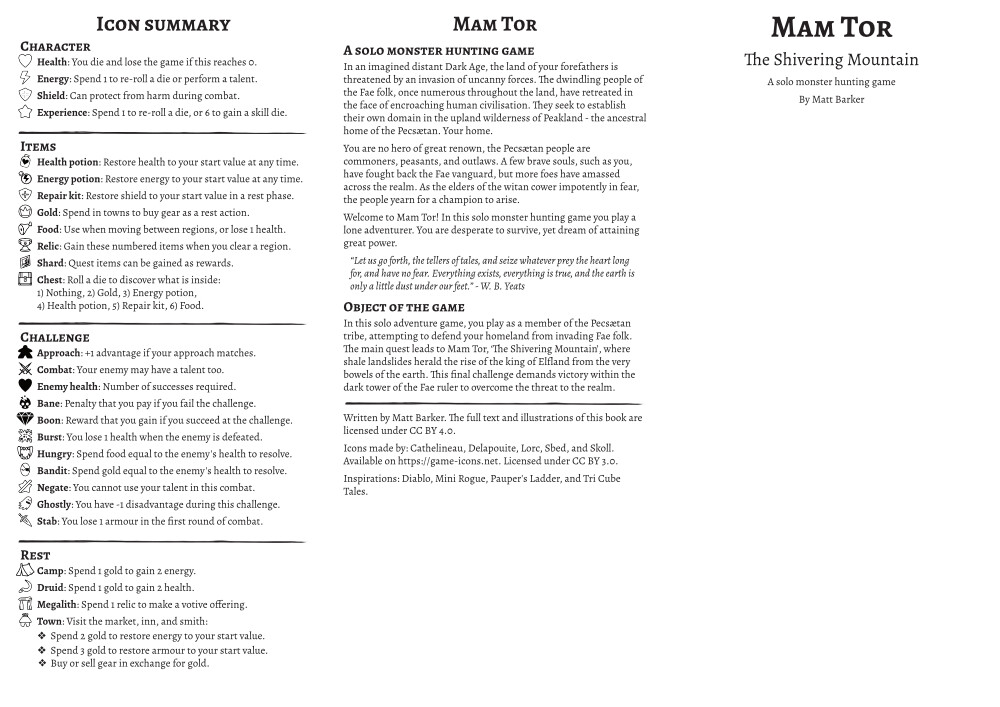
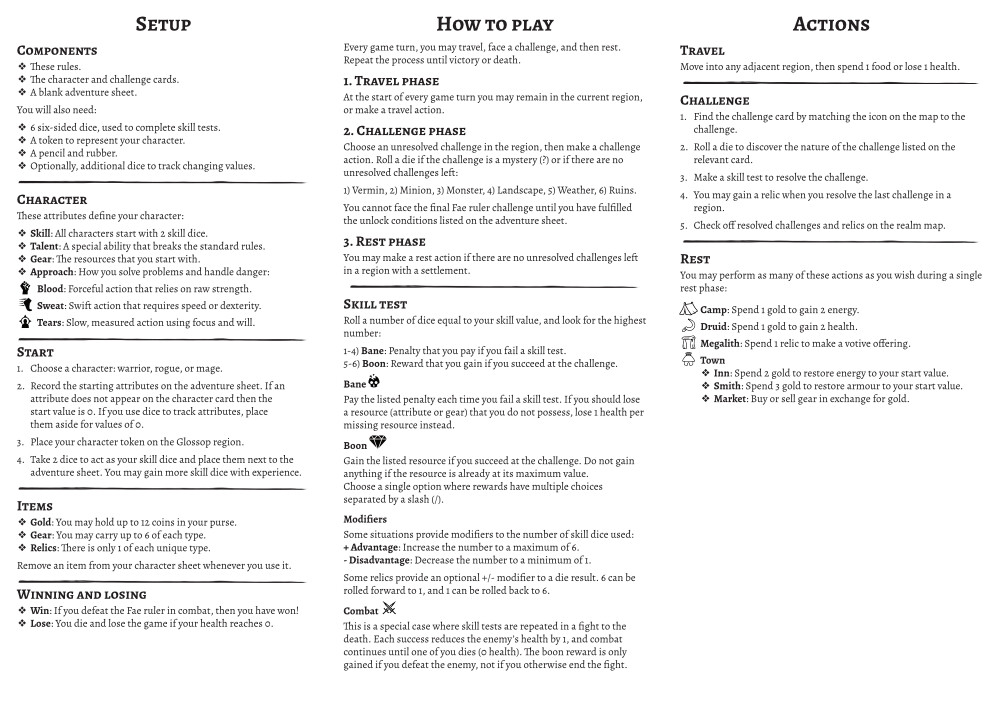
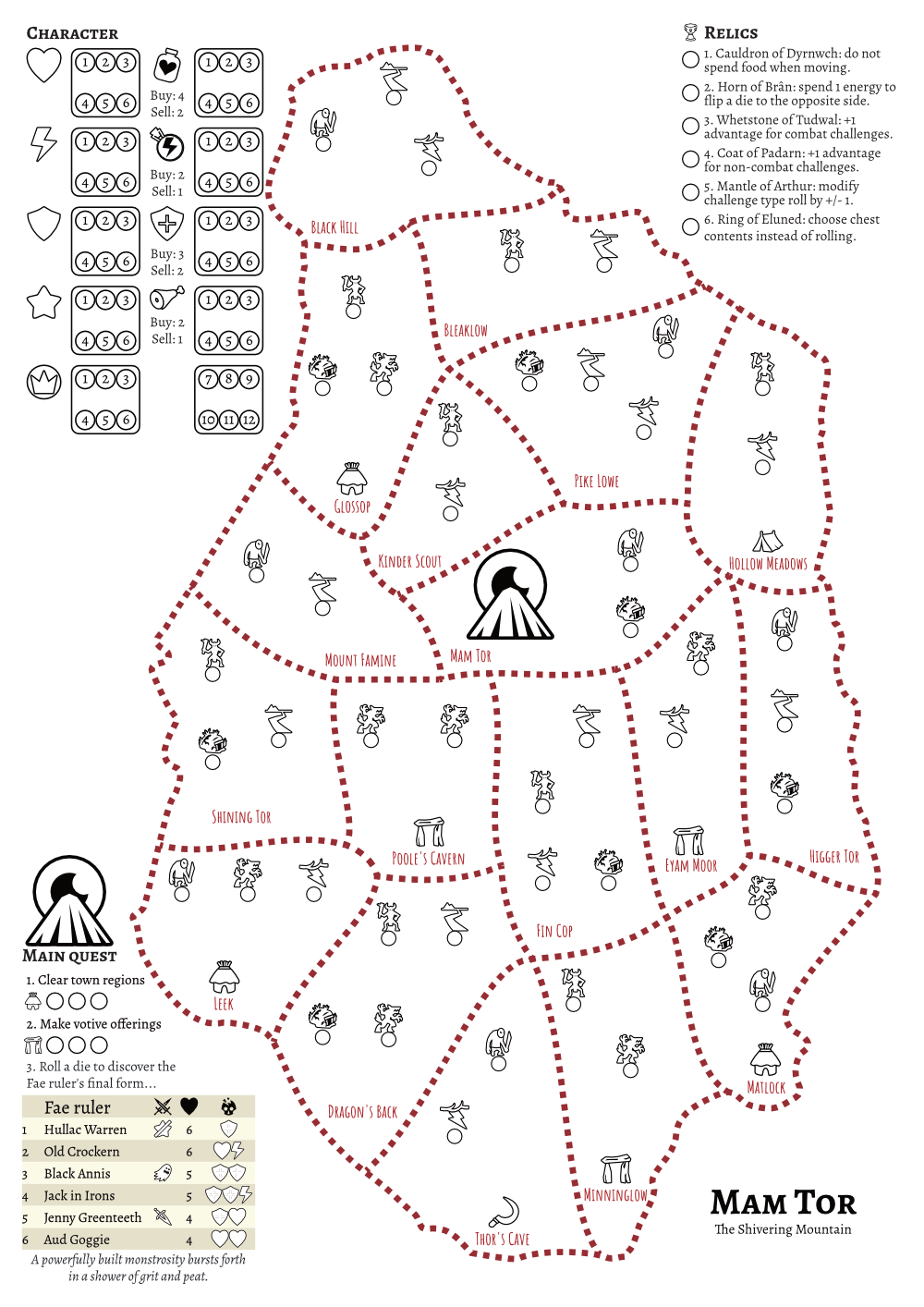
Inspired by tri-fold pamphlets in my collection, I have worked out this layout:

Page 1

Column 1 Column 2 Column 3
Icon list Back blurb Title page

Page 2

Column 1 Column 2 Column 3
Setup Phases Actions

Here is an example:


This looks confusing at first, but when printed out in landscape mode on A4 paper it will give me a compact folded leaflet.

Title: include a picture.
Blurb: the lore and aim of the game.
Icons: when the cover is opened this will be the first thing visible.

Still to do:

  • Make up some better talents for the enemy.
  • Refine the combat rules to make the turn sequence clearer.
  • Add rules for fleeing combat.

Still to think about:

  • Does the game need a magic system? Or are the magic relics sufficient?
  • Can I fit in multiple player talents to help with character progression? At the moment the progression is limited to skill level and loot.
  • Should there be a legacy element such as unlocked achievements?

There is a bit of room left on the paper, but not much so some of these ideas will have to be discarded.

Cards

Still to do:

  • Decide on the rewards (boons) and penalties (banes) for each challenge.
  • Create player talents and starting gear.
  • Draw portraits

Map

There are a few things to mention here:

Boxes

Since English speaking folk read top-left → bottom-right I have prioritised the box-outs around the map in this order:

  1. Top left: Character sheet - this has room for 16 mm dice so I can use either the check boxes or D6s to track stats.
  2. Top right: Loot - this is based on a truncated version of the late-medieval Thirteen Treasures of the Island of Britain.
  3. Bottom left: Quests - this section will not be used as frequently so is deprioritised.
  4. Bottom right: Game title - no in-game function so it comes last.

Check boxes

The challenges, relics, and quest conditions all have hollow circles so they can be checked off as each item is completed. Keeping these items all on the same piece of paper as the character sheet means players only need to re-print one page for each new game.

Still to do:

  • Create side quests.
  • Include the hand-drawn background.
  • Find a better icon for the main quest. All the icons so far are from Game-icons.net, but I may have to draw my own.
2 Likes

I’ll put my vote in for Ere Be Boggarts :slight_smile:

2 Likes

Oh, I’ll definitely use it at some point. I didn’t want my first game to be my magnum opus anyway. So maybe Ere Be Boggarts could be a full RPG, or tower defence, or a dungeon crawl …

Thanks for taking the time to read.

1 Like

You’ve put a lot of wonderful work into this. I love watching your process. Please continue to share your inspiration.

1 Like

Thanks. I had quite a flurry of work, but was then laid low by a back injury.
I’ve been away from the gaming table and my desk for about three weeks now.
Slowly getting back to it today though, with a few sketches done.

What do goblins look like anyway?

Previously I summarised the evolution of the orc as:
British folklore → Lord of the Rings → Dungeons & Dragons → Warhammer

…with a personal preference for folkloric goblins.

But what do they actually look like?

Folklore / fairy tales

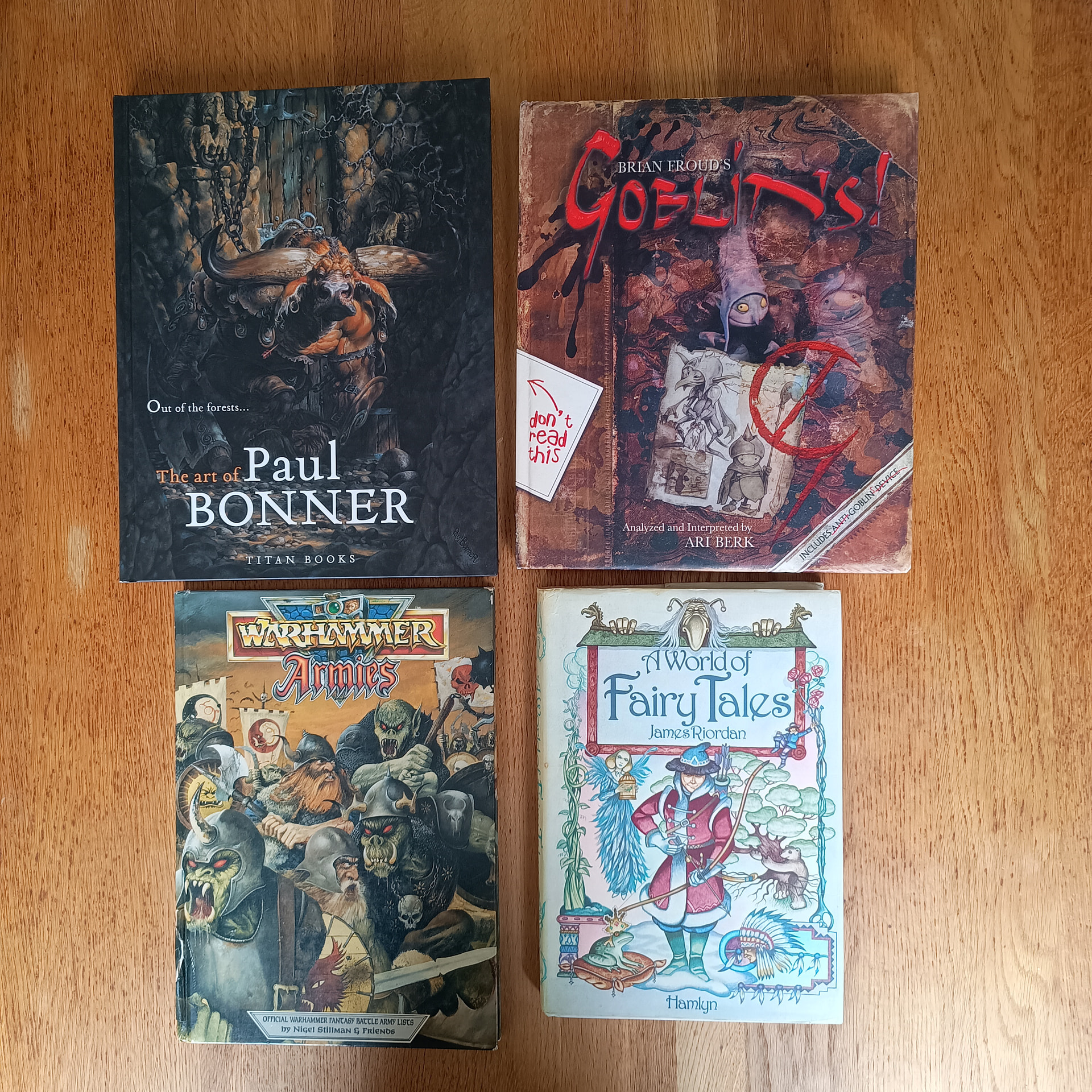
(Arthur Rackham, Brian Froud, early Paul Bonner)
Slender bodies, massive heads. This can make them look tiny in stature due to the babyish over-sized heads. I loved these illustrators at an early age and they remain a favourite.

Early Warhammer

(Rus Nicholson, Gary Chalk, Paul Bonner again)
Staying with the gangly limbs and large heads, but this time with extra bite and sharp knives.
Another favourite.

Later Warhammer / World of Warcraft

Muscle bound, bright green. My least favourite, they do nothing for me.

Peter Jackson’s Lord of the Rings films

I appreciate the effort to re-design the orc, but they are not how I imagine orcs and goblins.

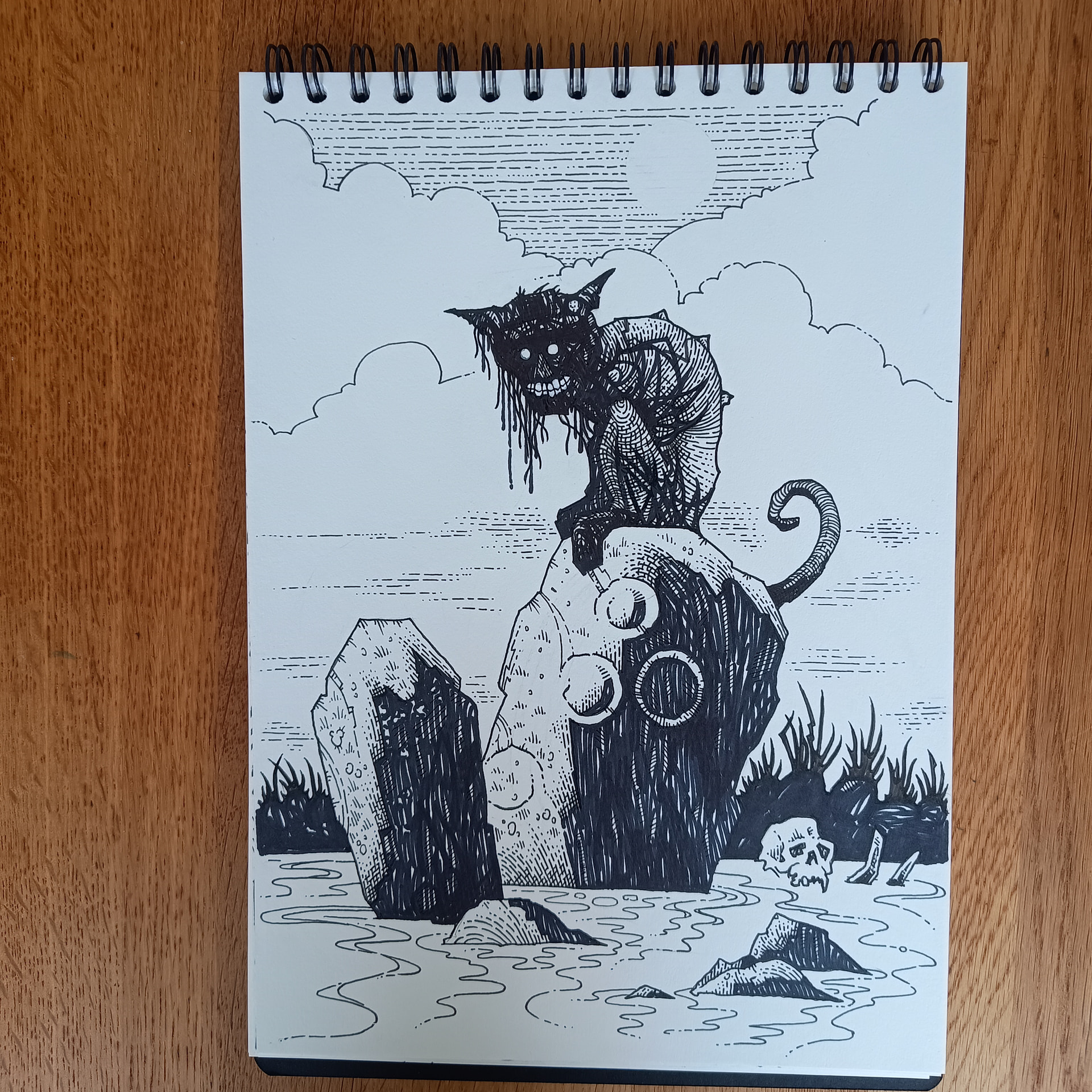
My first effort

I had a thought that if goblins are not the same as us, but are similar; then maybe they are simian - anthropoid means “human-like” after all.

The face of the first attempt went a bit wrong so I coloured it in black. I don’t mind it, but it doesn’t look like a goblin either. Since a few of the minion names will be unfamiliar to some players, I don’t want the illustration to be unfamiliar too. Originality can be over-rated - especially in a minimal game where a simple picture can be used to convey an idea. Familiar folklore archetypes such as trolls, giants, or witches can be useful here.

(the stone is heavily indebted to Hell Boy comics)

Warhammer

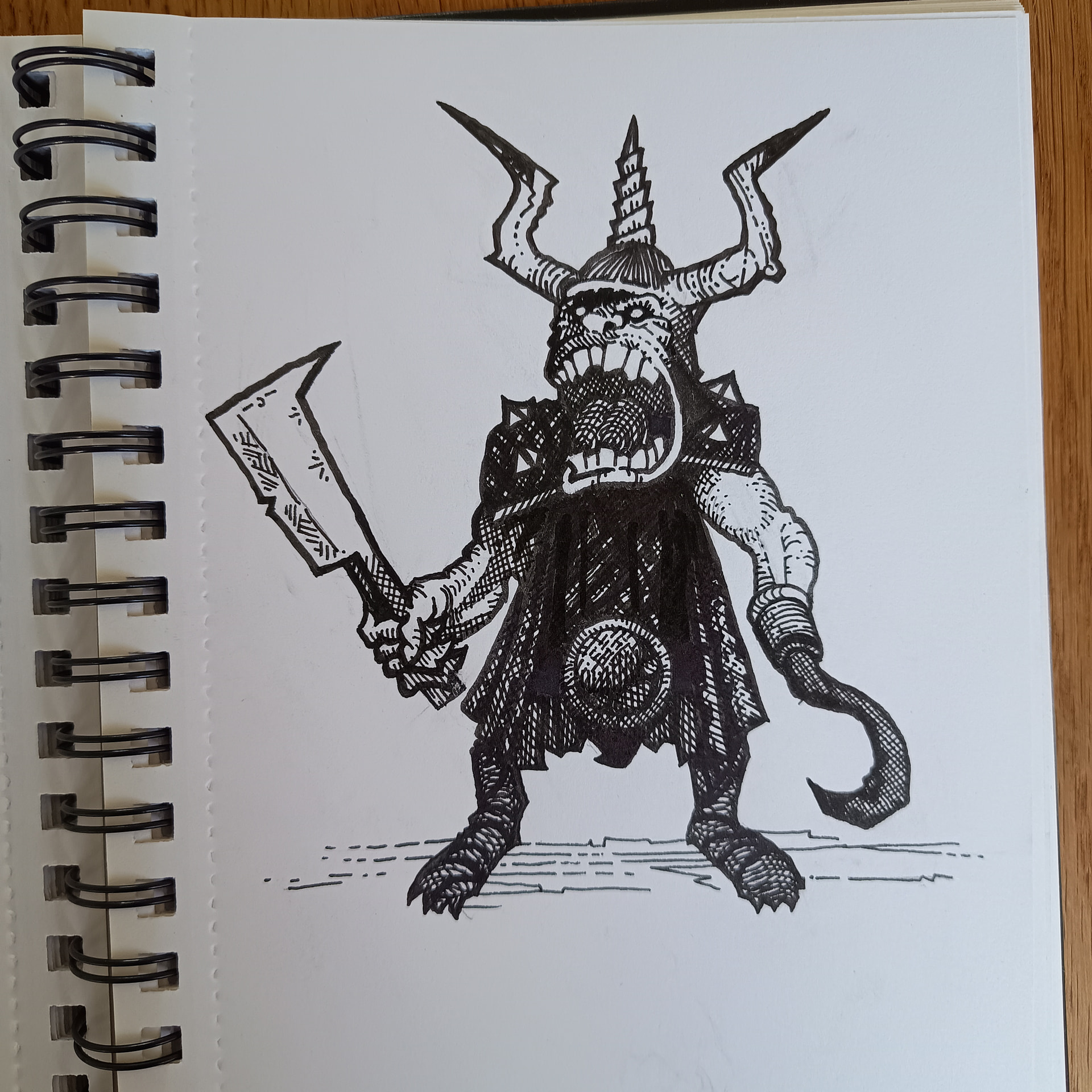
My next attempt was to draw a Warhammer mini. On reflection I can’t really use drawings of Games Workshop models in a published game, but that’s OK because I don’t really like this one anyway. The head looks correct in model form, but waaaay too big when drawn. Also - I am terrible at drawing hands, so had to replace one with a hook :slight_smile:

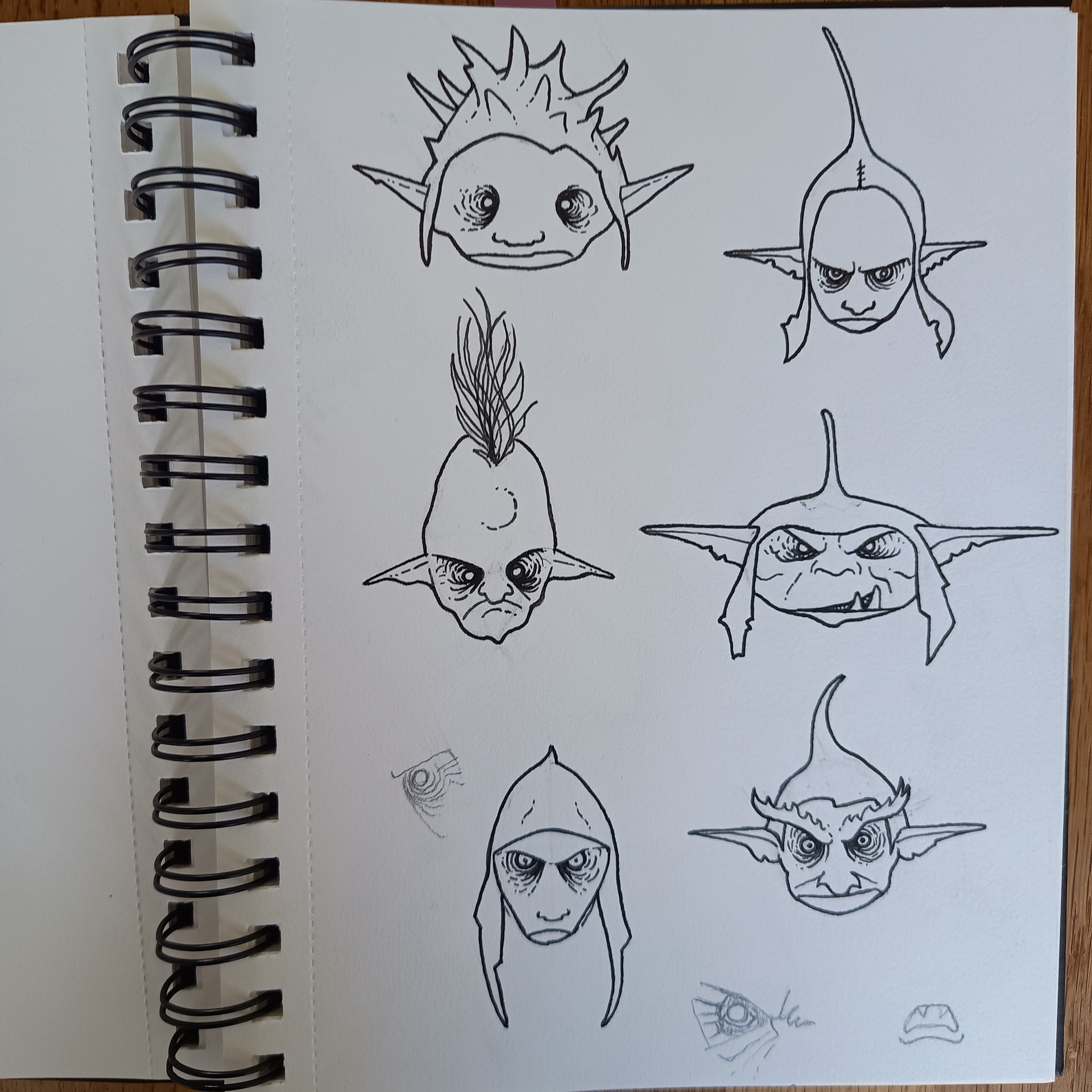
Brian Froud

Froudian? Froudesque? Froudish?

Anyway, I quite like these, but I haven’t yet worked out what to do for the bodies.

4 Likes