Loren's Projects

Hi All!

It has been a while since I’ve participated in the group. I had a child 6 months ago and the world is becoming a very strange place indeed! That being said, I wanted to share this card driven dungeon crawler I’ve been working on forever. It is just a rulebook right now but I’m pretty excited to be working on it.

I welcome questions, thoughts, concerns. A lot of the design of this game was inspired by all of you, and our shared interest:

This rulebook pretty much outlines how the game is played. The cards themselves are slower going. Could it be a CCG? Could it be a living card game? I don’t know! All I do know is that I wanted it to have a small footprint, some really neat elegant mechanics, to be fully solo-able, and capture the feeling of dread and exploration I so love about dungeon crawlers.

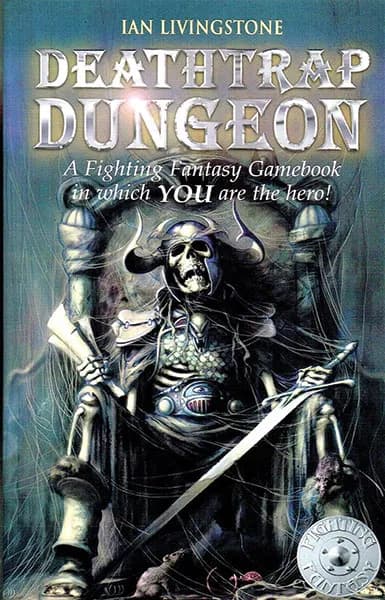
It is named after a classic Fighting Fantasy Book:

(Warning! I used Chat GPT to help me formulate my thoughts into a concise rulebook, and sometimes it shows… I simply don’t have time right now to work too much on it and wanted something that was clear enough to share with my friends. So if there are stupid A.I. examples, please don’t beat me up about it.)

5 Likes

Hi, I love this idea and Deathtrap Dungeon was and still is one of my favourite game books! I’ll read through your rules later but, congratulations on getting this far and for taking your time doing so. Folks sometimes design games and throw them out there without proper playtesting and proofing and I have a few games full of holes and grammatical errors that teallly hinder the playing experience. So my advice is, take your time, make it as good as you can and then let others tear it to pieces!:joy:… It works for me! It’s sometimes frustrating but in the end it’s well worth the pain!

4 Likes

Thanks Craig! It means so much to get feedback from a designer like you!

I used to be pretty hard on myself for not producing something even though I’ve been jumping between projects for a long time, but now I just enjoy the process and have tons of mechanisms and ideas to draw from, so I resonate with your advice! Having participated with this group for a while, I understand the importance of quality rules and clarity in design.

3 Likes

I decided to change the name of this post to “Loren’s Projects” rather than spam the group with a whole bunch of different posts. Thanks again for the time and attention!

Next up is a modification of the design of deck trap dungeon, simplifying it, making it more fun for me… I took a lot of ideas from it and plopped them into something else I was working on called “Into the Fray”

2 Likes

Hi All!

Every look at an Advent Calendar and think “those are dungeon doors?”

Here is an idea I’ve been toying with. I call it Dungeon Adventure as it’s a play on the fact that it’s basically a dungeon crawler advent calendar.

I intend it to be solo-able, or semi-cooperative, or cooperative. Basically you open little boxes and see what’s inside given a clever seeding mechanism, then collect cards in a certain way that makes cheating very hard.

Hidden movement!!!

It’s still very much in it’s infancy, but partially inspired by Dungeon Drop, sort of a kids game. Please take a look. Chime in! Any ideas of how to introduce interesting mechanics that still keeps the integrity of the rules?

4 Likes

Oakbound Studio did a dungeon advent calendar last Christmas. The advent doors become the dungeon doors and the components (dice, minis) were behind the doors

3 Likes

Why I love being a part of this group. I would have never known about such a thing without people like you!

1 Like

About a year ago, I designed a deck of cards that allowed me to play Advanced Heroquest (generating the maps on graph paper).

There is a part of me that wants to create a robust dungeon crawl using poker sized cards, to use the cards themselves to generate the dungeon, where the cards include the rules and plenty of theme. But clutter, table space, and the physical limitations of cards always ran me into a wall.

Ravage: Dungeons of Plunder was one that really hit me as a great attempt at it… but the limitations of the cards really prevent what my dream like goal was:


For example, unless you have standees/miniatures, and separate sets of rules that you have to reference, by looking up stats in a book, or on another card (i.e. Heroquest)… and I really really want to somehow have everything I need being a PART of the construction of the dungeon.

A bit later I stumbled upon these 3"x3" cards:


and I thought “how cool!!!” and it really got me thinking…

It is the Physical Dimensions, the tactility, and the elegant multi-purpose possibility that really excites me.

This morning I woke up after mulling over the dimensions of cards for a while and I had an idea I wanted to share, and invite collaboration if anyone deems it worthwhile:

Advanced Heroquest uses 21.5mm squares which are, a bit small. Too small to comfortably fit miniatures but ultimately is the minimum space I could imagine working with.

An American Poker card is 88.9mm. Divided by 4 and you’ve got a 22(ish)mm space. Slightly bigger than AHQ. I say 4, because the standard room size in squares for Warhammer Quest 95 was 4 squares.

The standard terrain wall for skirmish games is 50.8 mm, while the short way of the card is 63.5mm. A bit tall. However, if a board was made with 1/2 inch notches to slip a card into, you could basically treat the cards a 50.8 mm.

Meanwhile, a mini card is precisely 1/2 the length of a standard poker card. I ramble.

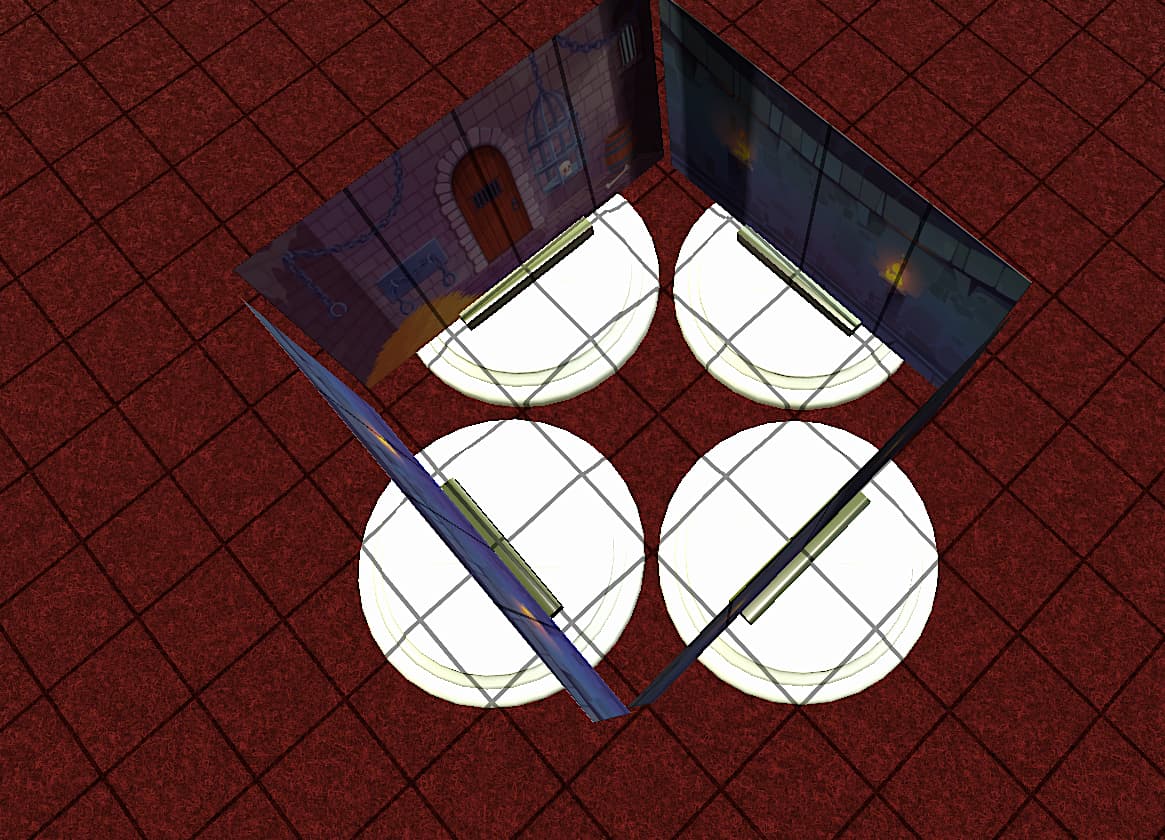
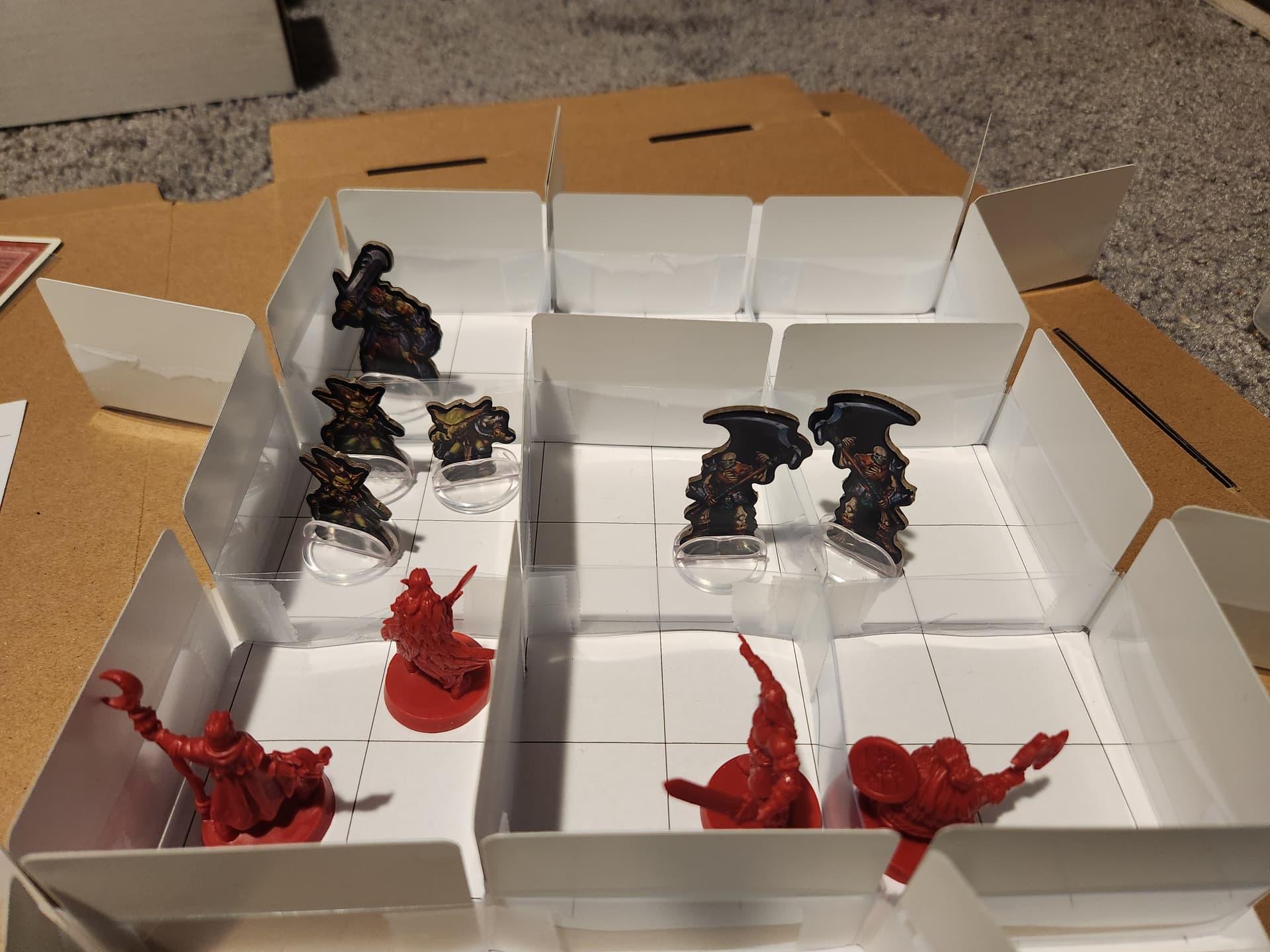
Here is what I’m thinking/working on:


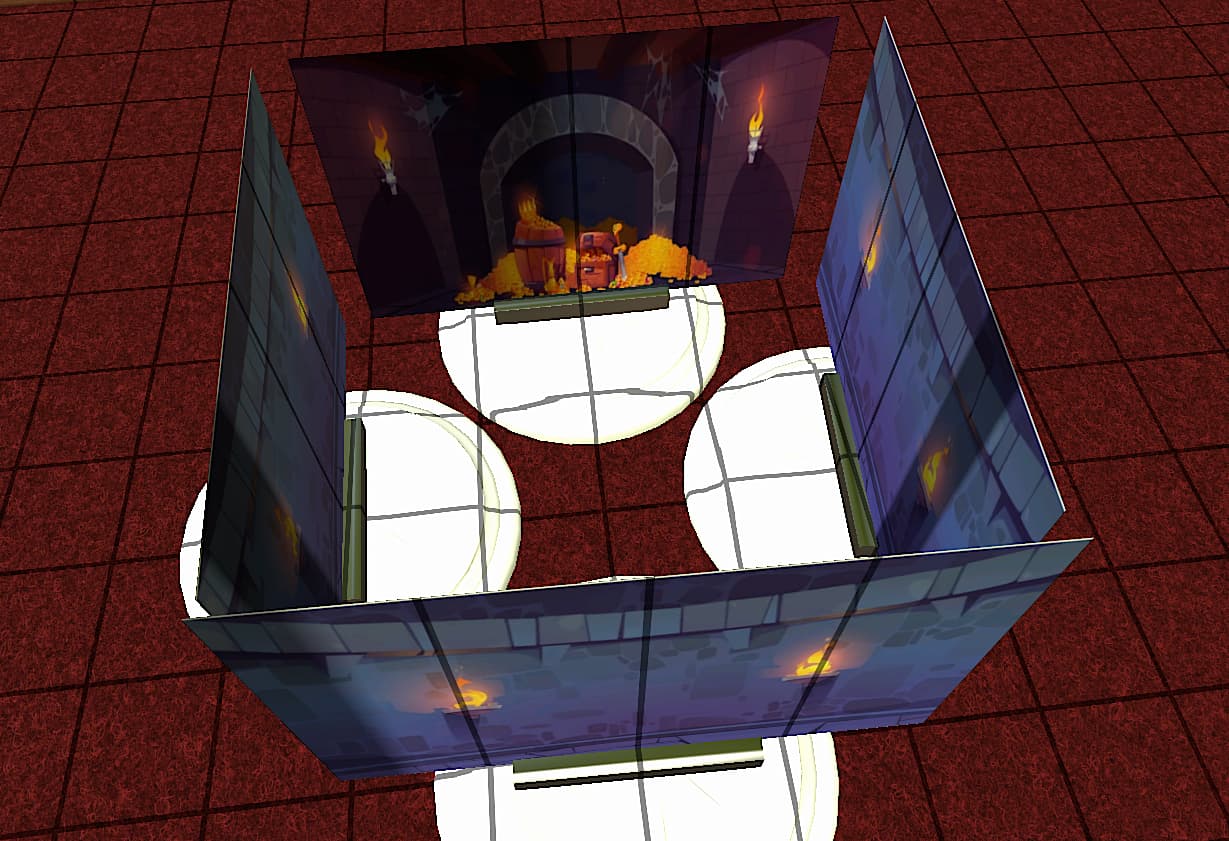
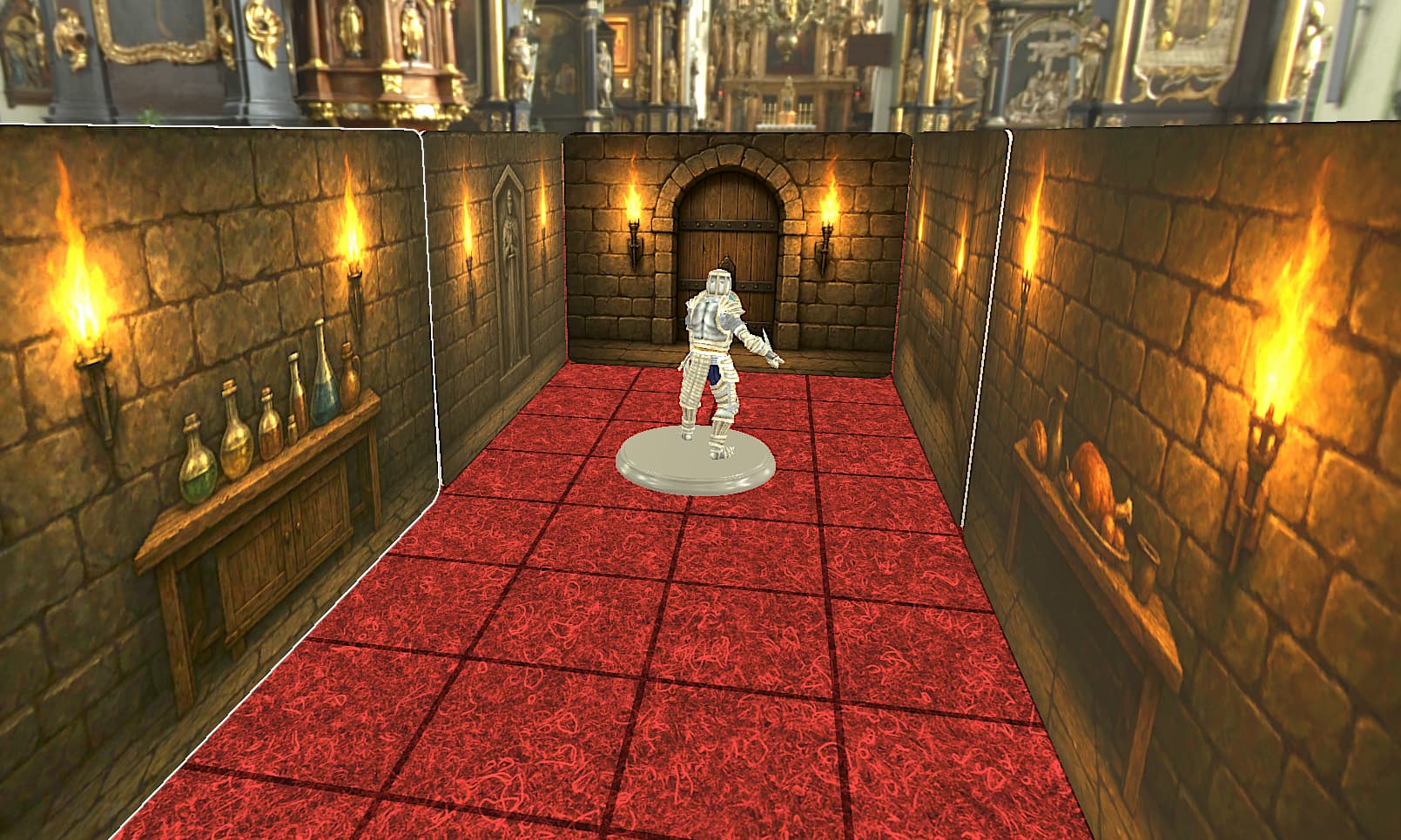
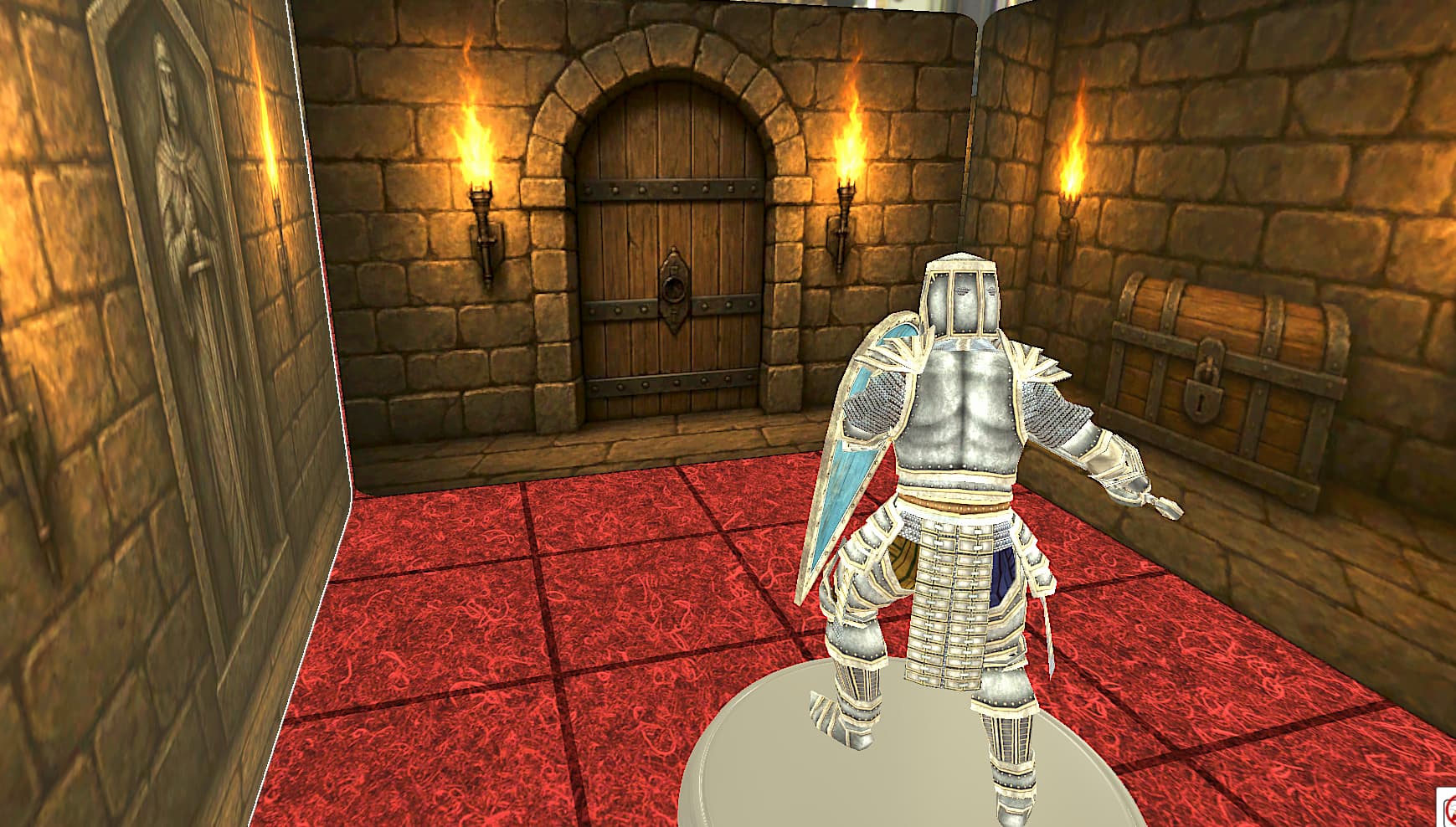
Obviously, table-top simulators limitations in quickly putting together a prototype are showing here. I tried to include the grid and show what a single room might look like. But the jhist is there.

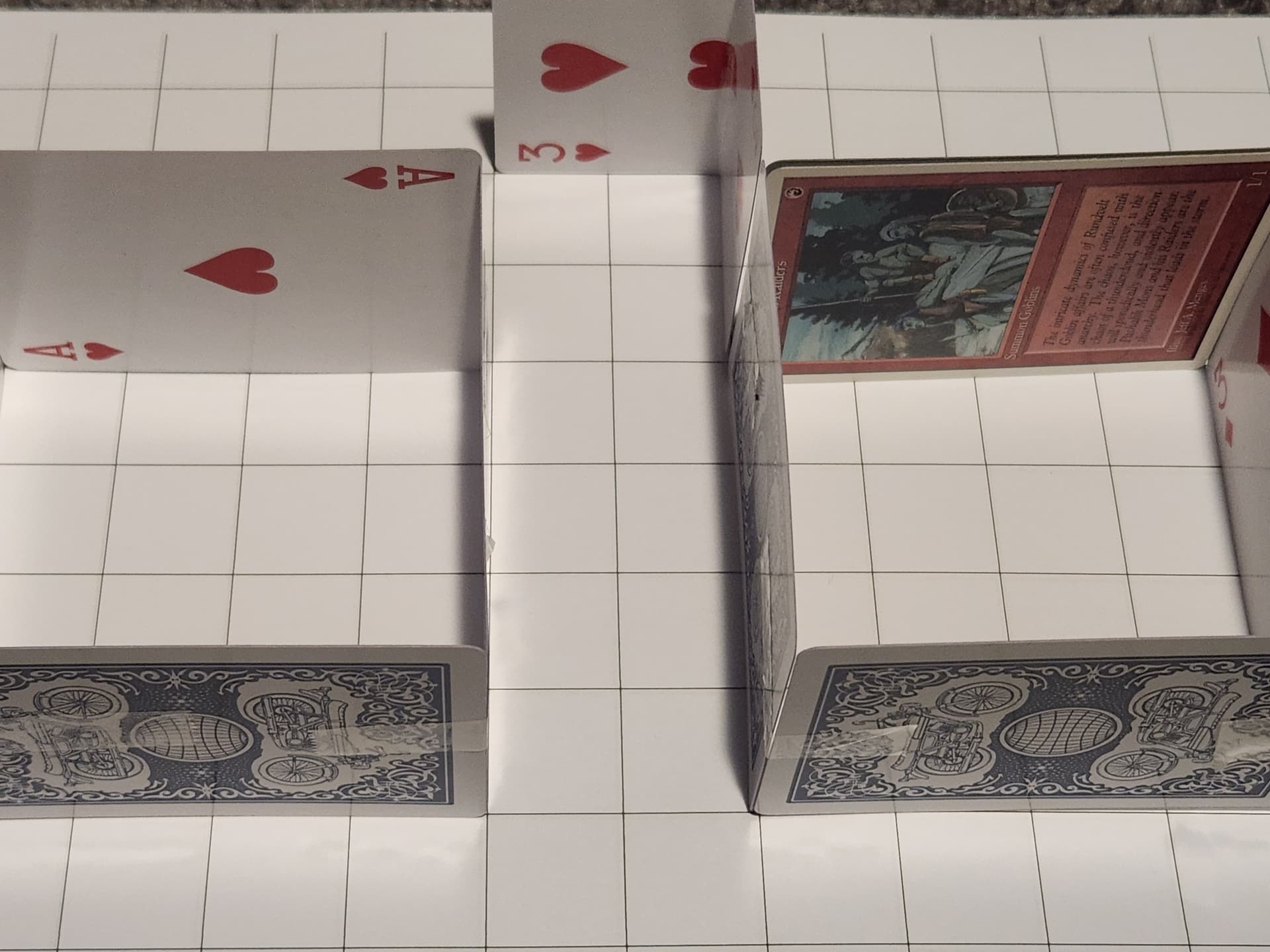
Using this method, you can, in a single 3.5"x3.5" room contain 4 cards worth of information… even 5 if you put 1 on the floor to represent some additional feature (like a magic circle, or a fountain). The “spaces” are slightly larger than AHQ and I’m sure it would be a little bit troublesome to move pieces around if the card’s weren’t secure but…

That is the idea. You can, given this orientation of poker cards, and “mini cards” Recreate any dungeon layout that you would want for AHQ… except with 4x4 rooms instead of 5x5.

You could put enemies on the cards, small tables for dungeon features (ala Axian Quest furniture) and create interesting a complex rooms with a spatial element.
1 Like


Prototyping with heroquest standees shows it’s a little tight.


But even with 2.5" walls and 1.75" corridors, you can get your fingers in without terrible trouble.


With .875" grid and a mtg card to test legability of cards within rooms.

1 Like

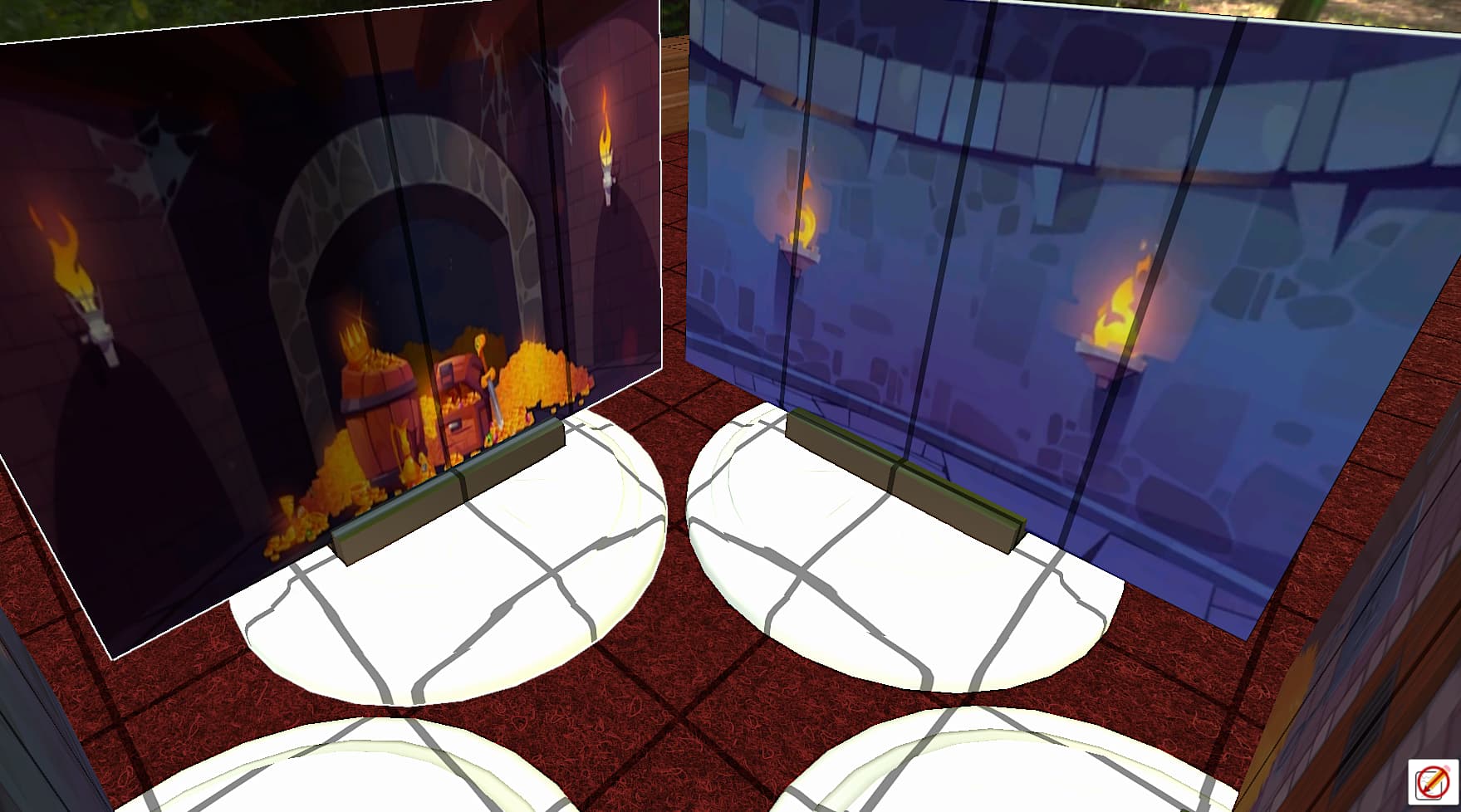
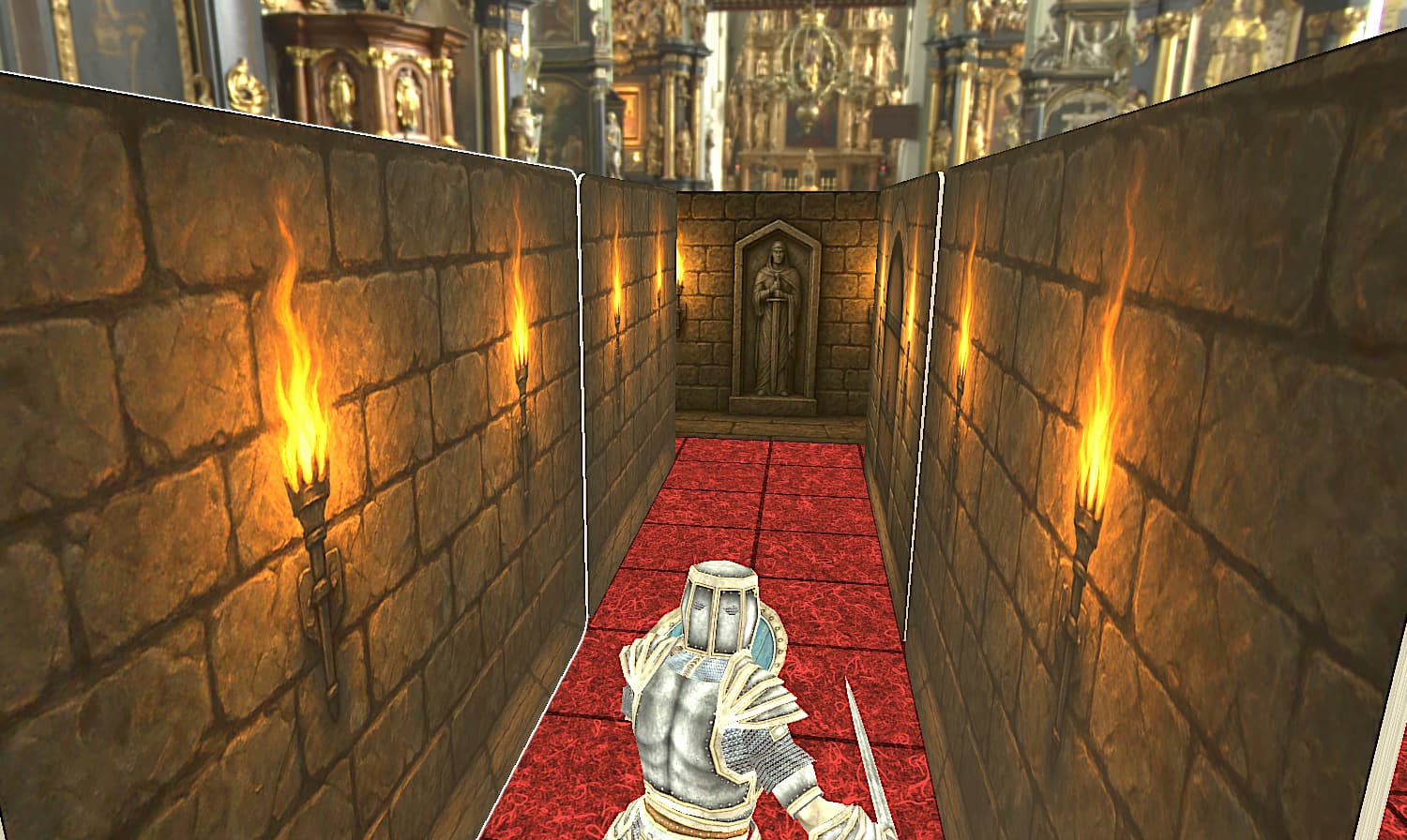
Using tabletop simulator and some generated art yields me this. Behold! Advanced Hero Quest… the CARD GAME!


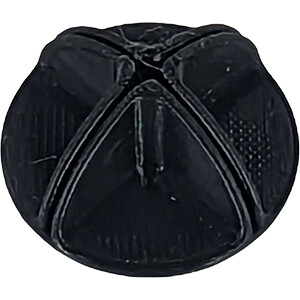
My goal here, is to expediate the dungeon generation process, using standard and 1/2 poker cards, and these little dudes from the game crafter:


As noted above. If I accept that I’m going to have little squares (slightly bigger than the original AHQ) I can use the poker cards to yield 4x4 standard rooms (basically remapping Warhammer quest 95 spacing using AHQ generation rules).

Custom minis and Standees might be required, unless I opt for more zone style movement instead of spaces. Any feedback from Warhammer 95 players???

1 Like


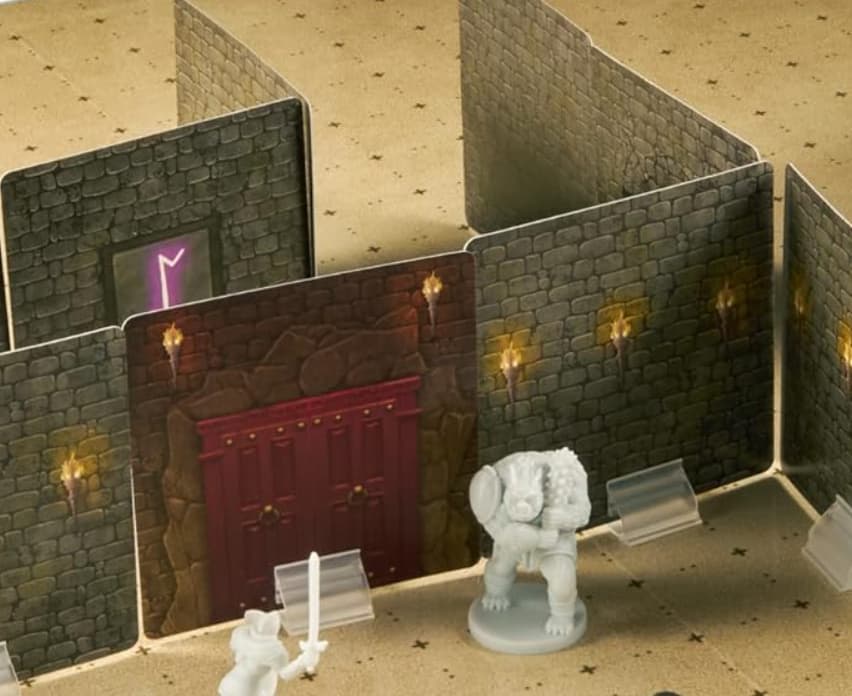
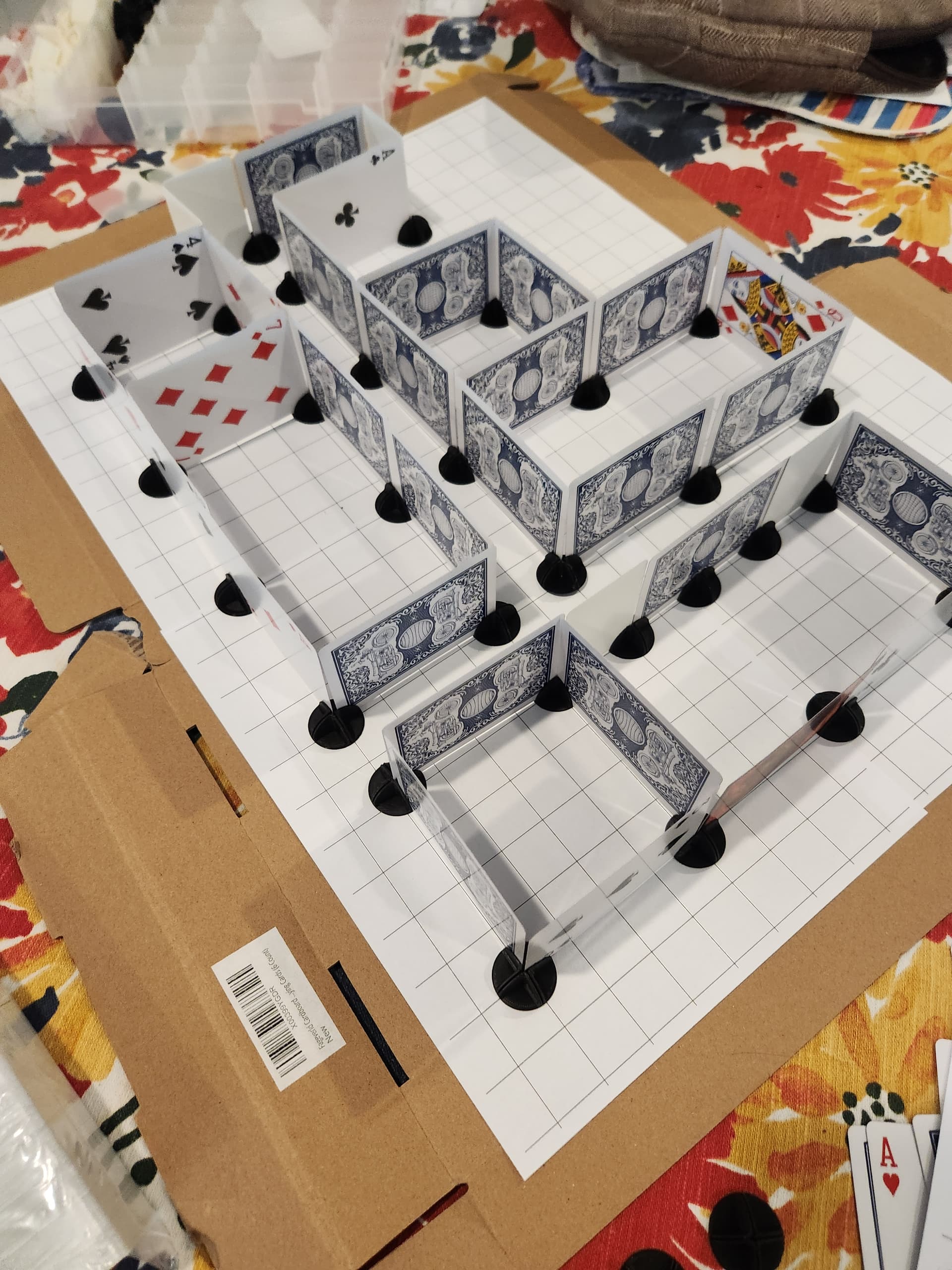
Recieved the pieces from the game crafter and overall I’m pleased with the results.

They’re 3d printed so you gotta get a knife in there to open them up better.

Handling the physicality of the components taught me a lot about the issues I might face working with a design like this.

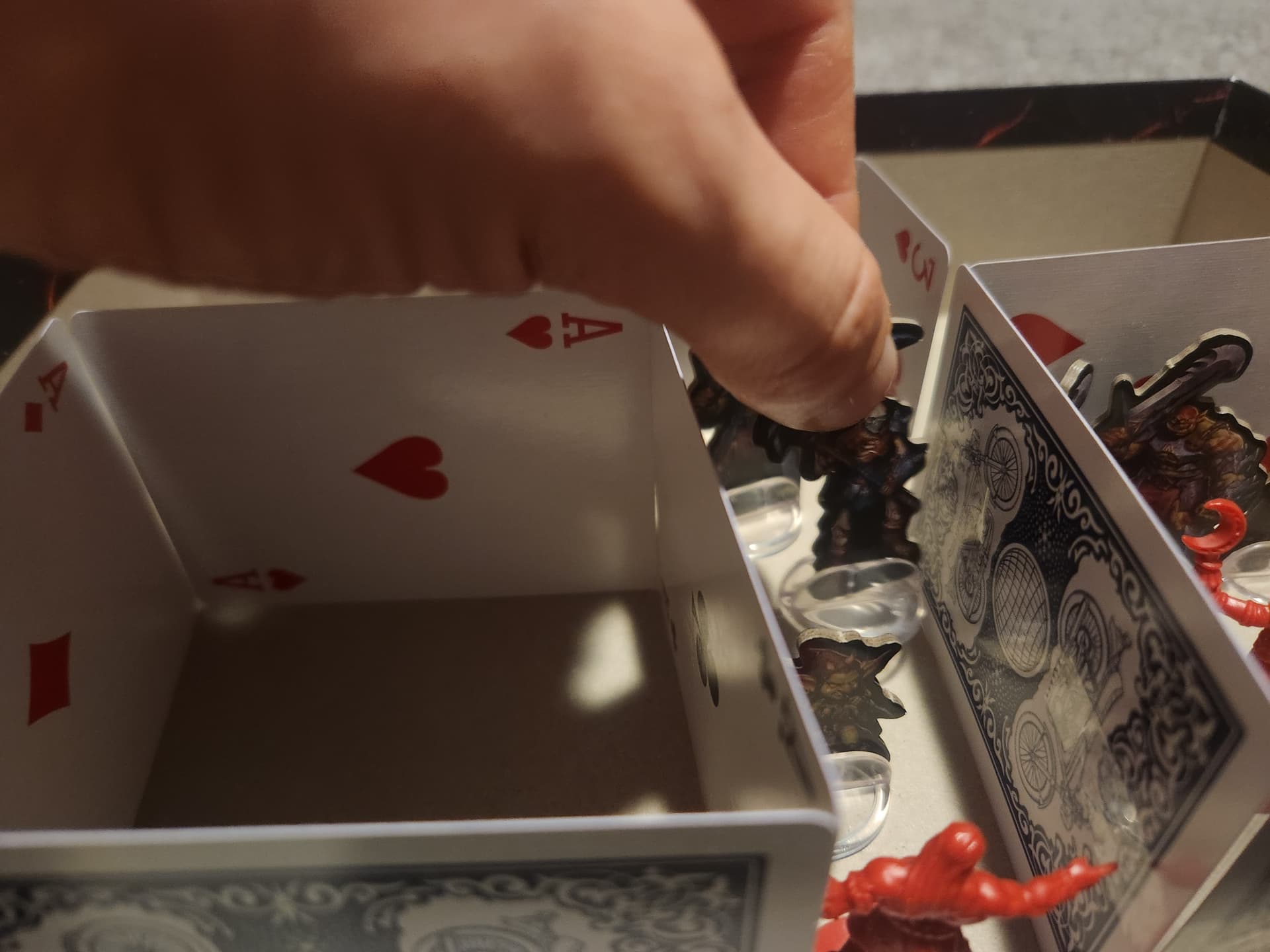
Fitting 1 card in the stands is fine, but 2 feels tight and hard to remove. If i want dungeon features on both sides of a wall, I’ll have to think about how to impliment, or if a custom component is needed, which i’d rather avoid.

Watcha think? Will it heroquest?

1 Like

After fiddling with the plastic game crafter card connectors, i got frustrated with set up time, the fact that you couldnt double up cards, and how i was damaging cards in using them.

So I started making a prototype that:

  1. Made set up easy and fast.
  2. Allowed doubling up cards.
  3. Was easy to manufacture/transport.

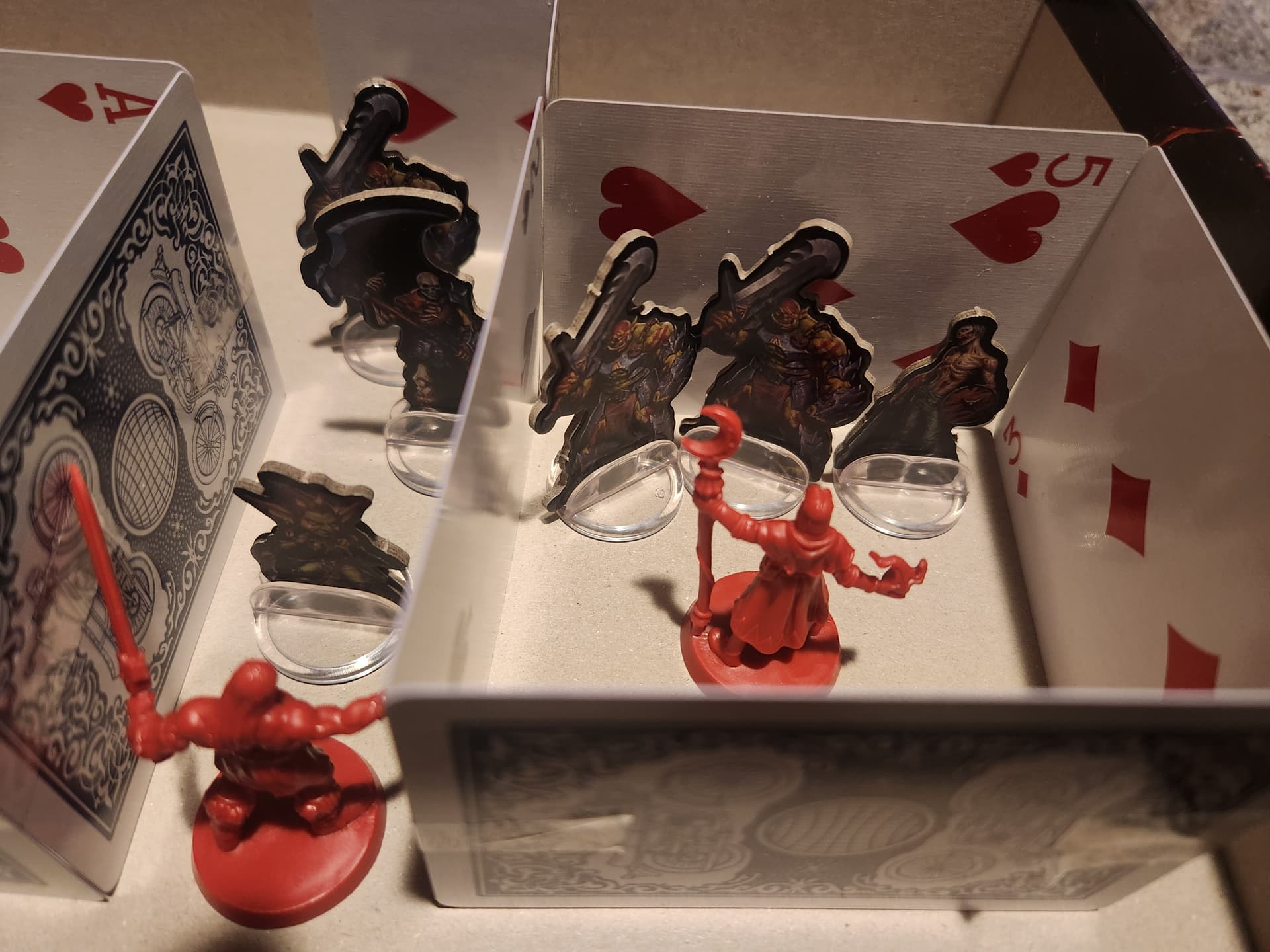
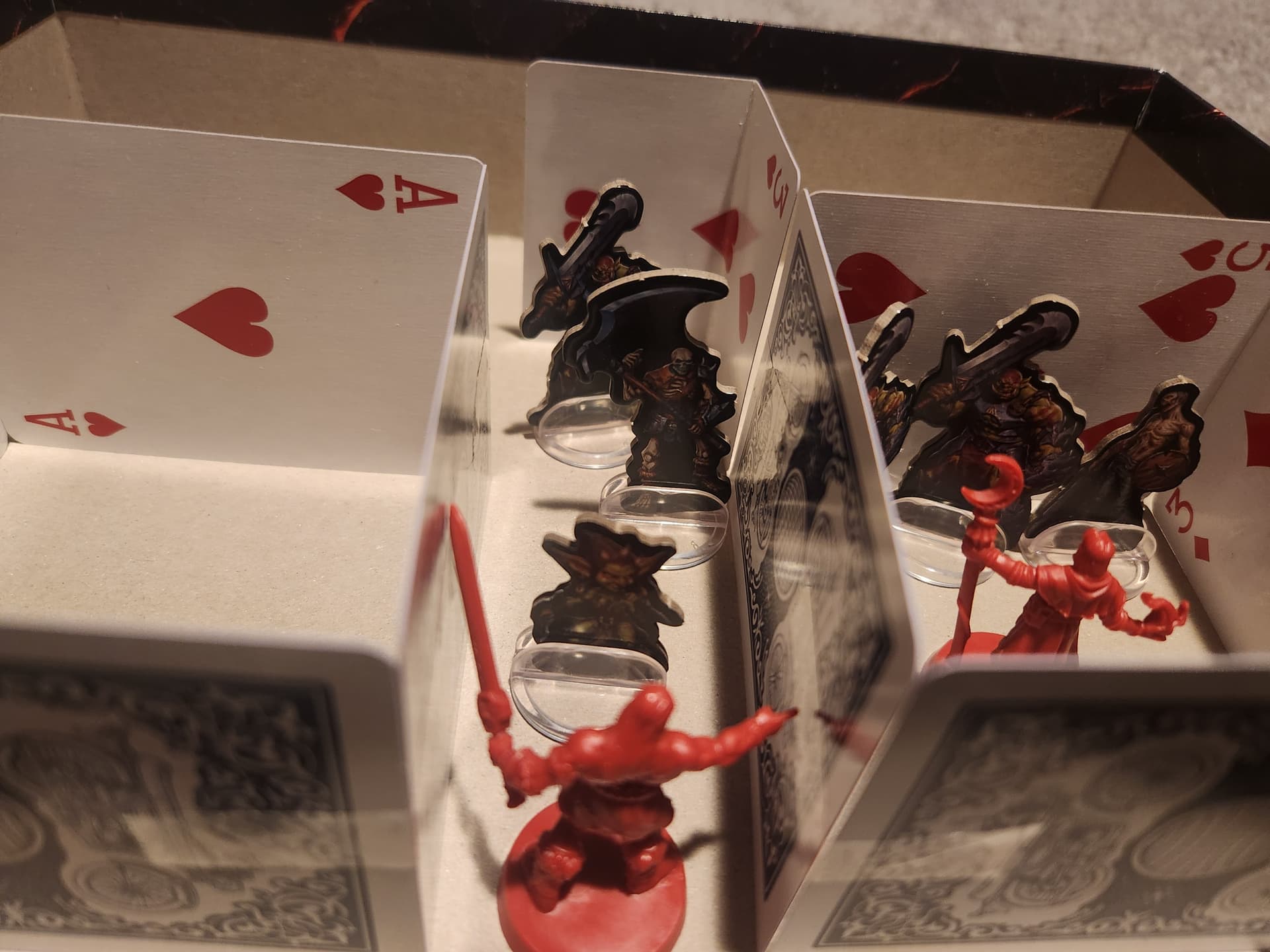
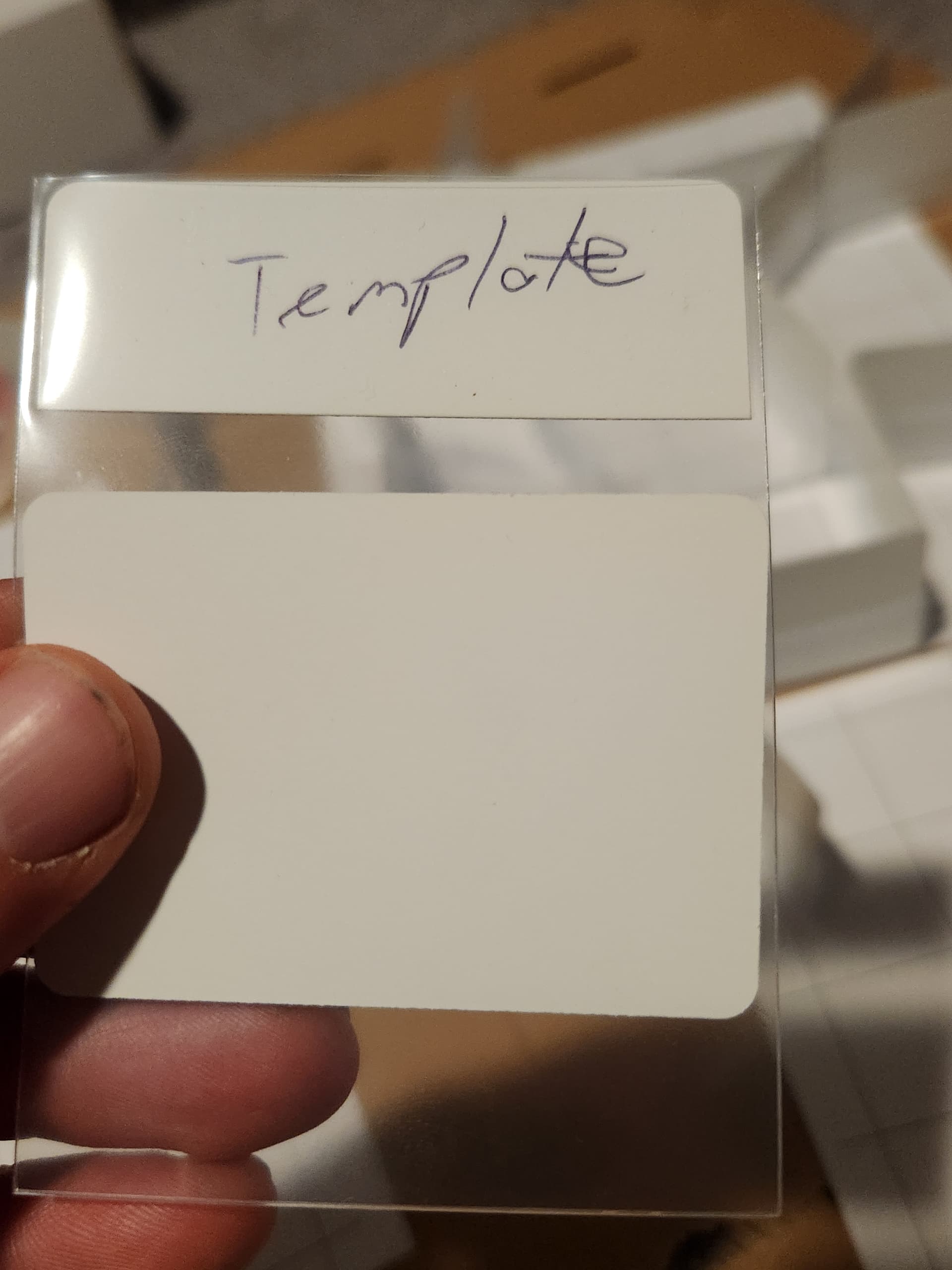
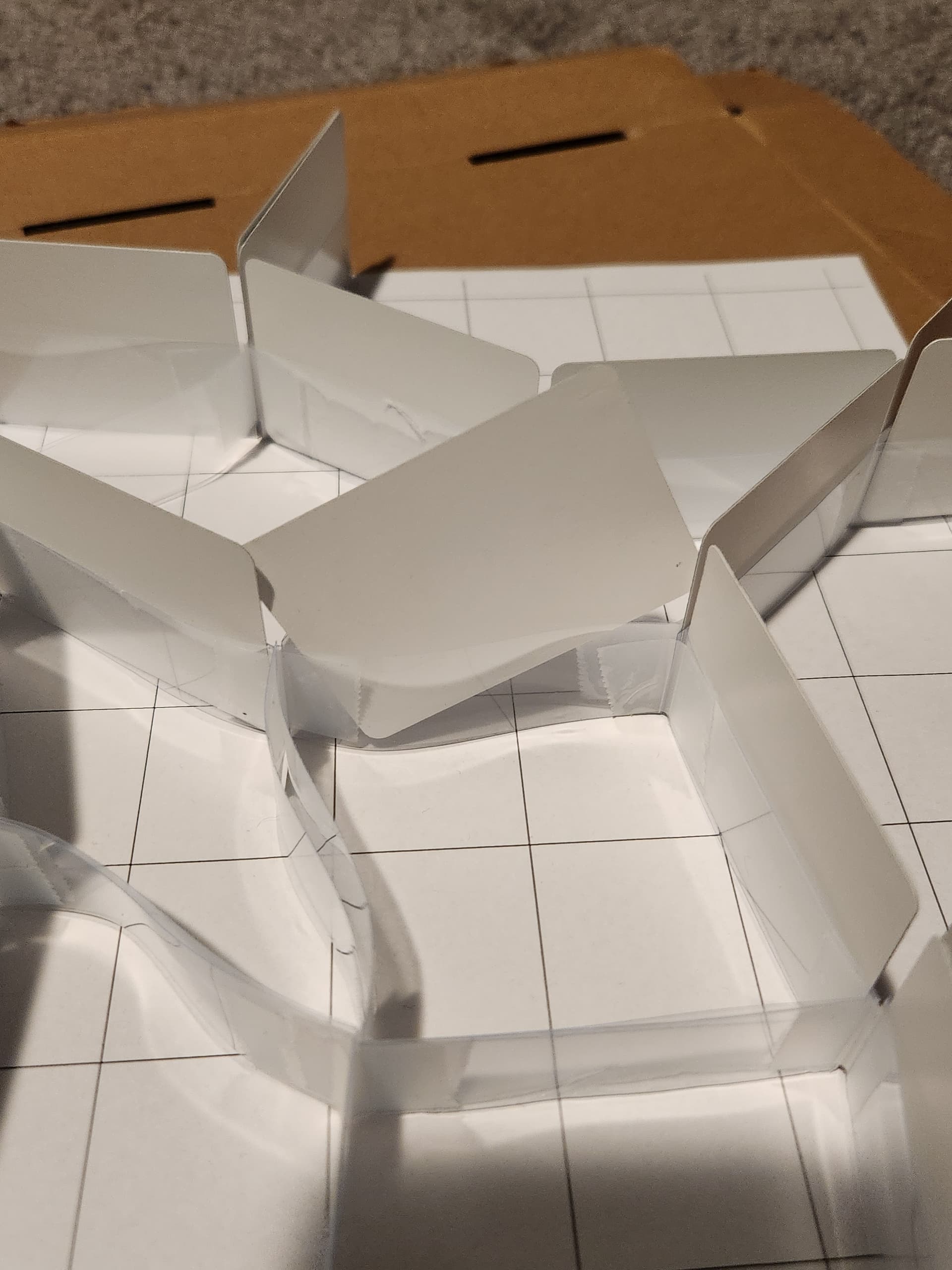
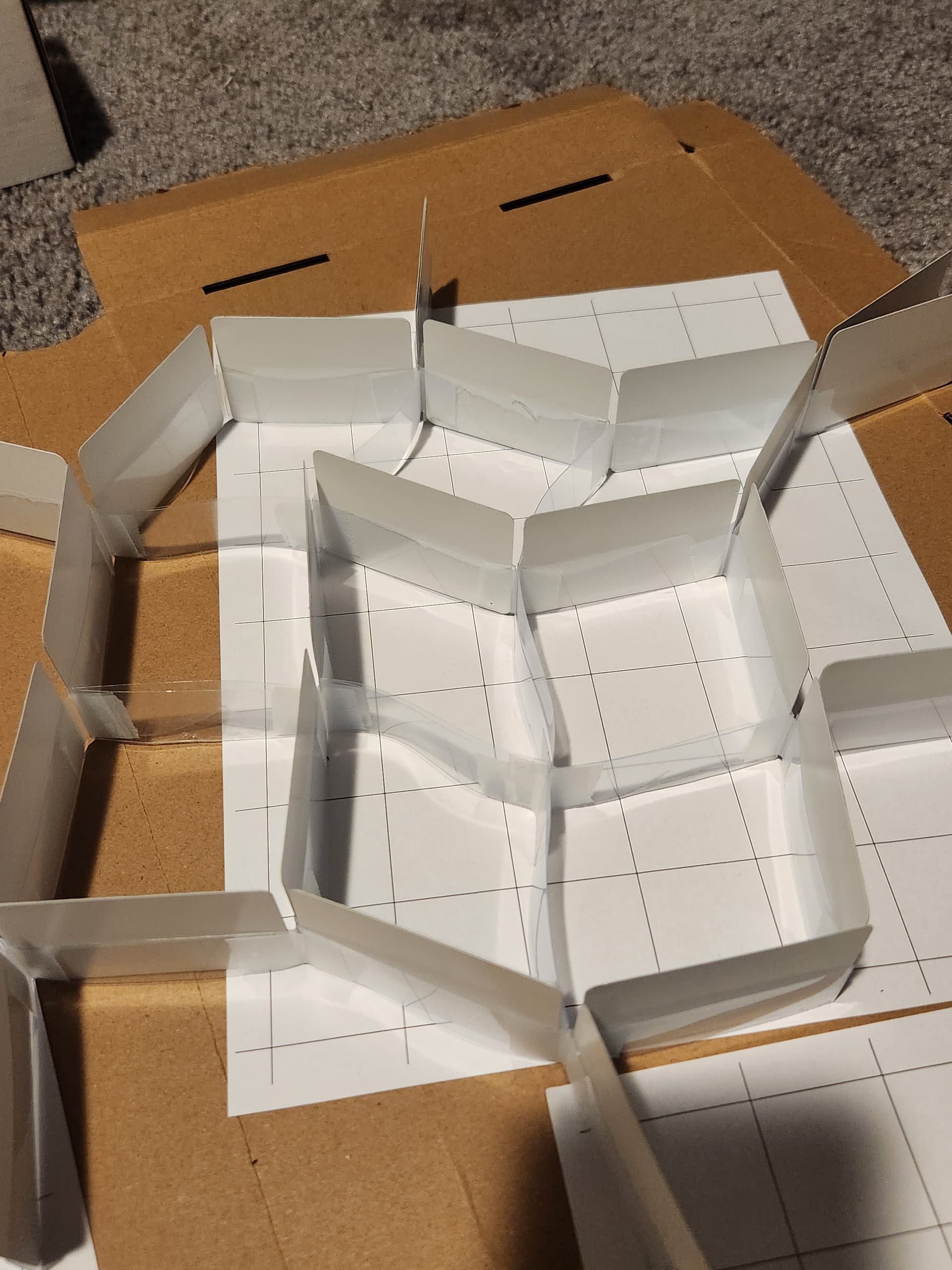
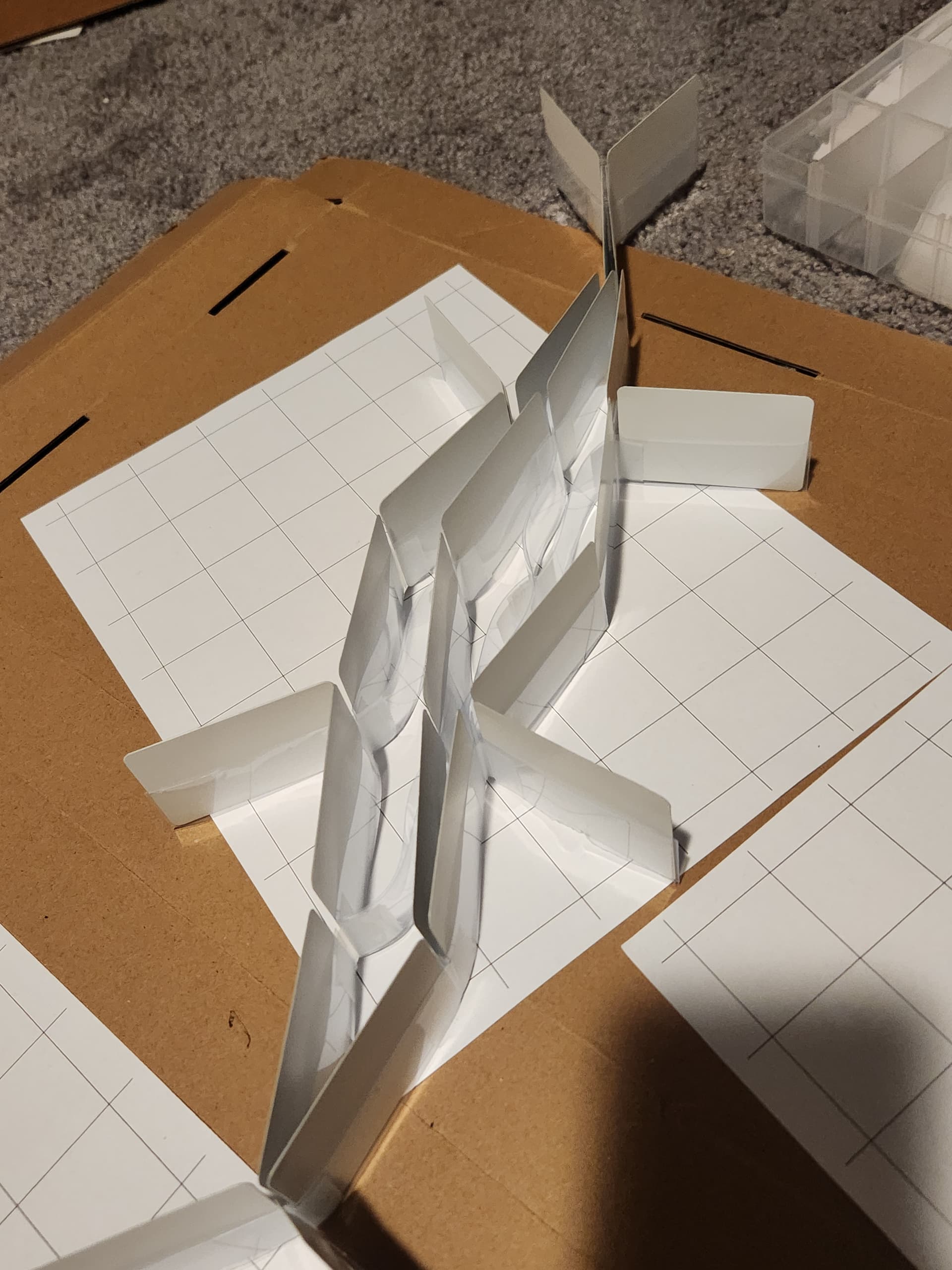
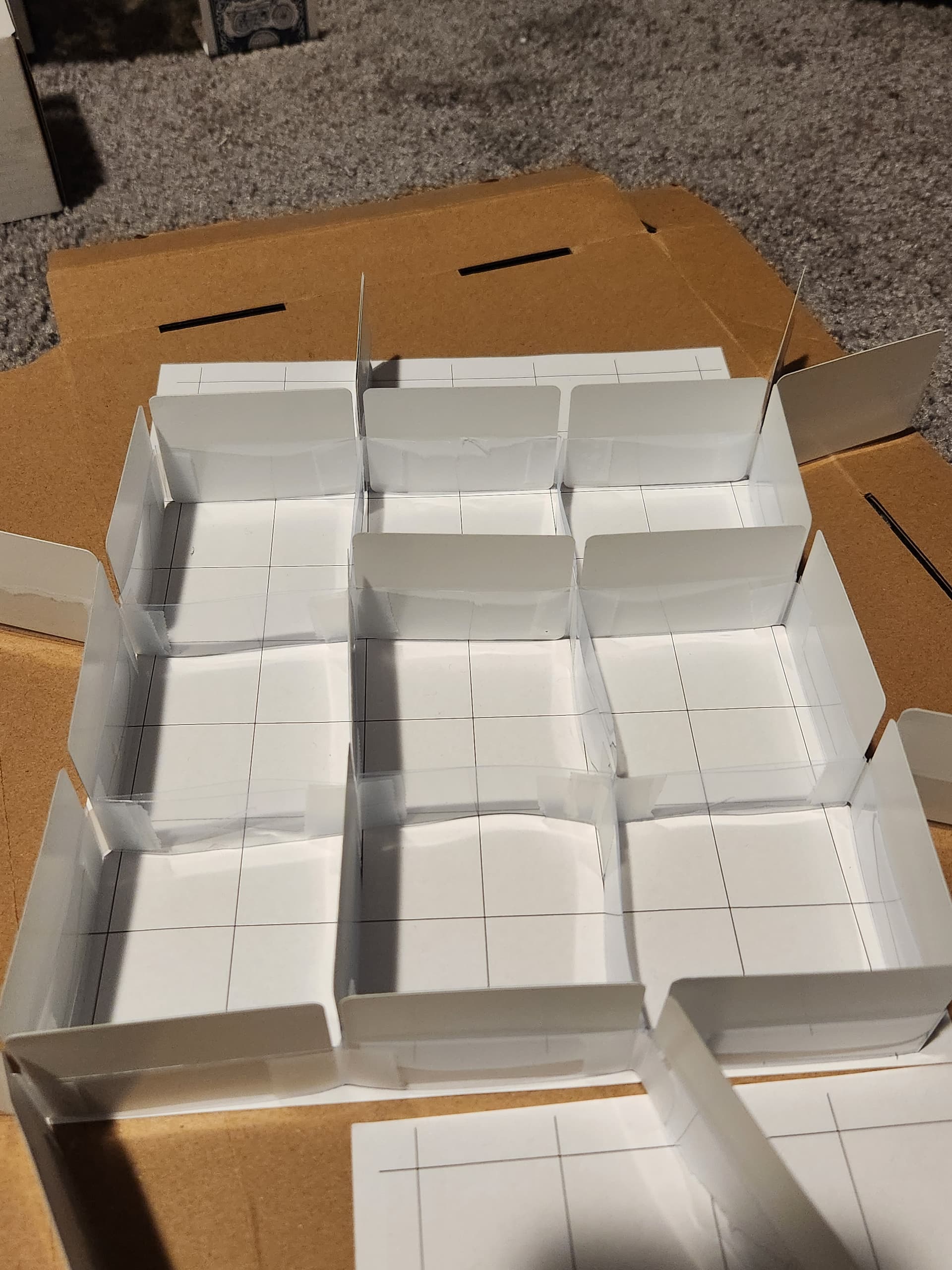
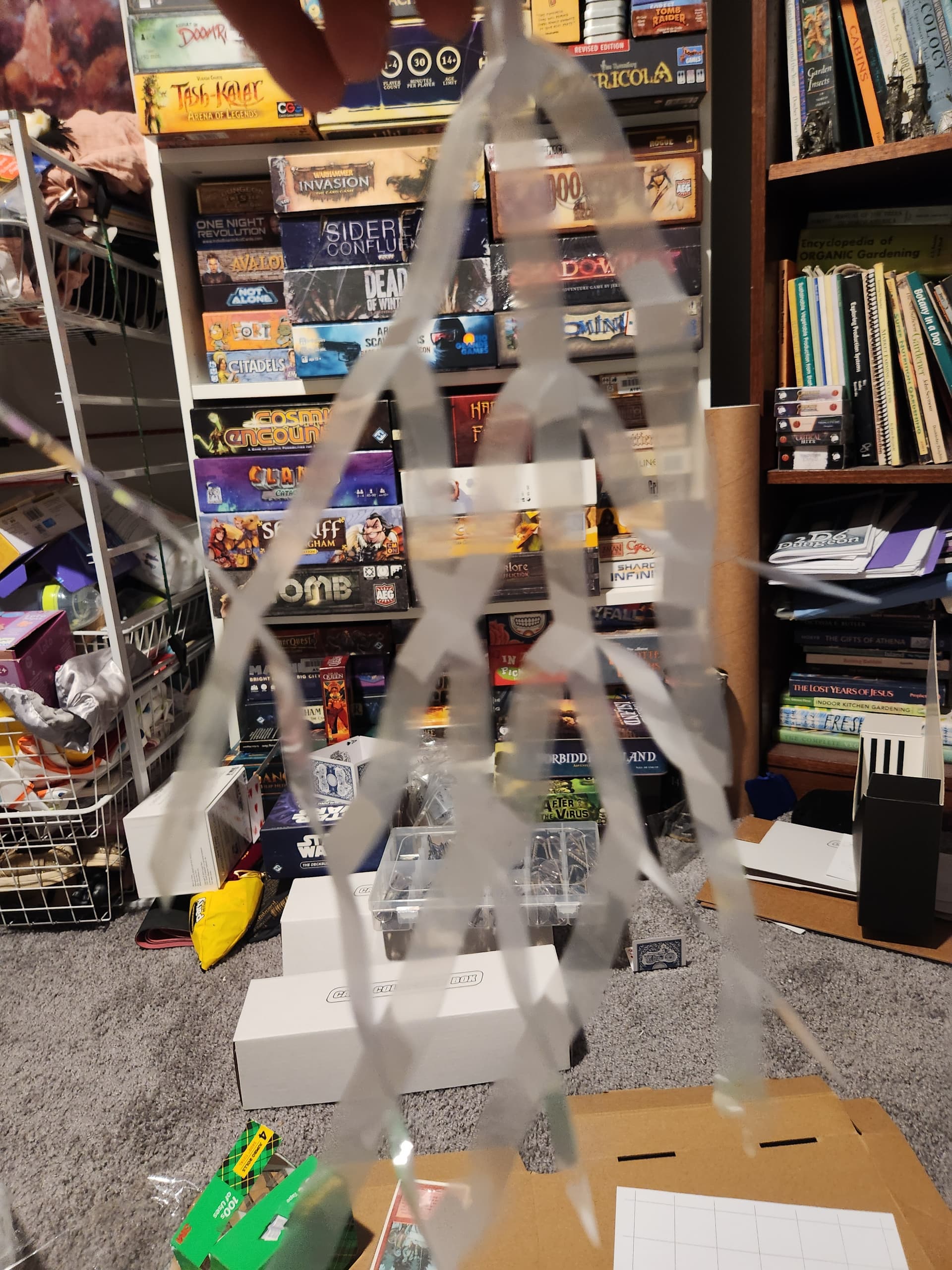
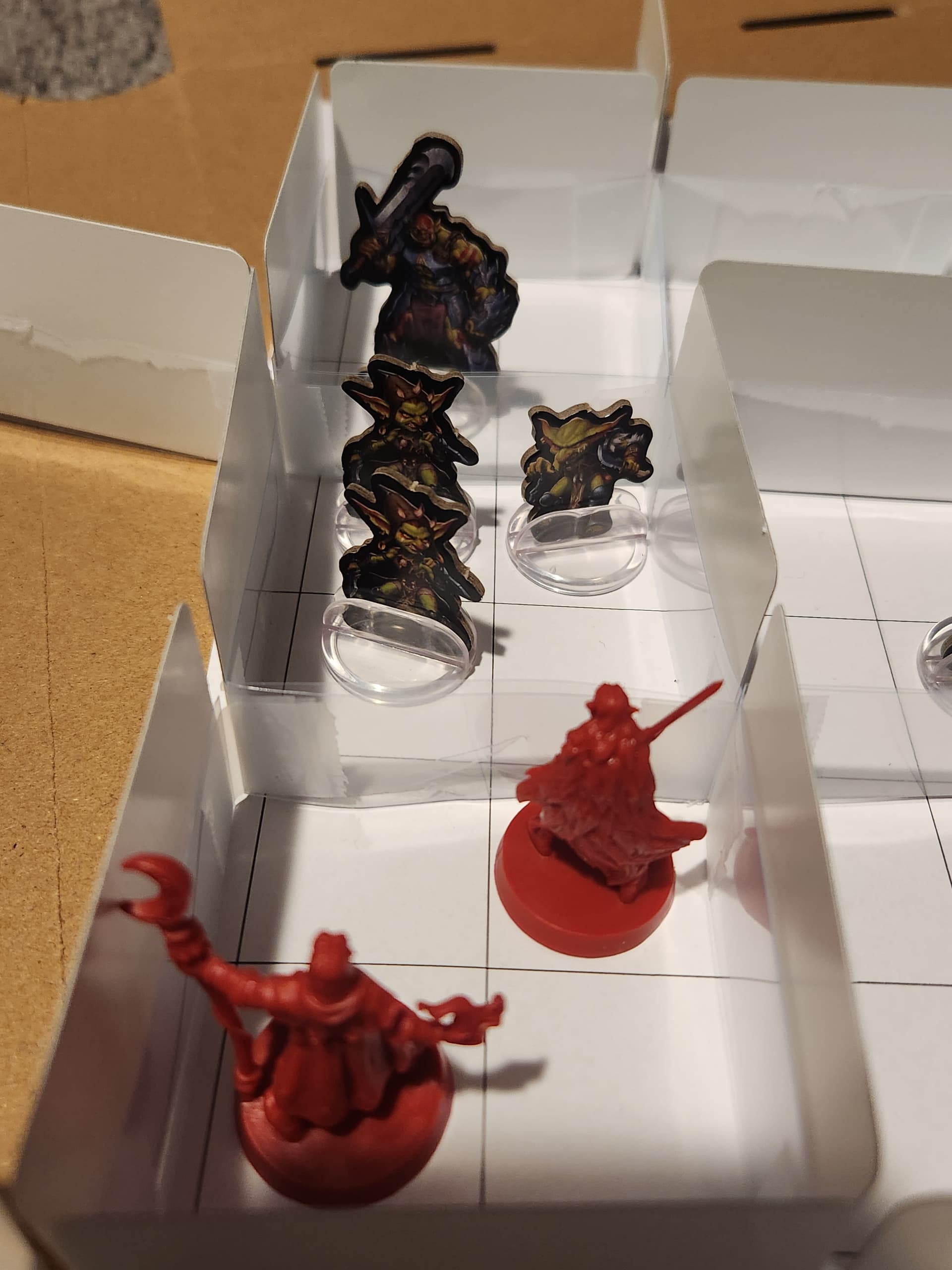
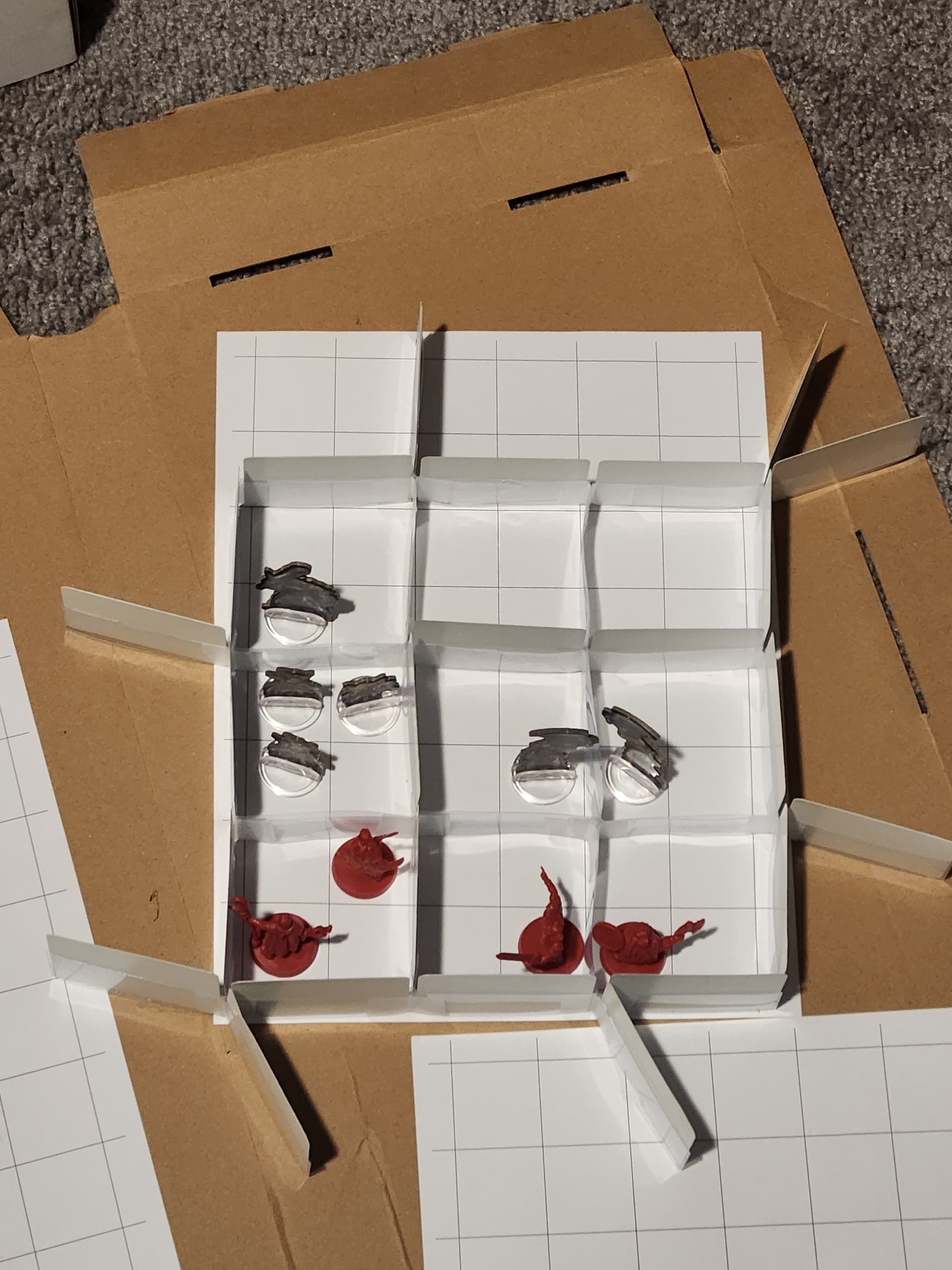
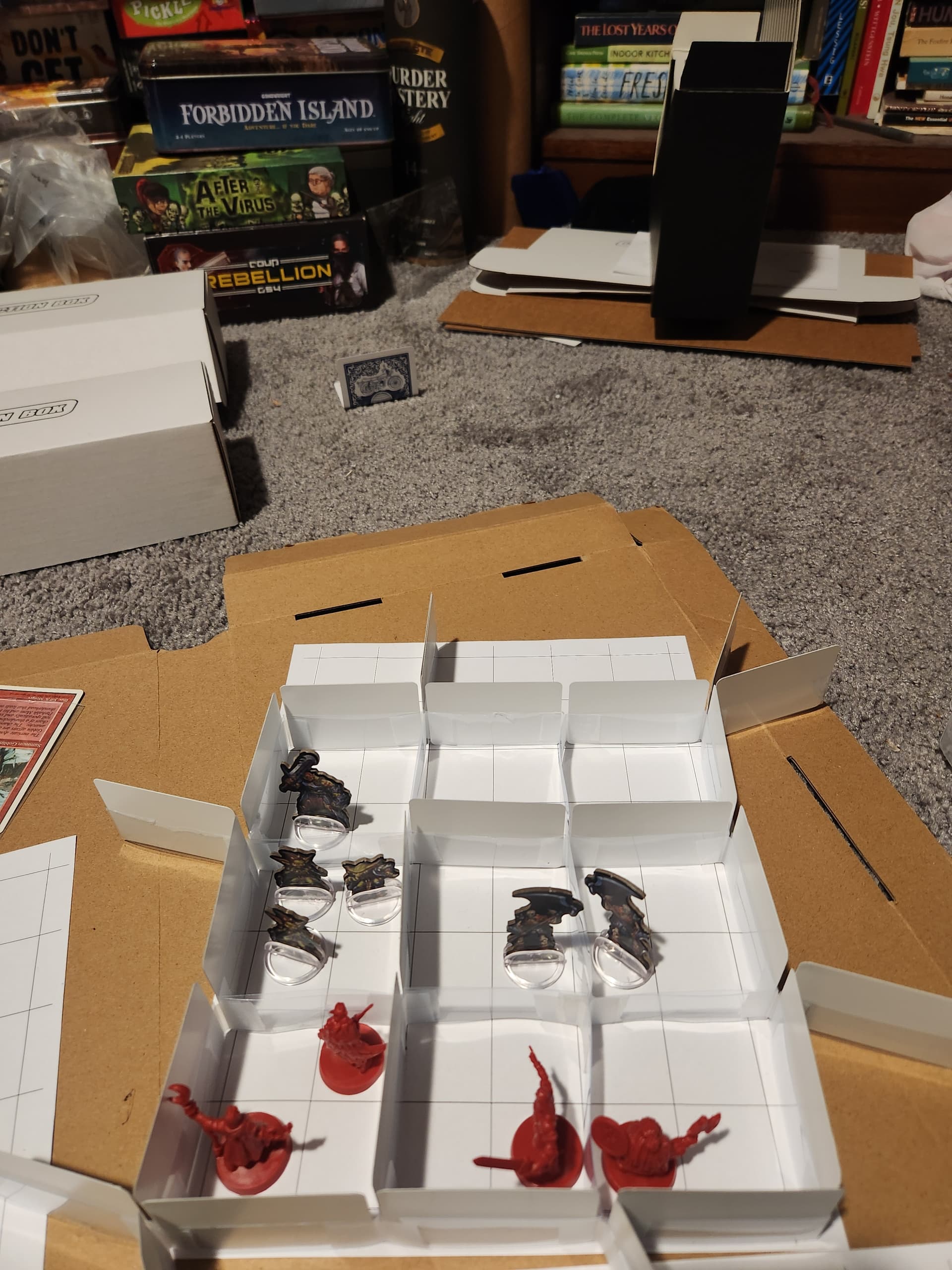
What i did was take standard card sleeves and cut them into 1/4th length loops, and tape them together into a matrix. Here is the result:


I wonder if the clear plastic everywhere would ruin immersion? Here is a picture of the structure with cards removed. It’s super flexible and could be taken anywhere. Saving your dungeon and folding it up for later is easy:

Here are some pictures woth heroquest minis included for scale:


1 Like

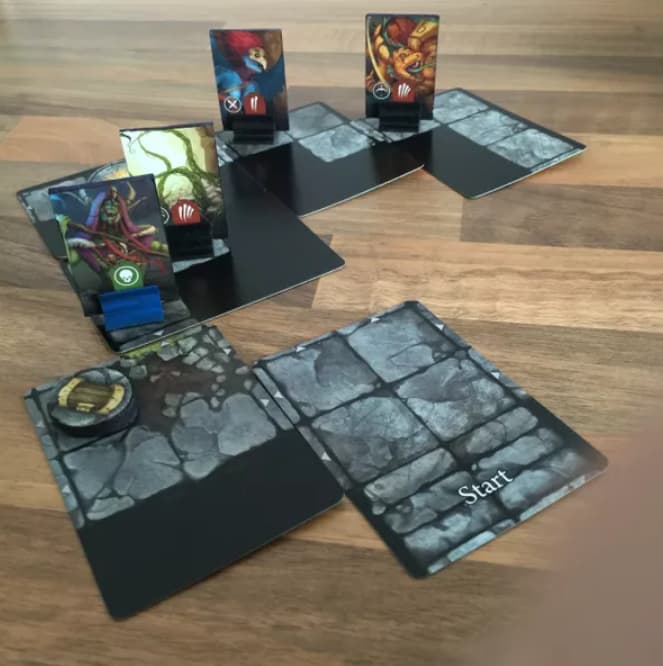
Quick update! I’ve been working on a fast elegant combat system to go with my Dungeon Skeleton (as depicted above). Here is what I’ve got. As always, grateful for feedback!

COMBAT RULES SUMMARY
Combat occurs between a player and all enemies that are within line of sight (LOS) of that player. All enemies in LOS participate, regardless of their attack type. Each round of combat follows these steps:
Calculate the Target Number:
Add up the total combat scores of all enemies in LOS.
If a melee enemy is in the same zone as the player, double its combat score.
If a ranged enemy is outside the player’s zone, double its combat score.
Add up these adjusted scores.
Then, use the following formula to determine the target number:
Enemy Combat / (Enemy Combat + Player Combat) × 10, rounded to the nearest whole number.
Below is a table to represent these values for quick lookup:


Roll Combat Dice:
Roll one d10 for the player and one d10 for the enemies.
These rolls are compared against the target number.
Gain Advantage:
If the player’s roll is strictly greater than the target number, the player gains Advantage equal to the amount they exceeded the target by, plus one.
If the player’s roll is equal to or less than the target, they gain only one Advantage.
Gain Danger:
If the enemy’s roll is strictly less than the target number, the player gains Danger equal to the amount the enemy fell short by, plus one.
If the enemy’s roll is equal to or greater than the target, the player gains only one Danger.
Spending Advantage:
After resolving rolls, the player may spend Advantage to kill any enemies in LOS.
Each enemy has a Defense value.
If the player is a melee attacker, enemies outside the player’s zone have their Defense doubled.
If the player is a ranged attacker, enemies in the same zone as the player have their Defense doubled.
The player must spend Advantage equal to the full (possibly doubled) Defense value to kill the enemy. Advantage cannot be spent partially or saved toward a future kill.
Danger and Wounds:
If the player’s accumulated Danger ever equals or exceeds their Defense, they suffer a Wound. When this happens, the player’s Danger resets to the excess amount above their Defense (not to zero). The player then draws one Wound card. Wound cards can have various effects, ranging from stat penalties to temporary buffs, and in rare cases, instant death. If a player ever has three Wound cards, they die.
Disengaging from Combat:
If, at the end of any round, a player is no longer in line of sight of any enemies, they reduce both their Advantage and their Danger by one point each. This continues each round they remain unseen.
Transferring Advantage:
A player may give Advantage to another player who is within line of sight. The cost to do so is equal to one plus the number of zones between them. For example, giving one Advantage to a player two zones away costs three Advantage. A player may only transfer Advantage once per turn.

1 Like

It’s a cool way to abstract larger fights into just a couple of dice rolls. Is there gear or skills or something that effect things? Looks like you have a wizard mini up there… How do spells work with this?

And I know it’s just a small part, but I really like the wound cards with random effects as players take injuries. More games should be doing that.

1 Like

Thanks for the positive feedback!

Honestly, i have a million ideas how things could work but I obsessively try to create/refine systems until they sing and capture the feeling of what I’m looking for. Here are some ideas:

Gear, yes, probably tons of it:
Modifies your combat score, special abilities let you spend advantage for specific effects in specific situations. Might grant advantages vs. Specific enemy types (you know all the tropes) “demon’s bane”. Armor boosts your defense etc… The design space of this system is large on the player side.

Since enemies don’t “activate,” like a player im still working on how enemy abilities work.

Spells could be different advantage cost systems like: pay 3 adv to kill 1 d6 defense enemy. Not sure honestly!

Very open to input for next steps.

Right now combat just “happens” each round you’re in line of sight of enemies. They don’t even move right now (and I don’t want them too!)

1 Like

Ok, I can see how it would be pretty easy to add little effects in to alter the combat while keeping it down to just a couple of rolls to cover everything’s actions.

If the enemies are static then maybe some of their abilities should force players to move? I suppose melee guys will want to move in anyway, but if some enemies had higher ranged defense or even directional defenses, it could push players into riskier positions with more enemies in LOS in exchange for better attacks on certain targets? Giving some fights more to think about with positioning?

Or even having terrain elements to mess with positioning. Like ranged enemies that come in with portable barriers that have arrow slits, forcing players to move around them.

No idea if your system already covers that or if it even meshes well. Just a thought that popped in my head. Increase your odds of doing damage by wading into the melee, but also increase your risk.

Hi All!

I’ve barely been able to participate since having my first child and being in the food system in America, I’m sure you can imagine that things are complicated. That all being said, I wanted to share what I’ve been working on for months now.

It’s always been a dream of mine to make a CCG/TCG since I was a little boy and I’ve been tinkering away at various dungeon crawler ideas for a long long time. This is a continuation of various projects I’ve been working on and a basic rule set as to where things stand. It is a living document.

Always looking for feedback/inspiration/encouragement as my time is limited and it feels good to have a little extra push sometimes.

I have my own notes on the left side of this document, and an AI summery/rulebook on the right. It helps me keep all of the ideas together and keep things clear/teaching an AI my rules keeps me on target.

This game is a deck construction game much inspired by Tomb Raider the CCG/Dungeoneer where your deck tells the story of your character and their encounters. It is designed to be fully solo-able. I imagine you would have pre-constructed decks and explore them.

The resource system is unique, as facing difficult enemies means you can pick up better loot/companions.

It is a semi-cooperative game! Your deck attacks other players randomly! They might steal your loot. Inspired by cutthroat caverns.

It uses life decking! Where your deck is your stamina and the more efficient your character is, the less stamina you use while going through the deck.

It is very inspired by the Mork Borg card game 7…7 and Plunderlust. I can say more but maybe better to just read it if you have the time and give me some feedback.

1 Like

Here is a project I’ve been working on:

It’s a tactical dice mechanic based on Sanctum/One Deck Dungeon/Sleeping Gods.

As I tend to, I have my gibberish notes on the left side of the document, and an AI summery on the right for clarity and organization.

Would love some feedback. Ideas on “where to go from here?”