I’m working on a dungeon crawler and I’m torn between two design directions:
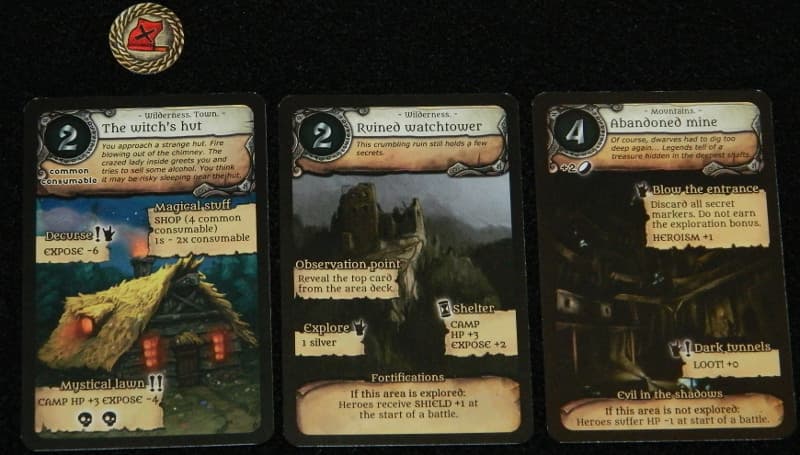
- Based on Assault on Doomrock (pictured), location cards with multiple options/features.
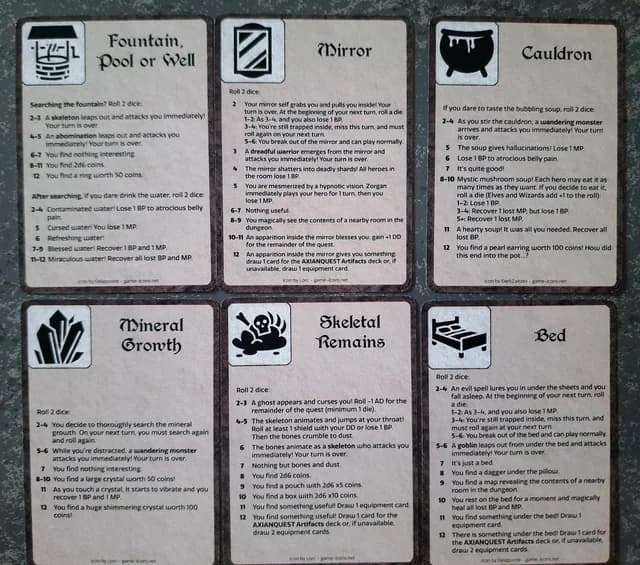
- Based on Axion Quest (pictured) /Dungeon Universalis and many others, feature cards that can appear in each room.
- Combination of the 2, have “themed areas with multiple features” and separate cards for the rules of the features themselves.
My goals in this design, is to save as much cardboard as possible, and make the game as easy to interact with as possible, quick, random, etc. You know… all the hallmarks of a fun and dirty dungeon dive. I’m trying to include as many multi-use cards as possible.
Pros of 1:
- Great theming
- Lots to do in each “location” all represented with one card.
- The card can be used as the “board” itself.
Cons of 1:
- Limited space means references/iconography to make it work.
- Strong theming can be a limitation, as it might not make sense for certain “types” of rooms to appear adjacent to each other.
- Needs additional tokens and fiddles to keep track of what has been interacted with already leading to clutter.
Pros of 2:
- Can be mixed and matched to create very random spaces.
- Can include detailed rules right on the card.
- Can be used as the “board itself” IF there is a limit of 1 feature per room.
Cons of 2:
- Having multiple features “in the same space” would require the cards to be stacked, which would add to fiddles. (i.e. if you have 2 bookshelves, how to you mark which has already been searched when the cards are in a pile?)
- Would need multiple copies of the same card.
Pros of 3:
- Potentially Overcomes disadvantages of above
Cons of 3:
- Lots more paper and references.
- Limits multi-use cards.
Thoughts?
3 Likes
These are some really interesting challenges. I’m excited to see what you come up with.
- A lot of things on cards lend themselves to lists. I found my self creating lists for Dungeon Crusade because not everything needs to be on a card. I’m suggesting that AxianQuest could be cards with symbols that refer to a table. Or you could have Doomrock cards with thematic symbols that refer to a table. Ex. The Witch’s hut with a Cauldron and Skeletal remains symbol.
- Symbol-link themes so that locations need to share a symbolic link. If you draw a card that doesn’t share a location-type symbol (really just tags), then draw another. It’s also a way to cycle the deck to make sure the same stuff doesn’t always come up. Ex. if you’re at the Witch’s Hut, it might have Village, Woods, Alchemy, etc. symbols, where the next location should match at least one symbol. And maybe you can do something with strong matches “affinities” like say a location “Mushroom Patch” with Woods, Alchemy, shares two (not just one) affinities with Witch’s Hut unlocking an uncommon consumable under Magical Stuff, and Mushroom Patch might have more potent mushrooms for harvest.
- This all kind of makes the same deck different based on the context in which it is experienced. If the overall quest is in a Village in the woods. You could force a quest affinity so that all locations must match at least one quest affinity. That will keep locations tightly aligned. That also opens a great path for expansions, like a woods expansion.
- You may want to dial back from Doomrock a bit to avoid becoming Doomrock 2.0 . That might mean showing a room tile (WarhammerQuest, LoD, etc.), but then you know, maybe the tile had the room features already. Maybe some cards are encounter only, and those are standalone, or they affect the next card drawn. So for ex. you’re on a Village Woods adventure to to find a goblin treasure. There’s a specific card mixed in the last five cards of the 20 card deck. You hit the mushroom patch wich has potent mushrooms, but is otherwise not a tactical location. Then you pull Demonic Taint card with makes the next location demon-posessed, if it is a tactical location, use the location and add this demon enemy, if it is non-tactical, use this map (on the card) and this demon enemy. So you pull the next card, Witch’s Hut. Presumably the witch is a demon who attacks you now. maybe you need a rule for swiping her stuff once you kill her. But it changes how you experience Witch’s hut because now there are more options because of matched affinities AND the event cards mixed with location cards.
- I think overall, and in the end you’ll need to dial back everything you can. The biggest problem I see in both games and software development is hanging too much onto the game. It’s like you want to build up the most robust game possible, where rules are interdependent, but then loosen those rules just a bit to allow for some interesting randomness, and then relentlessly chop any rules that don’t contribute to enjoyment. That’s hard, for example weapon damage. All different damages, maybe everything is a 1d6, or a 3 damage, What level of abstraction? Is rolling a dice important? Are different damage amounts important? Should damage be an effect of character class?
2 Likes
Deeply appreciate the thoughtful response!
-
A lot of the inspiration for what I’m working on comes from Advanced Hero Quest, Warhammer quest, and all of its derivatives. There are a few folks who made cards for AHQ and it speeds up the game significantly. I also have in the back of my mind 2d6 dungeon, which features tons of lists and tables, but looking them up again and again is a chore. Trying to find something in between. Having cards that tie to lists, and the lists can be customized is a great way to create ones own content.
-
With you on the symbol links, it emulates a method in programming called wave-function collapse, where the edges of cards need to match up and you cycle through cards until you find one that fits. Love this idea.
-
I think I’m drawn to the Doomrock location cards because it accomplishes so much with so little! Art, flavor text, “things to do.” Warhammer quest had its dungeon cards to determine the tile/if an event/special event happens, and event cards to populate it… but lost the furniture and Points of interest that AHQ had. LOD and DUN both reintroduce the furniture, but i’m trying to avoid tiles altogether and keep the game more compact.
-
Yes on the dialing back. Perennial problem is trying to do too much. Luckily I have a lot already! Just working on some environments to explore now.
2 Likes