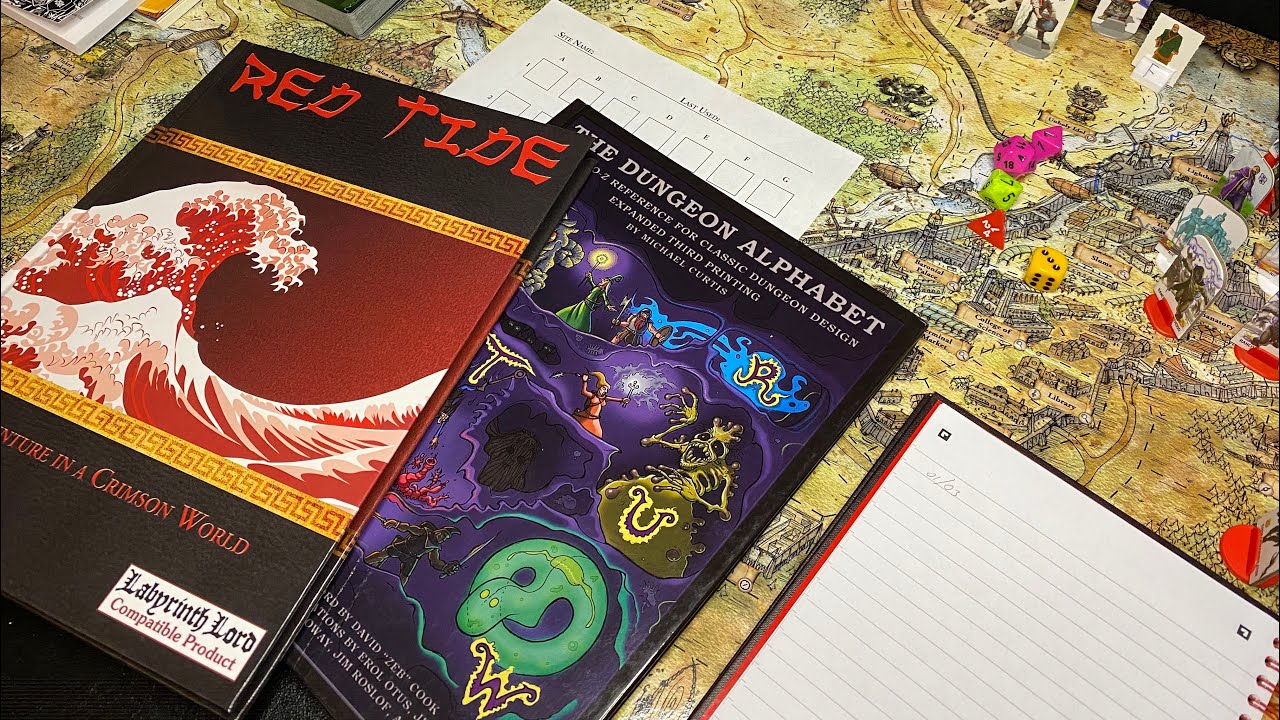
A short supplementary video in the Cymbaline Isle solo RPG run: Daniel (@dungeondive) builds a small explorable ruin live on camera in roughly fifteen minutes, stitching three tools together to do it. The Red Tide sourcebook (a Scarlet Heroes companion) supplies the high-level table — origin (a dwarven delve), cause of destruction (invasion or infighting), and current inhabitants (lizardfolk). Eric Bright’s Encounter Building Decks (Locations) generate the eight rooms one at a time — entrance, hallway, council room, barracks, T-shaped ceremonial wing, armoury, sitting room, meat-locker, statue room with a hidden secret door, narrow corridor, circular trap room, and a domed observatory. The Dungeon Alphabet sits open on the table for ad-hoc colour: pull a letter when a room needs a statue, a battle, a book, a pool, a piece of paraphernalia.
The point isn’t a polished megadungeon. It’s the deliberate skip of the maze-making step — Red Tide explicitly tells GMs not to bother with corridor-puzzle layouts, and to populate interesting rooms instead. The result is loose, paced for solo play, and trivial to reuse: each room has hooks (the secret door’s hard-discover/hard-unlock/loot stat block; the trap room left for the Traps deck to fill at play time) but no committed details that lock a future session in.
Does this assemble-as-you-need approach to dungeon prep — high-level Red Tide tables plus card decks plus a thematic alphabet — beat sitting down to write a finished location for solo play, or does the looseness leave too little structure to push against?