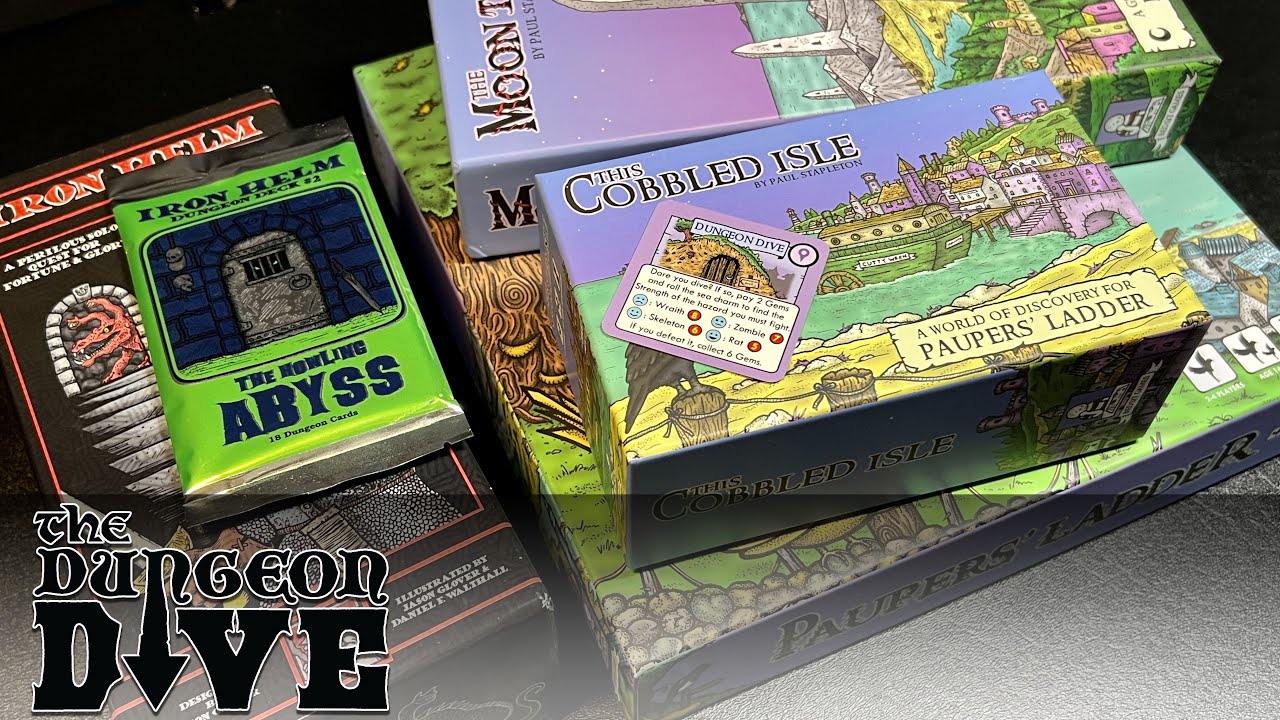
Daniel (@dungeondive) opens two expansions delivered on the same day: The Howling Abyss for Iron Helm (Jason Glover) and The Cobbled Aisle for Pauper’s Ladder (Paul Stapleton).
The Howling Abyss replaces the dungeon deck — eighteen new blue-backed cards swapped in for the original sixteen. Some cards are evolved versions of base-game encounters (Merchant, Altar, Treasure, Labyrinth, Aero Trap, Mushroom Grove, Campsite); others are genuinely new (Savage Encounter, Mystic Fountain, Archangel that checks the morality tracker, False Idol that lets you beg for power/wealth/life). It’s billed as slightly harder, and the art is dramatically improved — a visible chronicle of Glover’s growth as illustrator.
The Cobbled Aisle is the larger expansion: a city-region deck for Bright Helm with locations including, hilariously, The Dungeon Dive itself (pay two gems, roll for hazard); a roaming cargo-ship region (the Cudirin) for buying, selling, and fighting at sea; twenty new talents and curses; new birds (including a fairy); twenty-four character-specific quests; a Diced In gambling mini-game; virtue cards that shorten games or enable We the Collective — a fully cooperative mode against the Hawks Guard fort.
Daniel laments that his Pauper’s Ladder coverage underperforms — calling it a quintessential dungeon dive game, one of the very best overland adventure games on the market, and a quiet favourite that deserves a much wider audience.
Which expansion type changes a game more — the modular addition (Howling Abyss) or the systems-bolt-on (Cobbled Aisle’s co-op mode, cargo region, and quest deck)?