Dice Mechanic/Enemy Activation systems for HeroQuest/ttrpgs/my own dungeon crawl

Hi All!

I’m a designer by hobby, and I wanted to share something I’ve been working on that I’m sort of excited about.

The “rules” overall are very much a work in progress (barely organized and incomplete, still being written and updated when I have free time), but essentially I created this “dice system” to get rid of enemy HP and bookkeeping, but also be able to make “progress” while fighting enemies or trying to complete tasks.

In addition, there is an enemy activation system that I designed to do away with the classic “players go, enemies go” that occurs in many dungeon crawlers. It creates a mini-stealth game and a sense of tension I haven’t experienced in other games:

Looking for feedback and thanks for anyone who takes the time to look at it!

2 Likes

It’s an interesting mechanic. I like dice mechanisms that give you multiple data points in a single roll. It might work well to have special skill checks that depend on multiple result pools.

For example, a single roll/pivot per combat round:

  • for melee red is your attack pool and green your defence pool, simulating aggressive and defensive stances – makes it difficult to have both a high attack and defence in a single combat round.
  • Add to that special equipment that lets you convert one colour to another; eg. blue to red on magic sword
  • Special manoeuvres that need specific dice expended; eg. sneak attack needs to deplete green pool to achieve a bonus but reduces defence

I went through a bunch of different dice mechanics when designing the Ziggurat. I wanted all of the following in a single mechanism:

  • binary success option (success/fail)
  • graduated success (eg. strong hit, weak hit and miss)
  • a result in the roll; with bonus result (eg. a “better” result if you have some ability)
  • options to modify the roll (eg. you have a skill in something or advantage/disadvantage or a magic sword, etc)
  • options to mitigate the roll (eg. you can use a resource or ability to re-roll or change the result)

Ideally I want to only roll once or twice to resolve a combat round for example. It gets tedious rolling for attack, rolling for damage, rolling for enemy defence, etc

1 Like

@denouement231 I just wanted to say that I looked over this mechanism as presented, and I find it quite interesting. It’s the kind of design I love! So much potential here. The neat thing about a system like this, that there is a built in satisfaction with the dice always feeling like a mini game.

2 Likes

I just went to BGG and looked at the PnP stuff for Ziggurat! Wow! Very polished. Very promising! Looks like it fits right in with many of the trends in indie self publishing right now.

2 Likes

Wonderful to hear you say that. I had to take a quick look myself – that little PnP trove is over a year old. There have been many misadventures in my game design journey since then :wink:

1 Like

Thank you so much for taking the time to look at it and give feedback. So encouraging!

On your thought about having high attack/defense in a single pool. When you choose to attack with your red dice, you’re effectively risking those dice by “spending them” and re-rolling them, so in my mind the choice is “do i kill these guys and leave myself with low defense? or do I save my red dice and fend off all the attacks if I draw them all to me?” Interestingly, if you opt to save green dice (by not moving much), you’ll attract less aggro and need less red dice so you can use them more aggressively. I have yet to really sit down and playtest the fine balance between managing all of the different systems.
2. Color conversation is definitely going to happen! Sometimes thinking something like “a heavy axe” = (strength score - 3) * 2 which basically means you need a minimum strength to use it, but rewards you with greater power.
3. YES on the special maneuvers. There is so much to think about how these dice can work. Right now I have all sorts of ideas on insight (blue) driven magic attacks that use other dice as well.

I feel like I might have stumbled upon Ziggurat it on my own research journey. Excited to give it a second look!

I’m with you on the tedium on the rolling, this is why I chose to have everything, 1 roll, and success/not success, kill them or not. When enemies attack, right now I have the player pivoting/spending for each enemy attack, which might be a bit much, In theory I could combine all enemy attacks into a single pivot/spend.

Needs lots of playtesting I suppose!

1 Like

I was driven to just, not want to track hp anymore… too many little pieces, or funny little workarounds. But I wanted to have the “feel” of making progress while fighting, or trying anything really.

I really liked Dungeon of D’s power card system, where it’s sort of a hand management with chance.

Part of me wonders if I should make it entirely card based, where each multi-use card has the dice #s at the top as well as other information used for playing other parts of the game.

Thanks for taking the time!!!

1 Like

Cards are cool too. There is the issue of having 10 dice to manage, which is a lot. There’s also the issue, of having 4 players each needing a set of 10 custom dice. Thats a lot of component glut for a simple resolution mechanic.

2 Likes

Returning to this after over a year, mostly thanks to @Jerry.Hawthorne chiming in back then and being very encouraging.

My original design goals were:

  1. Do away with as much bookkeeping (specifically of hp) as possible.
  2. Create a more interesting player decision space than “look at target number, roll +modifiers, did I win?”
  3. Keep all dice rolls facing players.
    And I added:
  4. Create a sense of progress despite the lack of bookkeeping.
  5. Use standard dice.

Here is how it works (and as always always looking for feedback/thoughts):
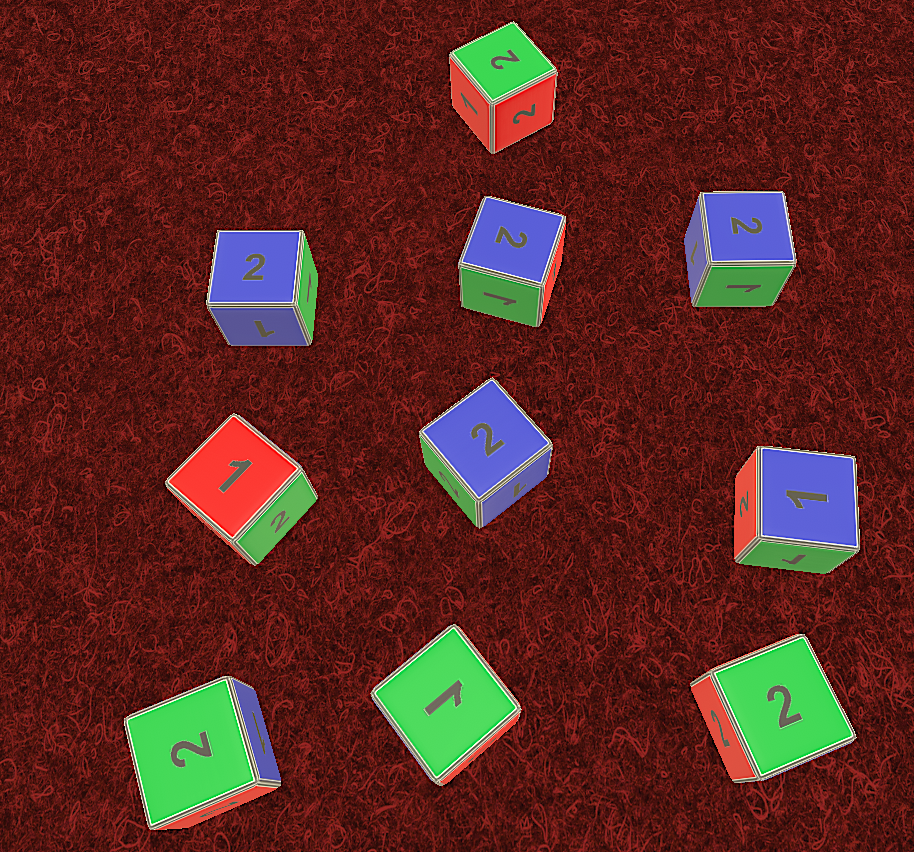
You have 9d6 made of a combination of 4 colors each representing one of the elements.
Red = Fire = Charisma (outer)/Intelligence (inner)
Blue = Water = Perception (outer)/Wisdom (inner)
Yellow = Air = Agility (outer)/ Dexterity (inner)
Green = Earth = Strength (outer)/ Constitution (inner)

High numbers on the d6 represent gross external displays of the element, where lower numbers represent subtle inner representations of the element. Together you have essentially a D&D attribute system.

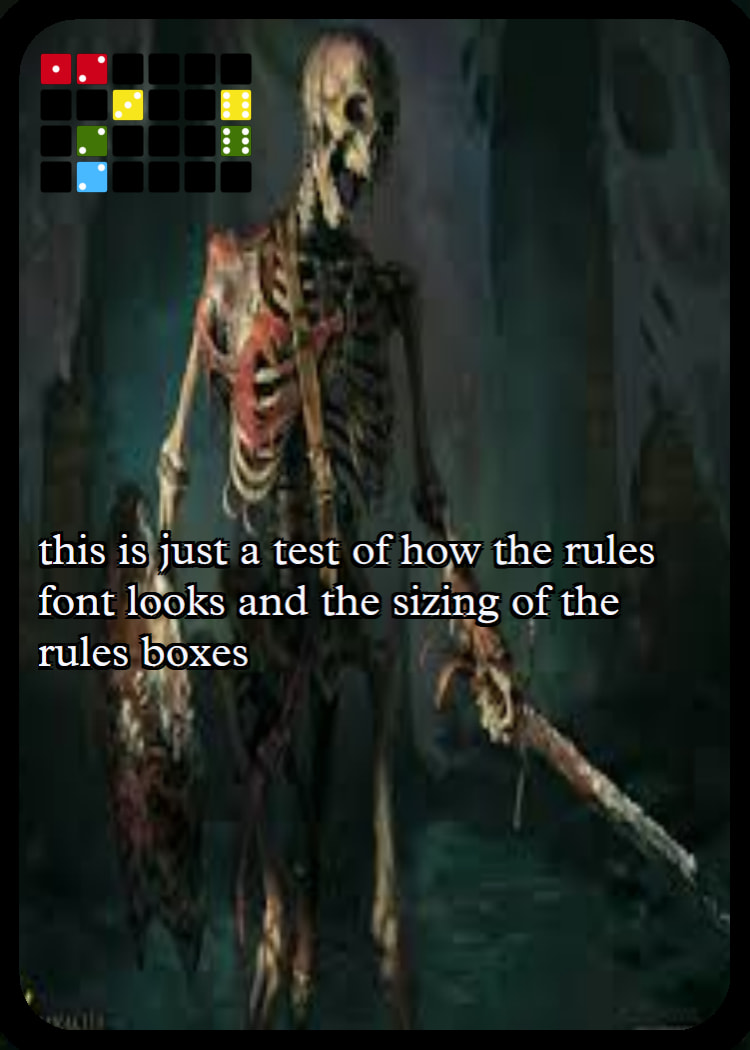
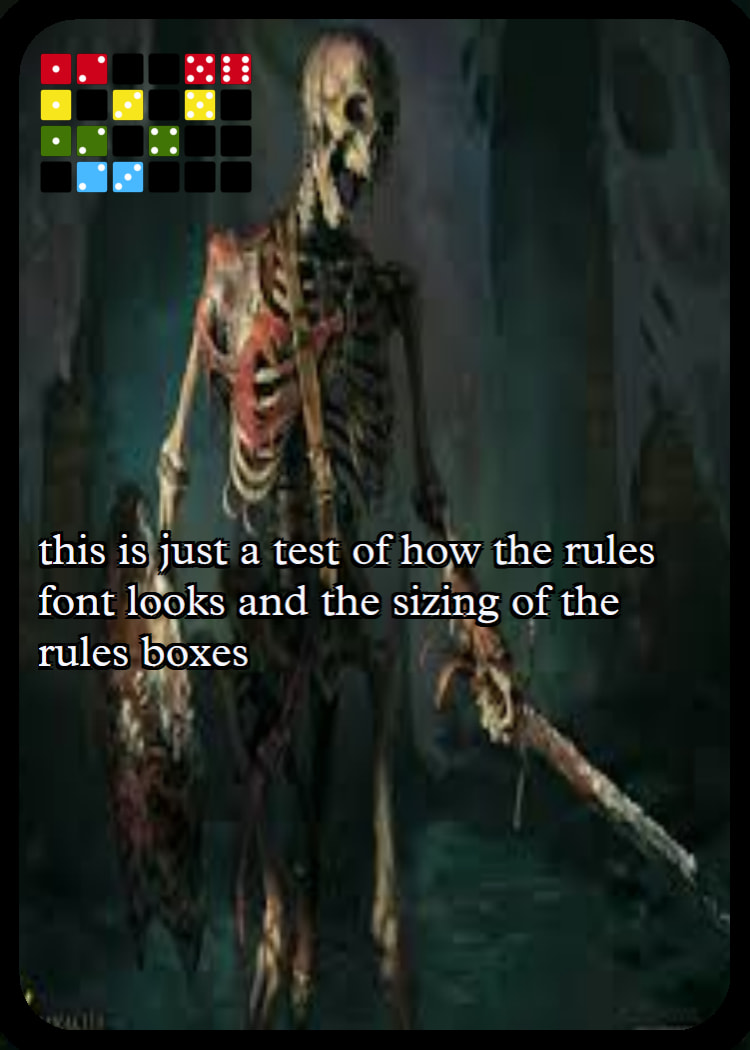
The above images were a prototype for an enemy. You will notice that in the upper left corner a bunch of dice values in the colors corresponding to the enemies. This is the enemy’s “stat block”

In short, of your 9d6 pool, you must select one or more of your dice that fall within one of the “holes” (e.g. isn’t displayed on the stat block) in order to effect the enemy. The enemy on the left is obviously easier to defeat than the enemy on the right.

Enemies require 1(easy) to 4(hard) dice to effect. So a hard enemy might require you to have 1 die of each element within the holes of the stat block, where an easy enemy would only require 1 die of any element. The same goes for any obstacles, traps, opening chests, etc. It’s a very general system. Everything has a stat block and in order to affect it you have to have the right values of the right colors.

I really liked some of the mechanics from 9d6 Quest, specifically, having 3 pools, ready, exhausted, and wounded. You can re-roll a die but then you must place it into the exhausted pool. You also re-roll a die when you “spend it” in effecting an enemy whether you attack or defend.

In short:

  1. Look at your dice pool vs. encounter stat blocks.
  2. Re-roll dice and place them into the exhausted/wounded pool (if need be).
  3. Choose dice that can effect the encounter, “spend them” and re-roll them.

Add to this abilities/items allows you to modify your dice somehow (e.g. reroll the lowest fire die)…

So there is no HP to track, and as you use your dice, they’re constantly getting re-rolled, potentially getting you closer to overcoming the encounter you face. Since you’re re-rolling every time you “spend” a die, you can potentially get the combination you need for a harder obstacle while dealing with easier obstacles.

I realize this is a very brief and superficial treatment of the system, but I hope it garners some feedback.
1 Like