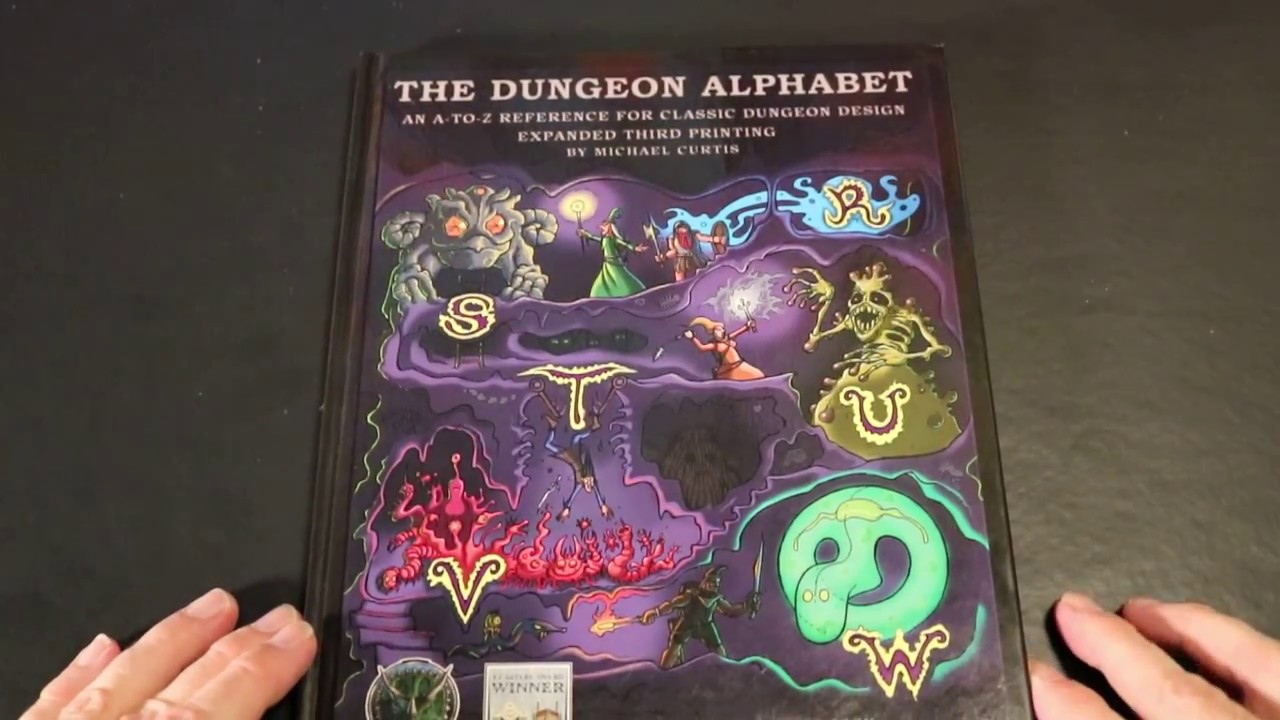
Daniel (@dungeondive) flips through The Dungeon Alphabet, Michael Curtis’s A-to-Z dungeon design reference from Goodman Games — expanded third printing, hardback, and as much art book as toolkit. Goodman’s old-school aesthetic is the hook: deceptively simple, nostalgic, the sort of line work that sends him straight back to leafing through 1980s D&D manuals.
The conceit is one dungeon concept per letter, each backed by a random table. A is for altars (a d20 of thresholds between mortal and divine — one of bone, holding sacred texts, transmuting base materials to gold once a week). B is for books, a d100 of invented titles like Jokes, Jests and Grand Goofs, and for battles, twenty unforeseen mid-combat developments, including corpses attracting the dungeon’s mindless cleaning crew so fighters must wade through flesh-eating oozes. M is for maps, among them a temporal anomaly that walks the party backwards or forwards through the dungeon’s own history. Y is for yellow, six sinister uses of a colour the book ties to Chambers, Lovecraft and The Yellow Wallpaper.
Daniel’s angle is not the DM’s. He rarely runs games; he wants this as a companion for solo crawls — Four Against Darkness, d100 Dungeon, Advanced HeroQuest, Mice and Mystics — where a roll supplies the narrative embellishment a bare dungeon tile won’t.
Random tables as imagination fuel rather than rules: which book do you reach for when a room needs to become a story?