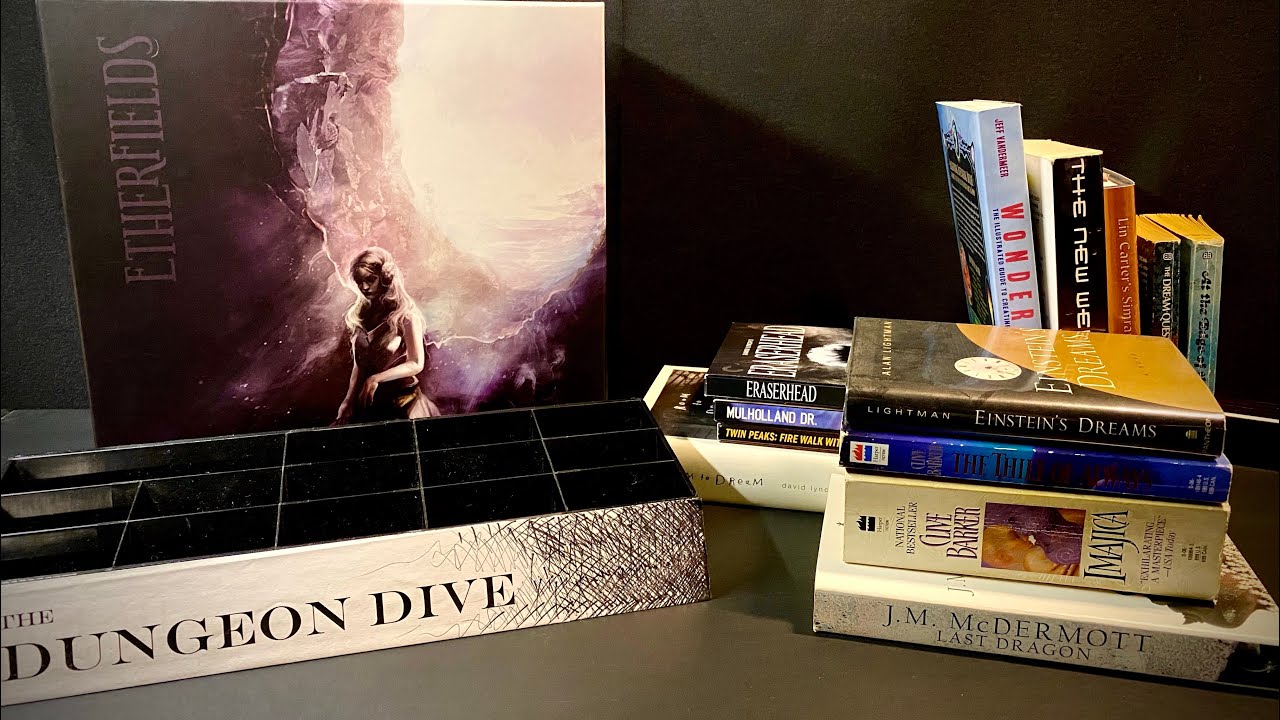
Daniel (@dungeondive) delivers his long, rambling review of Etherfields, and it doubles as a love letter to dream-logic art. He frames the game through David Lynch — the Monica Bellucci scene in Twin Peaks: The Return that gives this video its title — and a whole reading list: VanderMeer’s New Weird anthology, Lovecraft’s Dream-Quest of Unknown Kadath, Clive Barker, J.M. McDermott’s Last Dragon, Alan Lightman’s Einstein’s Dreams, and the music of The Caretaker. Etherfields, he argues, is genuinely surreal rather than weird-for-weird’s-sake: a fully realised world with a decipherable dream-logic.
The criticisms return — the disastrous board (he plays without it entirely), a script-book that should be organised by dream, prose that’s merely serviceable. But the experience overwhelms the flaws. This is the game he wanted Seventh Continent and T.I.M.E Stories to be: rich exploration without endless box-diving, puzzle-solving without punishing resets. It has Metroidvania backtracking, a roguelike rhythm of awakenings and Delta-phase resets, and a world that remembers you. Designed as a true solo lone-wolf game, every new card is a “wow” moment.
He won’t vouch for the whole campaign — an error could still stall him — but for the hours played, he’s smitten: a game that feels sneaked out of his own brain.
Which artists, films, or books would you hand someone to explain why a game’s atmosphere matters more to you than its mechanisms?