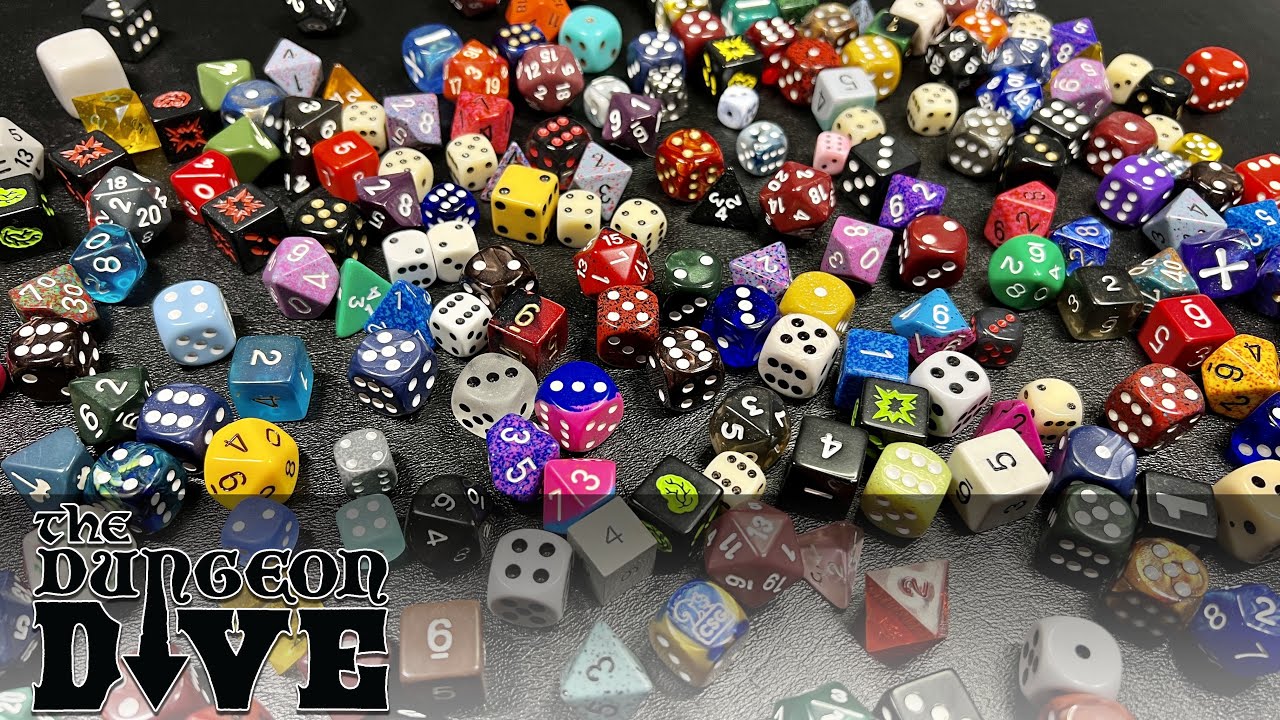
A new series, Diving In, taking over from What I Talk About When I Talk About Dungeon Diving and revisiting mechanisms with fresh eyes. Episode one is dice, and Daniel (@dungeondive) makes three arguments for them. They’re tangibly fun and collectible. They’re universally understood — tell anyone to roll a d6 and they know what to do, which isn’t true of shuffling. And they favour luck over skill, which he wants: he’s frank about being bad at games, and a roll gives him permission to lose gracefully, where a skill game leaves him feeling he underperformed. Dice create drama, too. People stand up to roll; nobody stands up to play a card unless they’re in an anime.
Then a countdown of dice systems. Fifth: Solitary Defilement’s 2d20 for Mork Borg, where both dice beating the target is a strong success and one is a weak success with a complication — easy to narrate solo. Fourth: Hellboy’s upgradeable and downgradeable coloured d6s. Third: Dungeon Degenerates, where you roll 2d6 under your stat to succeed, then read the highest single die as the degree of success or failure. Second: dice-for-action-selection in the newer Warhammer Quest games — Silver Tower, Blackstone Fortress, Cursed City — luck first, then tactical assignment. First: the d6 dice pool of Arkham and Eldritch Horror, also used in his own design, A Land in Peril, because it scales cleanly on both sides of the table.
He ends holding a mystery die marked with plus and minus values, hoping a viewer identifies it.
What’s your favourite dice mechanism in a game — and do you agree that luck-driven systems make losing easier to take than skill-driven ones?