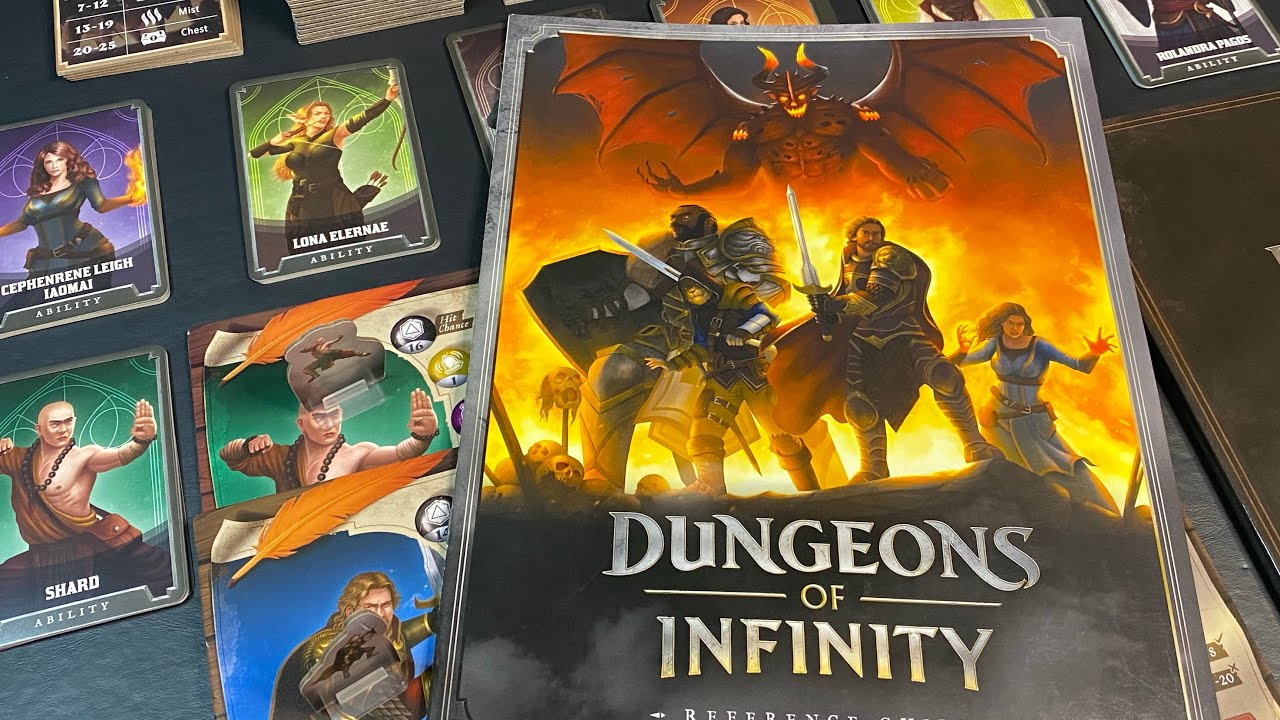
Daniel (@dungeondive) opens a series on Jack Sperner’s Dungeons of Infinity with an unusual disclaimer: he hasn’t finished a full game yet, because he’s had real trouble learning it. This is a first designer’s game, and he says that shows in both directions.
The upside is sheer content density. Ten heroes ship in a standard-sized square box — most big games manage eight, many only four to six. Each gets a double-layered card with stat sliders, an extensive background, a standee, and its own eight-card deck of powers. You start with a few level-one cards and gain one per level to five, and the cards themselves scale with your level.
He walks through Shard the monk and Endolf the paladin. The monk can’t use weapons at all, carries one backpack slot, and starts with five action points to the paladin’s three. Hit chance is a d20 roll-under, so misses are rare. The mechanism Daniel singles out as new to him is noise: each hero has a base noise value and triggers the Dungeon Lord in different ways — the monk only on entering combat, the armour-clanking paladin on combat, running and every move.
He notes the balanced hero roster approvingly, and flags the art as serviceable rather than exciting.
Ten heroes with individual power decks, in a box with no plastic to store. Is content density like this worth putting up with rough documentation?